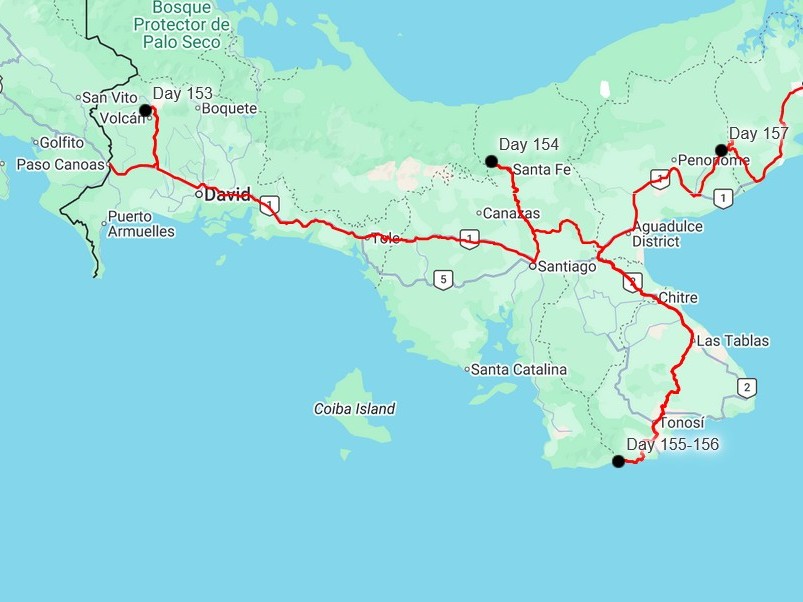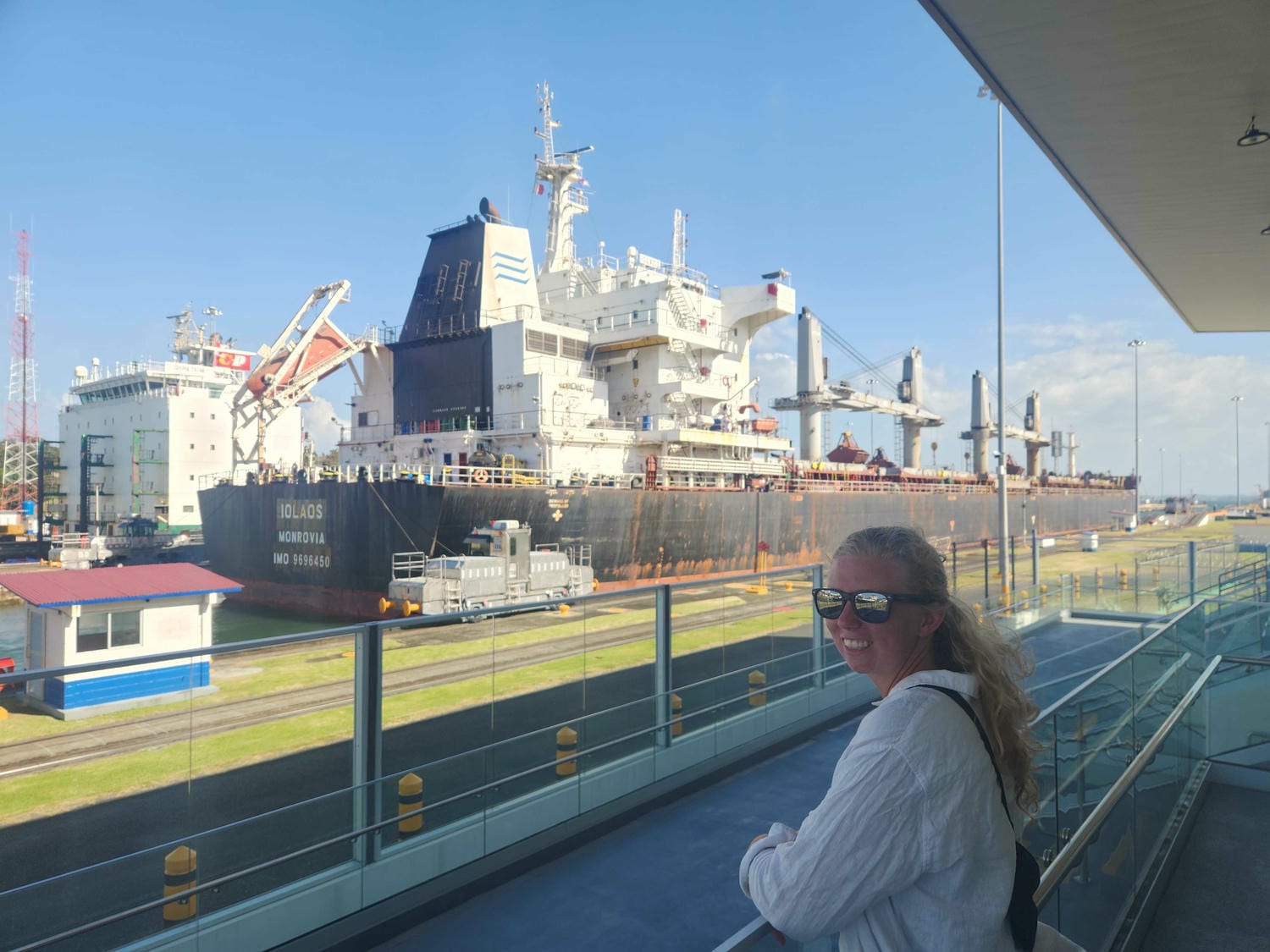
We arrived at the border to Panama around 9am on 3/7/26. We paid our 8$ exit tax, were stamped out, and then had the vehicle TIP canceled. There was a man who was trying really hard to get us to go make copies of our documents at his copy shop, and he wouldn’t take no for an answer- I had to slam the jeep door in his face. People being “pushy” is much more culturally acceptable here, and I don’t think what he was doing was abnormal, but it still felt odd to have to resort to slamming the door shut to say “no, I’m not making copies.”
The Panama side took a bit longer with more complications, but we were soon through and driving down a beautiful 4-lane highway. We headed up towards the town of Volcan, and found a nice campsite next to a lake. It was still pretty early in the day, but we were glad to have found a spot so early after a border crossing day. Despite a rough 4×4 road to access the lake, it was a popular local hangout spot- fisherman, campers, and picnickers were around for most of the day. There was a very nice 3-generation Panamanian family that I talked to for about an hour about life on the road, and their life in Panama. They seemed really wholesome and down to earth.


The next morning, we headed back down to the main highway and stocked up on groceries before continuing east. We found a great camp spot near the village of Santa Fe, a popular mountain vacation town. The spot seemed to be an old laydown yard for the construction of the road, which was obviously pretty new- but one of the windiest and steepest paved roads I’d ever seen! There was a beautiful view down the valley to the north and towards the Caribbean. A few other vehicles stopped during the afternoon, but never for very long. Some foreign tourists stopped in, and one of them slipped in the mud and got pretty dirty! After they left, Delaney went to check where she had slipped, and herself slipped and fell in the same spot, getting covered in mud! Since there had been a river just a few miles up the road, we drove back to the river to do a quick load of laundry before having a good night back at the spot.


We hemmed and hawed about what we would do the next day. Neither of us was really interested in another night at a beach, but we’d seen our favorite Pan-Am YouTubers, DirtSunrise (now SaltySunrise as they are traveling the world on a sailboat) several years ago find an incredible beach spot on the Azuero Peninsula to the south. We decided that we may as well go for it as we’d have to get used to the heat around Panama City. It was yet another long drive day, first through the jungle around Santa Fe, then through a populated area south of the main highway, and then we climbed into some dry hills- probably the driest area we’d seen since western El Salvador, or maybe even Mexico. The views were amazing, and we got glimpses of the ocean from high up in the hills. The scenery may have been amazing, but the road definitely wasn’t- full of potholes. The last 30 miles to the coast were pretty slow going, and I wish we’d aired down the tires sooner than we did. Once at the coast, we drove west on a dirt road that got smaller and smaller. It seemed to be mostly used for the small ranches along the way. The road eventually popped us out right on a beach, which was where DirtSunrise had camped. We were a bit worried about high tide, as the beach was very flat, so we kept going through the sand until the tire tracks let us back onto the dirt road. Not much further we found an amazing campsite, but between us and it was a ditch perpendicular to the road. Thanks to the jeep, we made short work of it, and had an incredible spot.
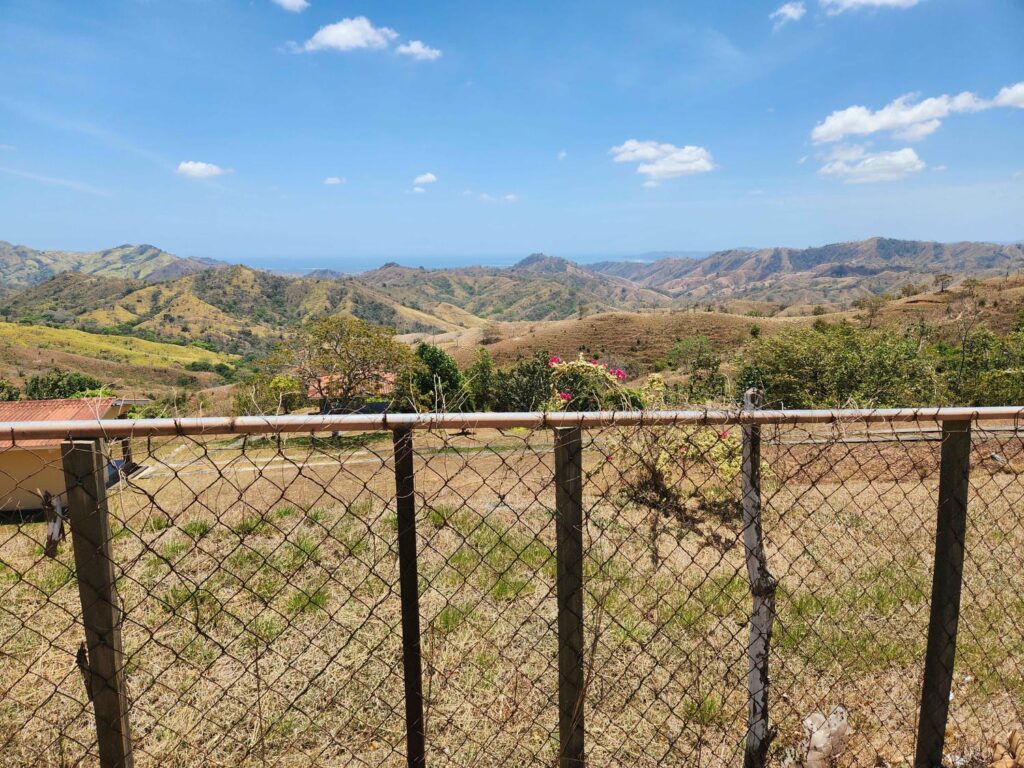

We spent the next two nights here. It was hot, but not too hot- we actually had a sea breeze for once. There were massive waves crashing into some otherworldly rocks right in front of us, and we sat and watched for hours both days we were there. The second day, we also swam for an hour or two. The waves were huge, and I had a great time going out into the big ones. There was a bit of a disconcerting sideways current though- the waves would come straight in and crash, then the water going out would pull us 10 or 20 feet down the beach. I’m not an expert in identifying rip currents, but I think that a sideways current is one of the danger signs, so I didn’t allow myself to be pulled too far down the beach before I came back in to shore.


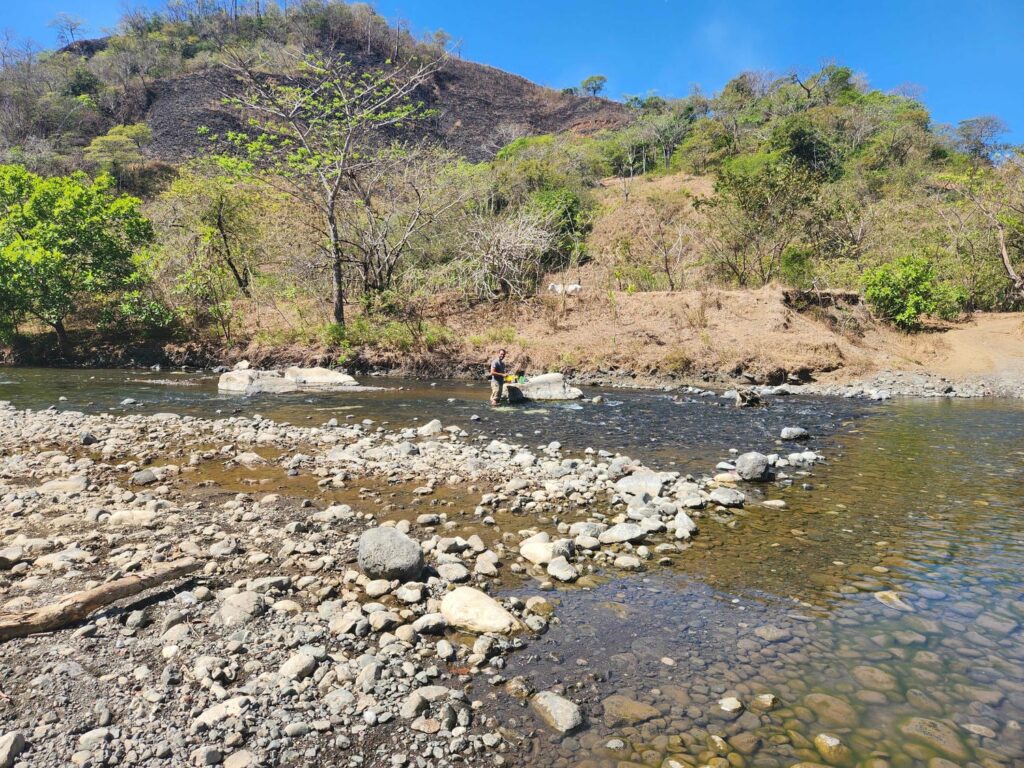
Between swimming, tidepooling, and watching the waves, the hours flew by, and soon it was time to leave. Just as we were about to go back through the ditch, we noticed a cow walk by on the dirt road, and then another one! It was a cattle drive, and we watched several cowboys herd the group of 30 or so cows along the dirt road. They were super friendly and waved as they went by. We drove back across the beach, along the dirt road, and then through the 30 miles of potholes, which was much more comfortable with the tires at 20psi than it was with them at 40.


We stopped in Chitre to re-fill on groceries before driving all the way to El Valle de Anton- another long drive day. El Valle de Anton is similar to Santa Fe in that it is a mountain vacation down, but El Valle seemed to have far more “second home” vibe than Santa Fe, which was mostly small hotels and lodges. Our guess is that because El Valle is the closest mountain spot to Panama City, it is filled with second homes of wealthy people from there.

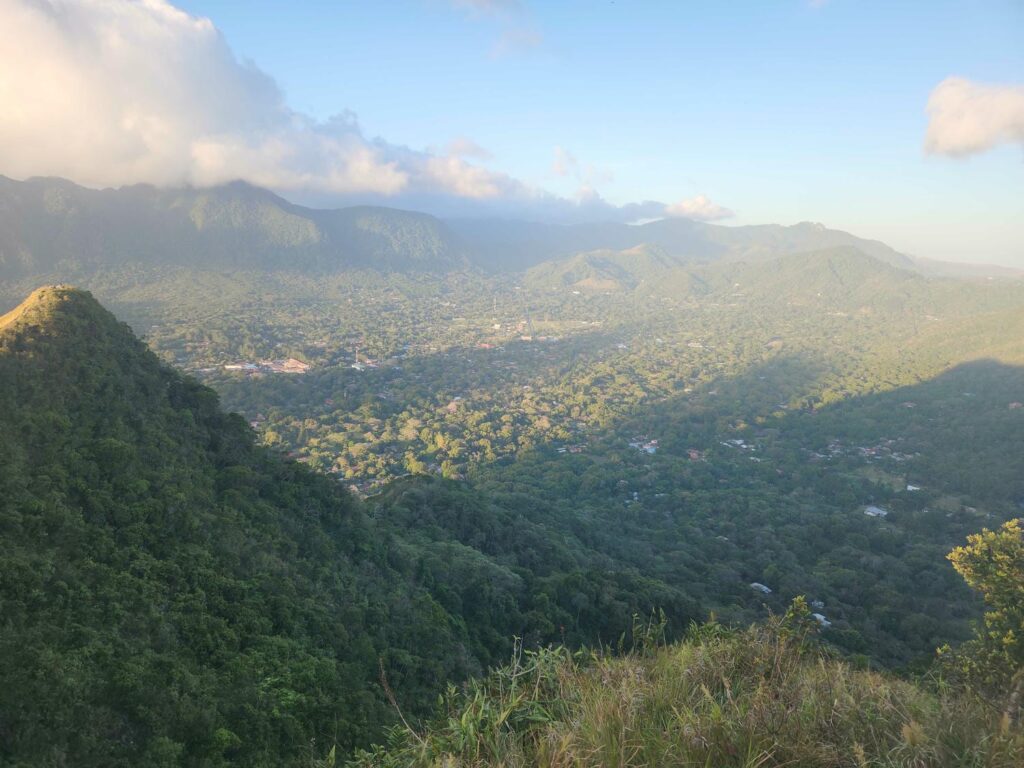
In any case, El Valle is a fascinating town- it is entirely set in the center of a large volcanic caldera. At some point thousands of years ago, the caldera filled with water, which then either overtopped the caldera or caused a landslide down the southwest flank. This means that there is only one “low point” in the ridge encircling the city. It is cool and wet due to its altitude, contrasting with the hot lowlands all around. We camped in a roadside pulloff near a trailhead, in a really cool spot overlooking the city. Before making dinner, we climbed up Cerro Cara Iguana, or “Mount Iguana Face”, for an incredible view of the whole area. From here we could see not only the entire caldera, but also the Pacific Ocean thousands of feet below. We could even see part of the Azuero Peninsula through the haze! It was an amazing view.


The next morning, we drove down through town. The bottom of the caldera is remarkably flat, and is filled with beautiful homes and large estates. We drove up the other side to an area where a rare hummingbird can be found- the Snowcap. We didn’t find it, but we had a beautiful walk through the jungle, and even found a sloth! He never turned to look at us and just looked like a ball of fur. We left El Valle and returned down to the main highway along the coast.


Before we knew it, were almost to the famed Panama Canal. We chose to take the northern bridge across the canal, called the Centennial Bridge. It was built in 2004 to relieve some of the traffic across the original bridge, the Bridge of the Americas, built in 1962. Before this, vehicles had to either take a ferry or a small swing-out bridge that went across the locks of the canal, which seems like it would have been incredibly slow! It was pretty surreal to be driving over the bridge and looking out at the canal. I’d read lots of books on the history and construction of it, and to be here was just incredible. Just to the north of the Centennial Bridge we could see the beginning of the Culebra Cut, the most difficult part of the canal to build. Not only was the highest point on land that the canal had to cut through, it also had the most unstable rock, and the construction and early years of the canal were plagued by landslides. To our south, we saw a huge ship headed away from us, dwarfed by the size of the canal.
We drove down to a viewpoint for the Pedro Miguel locks, which are the first step back down towards sea level for ships heading from the Atlantic to the Pacific. We watched a few ships go by, including a massive car carrier. Being up close to these massive ocean-going ships was just incredible. I’ve been around some container ships, barges, and tankers in Anchorage for work, and they do not even begin to compare to the scale of these monsters. It was like watching a skyscraper float by. We had to wait for a while, but we saw one of the ships traverse the locks, being let down slowly to the next level before it would continue on to the next set of locks.
After standing in the hot sun for over an hour, we were so thankful to get back into the air-conditioned jeep. It was scorching hot out, and now we needed to drive straight through the heart of Panama City. The traffic was crazy and the drivers were crazier, by far the most aggressive of anywhere we’d been so far. The roads through town were complicated- we would frequently have to merge clear across 4 lanes of traffic in less than a quarter mile to get to our next exit. After some confusing on and off ramps, we made it to our destination for the night- The Overland Embassy.


The Overland Embassy is a company that ships overlanding vehicles from Panama to Colombia, and vice-versa, but has also been branching out into other countries- I think they can facilitate shipping to and from Panama, Colombia, Chile, Uruguay, the U.S., Mexico, and Germany, and probably more. The company was started by Alejandro, a Panamanian, who had driven throughout North America back in 2019 and then had a rough experience shipping his vehicle back home- the company he had used messed up his paperwork, resulting in the Panamanian customs confiscating his vehicle for over three months. He learned how the Panamanian customs system worked while working to get his vehicle back, and a few other things came together to lead him to start the company. His family owns a vehicle body shop, and business was very slow during COVID. Panamanian rules were also quite harsh during COVID, and would not allow people to camp in their vehicles. With the empty shop, Alejandro started having people just camp inside, which was somehow legal (make it make sense!). In the U.S., he had also met someone who imported Land Cruisers from Central America, and began finding Land Cruisers in Panama to ship to the U.S, learning how the shipping process worked. All of these things came together, and now The Overland Embassy has an on-site campground, and they ship vehicles all over the world.
We’d contacted them about 6 weeks earlier, and had received our shipping date roughly 4 weeks ago. They made copies of all of our paperwork, and prepared us for the vehicle inspection that would occur the following morning. We stayed the night in their campground and then got up early to leave the next morning. We woke up around 5am and headed back across town to the customs office, where they would inspect the vehicle, mostly making sure that the VIN number matched our paperwork. We arrived just after 6am and there were several other overlanders already there- some we had met at the campground, and some were new. Imagine our surprise when another Jeep like ours pulled up, with the exact same pop-up roof that we have! Tim is from Colorado, and is doing the same trip as us, albeit at a much slower pace- he’s been south of the U.S. border for 2 years already! Pia and Dominic, our container buddies, were stuck in traffic getting across the bridge into the city, but they made it in time. We’d met Tim’s container buddies the night before at the campground, the Dutch couple Frank and Karin in a Toyota Hilux. The group was rounded out by Anish, an Indian-Canadian in a Land Rover LR3, and Dimitri, a Russian in a Honda SUV.
The process here was pretty simple: an agent would check the VIN number on our vehicle, and make sure it matched our vehicle title, registration, and Panamanian TIP. After that, we walked across a pedestrian bridge over a 6-lane highway, where we presented our inspection form at the office there. We would then return at 3pm that afternoon to collect our finished paperwork, permitting export of the vehicle from the country. We unfortunately had a typo in our TIP (wrangher, not wrangler), so we then had to drive back across town to a different customs office to have that corrected.
Before we could do that, we had to get back to our vehicle. We’d been directed to park in a concrete basketball court when we’d arrived for the inspection, along with everyone else. The area we were in was really not a good area of town- lots of trash, run-down buildings, and poverty. When we were getting back into the vehicle, a man who had been directing everyone to park on the basketball court asked us for money for “watching the vehicle”. We didn’t feel that we had needed this, and we certainly didn’t ask for it. There were plenty of other overlanders around to watch each other’s vehicles. I tried to explain this to him, but he wouldn’t take no for an answer. I finally told him that I would only pay if I could get a receipt- if this charge was official, then there must be an official receipt. He of course could not produce a receipt and was quite angry with me, and went off to get another man who I hadn’t seen before. This next guy looked quite intimidating- like a retired boxer. He was big and stocky, wore a stern scowl, and didn’t have a shirt on. I’m sure these guys were just neighborhood bullies who took advantage of people coming to get their paperwork done. There was no sign about any charge for parking, no sign for private property, and I was sure he was just seeing what he could get out of me, so I called their bluff. I stood my ground and refused to pay. They were both quite angry with me, but didn’t dare do anything with all the other people around. As we drove off, they made some gestures that I wasn’t familiar with, but I’m sure they weren’t waving us goodbye.
That unpleasant situation over with, we headed back across town, with morning rush-hour traffic in full effect. As I mentioned before, we had a typo in our TIP. We’d noticed it after we’d crossed into Panama, but foolishly didn’t do anything about it. Fortunately, the customs people inspecting the vehicle hadn’t noticed it, but we still needed to correct it. Traffic was crazy, but we made it to the office, where it took me only 10 minutes to get the corrected form. We then headed back to The Overland Embassy, where we met back up with Dominic, Pia, and Tim.
We were quite busy for the rest of the day until we had to go back to pick up our paperwork. Tim and I been warned by Alejandro that our external fuel tanks had to be absolutely empty and nearly odorless, or they might not be allowed to be shipped. Tim rinsed his out with water, while I dumped out the dregs and let it bake in the sun with a small fan pointed at the entrance, hoping that the residual fuel would evaporate out. I did an oil change on the jeep, and also helped Dominic with a few small fixes on his van. In the meantime, Delaney did multiple loads of laundry, which for us is a lot of work! We have a small dry bag with a small washboard built into the inside of it. Water, soap, and clothes go in, then we knead the bag around, rubbing the clothes on the internal washboard. The bag is then drained and refilled with clean water, and kneaded again. As you can imagine, this is a lot of work! We always like doing our laundry when we are camped near a stream or at a campground with running water, so that we can pre-rinse everything, which makes a big difference. Laundry uses a lot of water, which is a precious resource when we’re out in the middle of nowhere.

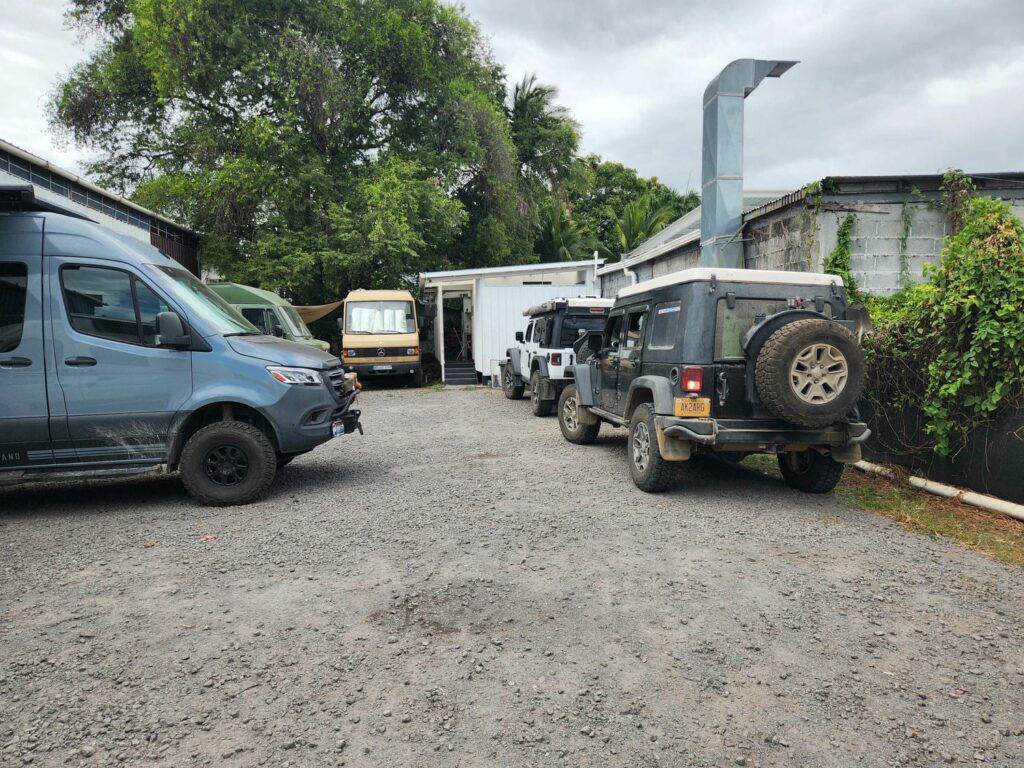
The afternoon flew by, and soon it was time to head back to the Aduana office to pick up our police inspection form. Everyone else took an Uber to and from the office, as it wasn’t necessary to have the vehicle present for this step. We were all pretty tired and stressed out about driving through Panama City- definitely the worst city as far as traffic goes so far. Despite this, we drove the jeep to the office, planning on receiving our paperwork and then heading out of town to explore more.
The drive was stressful but thankfully uneventful, and our paperwork was fortunately correct- the office made mistakes on two others in our group, which we had been warned about. They had to stay much later while their paperwork was corrected. With our completed paperwork, we dove back into the crazy city traffic and headed north out of town. We were headed for one of the few “wild” camps in the area- it is quite difficult in this area of Panama to find free campsites. On our way, we crossed the Chagres River to the small town of Gamboa, which originally was a Canal construction camp.
The Chagres River was one of the most difficult challenges that the canal builders had to overcome. The Canal depends heavily on the Chagres- it is its main source of water. Its flow is highly dependent on what season it is- a slow and meandering river during the dry season, and a raging torrent during the wet season. The wet season Chagres would bring all sorts of Canel-clogging sediment, cause landslides, and make the indispensable water supply unpredictable and irregular. The ultimate solution was to dam the Chagres, which was the second most expensive and complicated part of building the Canal, behind the Culebra Cut.
Just past Gamboa is an area which is now called “pipeline road.” It is a disused road that leads straight into the unspoiled jungle, and is apparently one of the best and most accessible places in Central America to find jungle mammals, birds, and reptiles. The road was built during World War 2 to facilitate the construction and maintenance of a fuel pipeline that led from Panama City on the Pacific to Colon on the Atlantic. The Allies were quite concerned that the Canal would be bombed or otherwise made inoperable during the war, and built the pipeline so that at least fuel could still be transferred from the Pacific to the Atlantic. It was never used, but for some reason the road was continually maintained and the jungle never erased it. Roads through unspoiled jungle are quite rare, especially roads where vehicles are no longer allowed, which makes the destination so appealing.
The trailhead is a known camping spot, and we arrived just as the sun was setting. We saw some of the ubiquitous coatis and some raucous parrots called overhead as we made dinner and went to bed. Delaney woke me a few hours later- she hadn’t been feeling great all day, and now had some pretty intense stomach pain. We are pretty certain that it was food poisoning, and after getting rid of the offending meal, she felt well enough to try and go to sleep again. In the moment, I was prepared to pack up camp and head to a hospital, but we both slept well the rest of the night and she had no ill effects afterwards.
We woke at sunrise and started walking down the pipeline road. We saw few birds and coatis, but the road was surprisingly a bit of a letdown- perhaps we’d let it get talked up too much. In any case, it was nice to get a few miles of walking in before the day got too hot to do anything physical at all. After getting back to the jeep and making breakfast, we drove back into Gamboa and found a great spot to watch ships go by in the Canal. The ships are just breathtakingly large-again, like a skyscraper floating by. The Canal generally has ships go from the Pacific to the Atlantic in the morning, and vice versa in the afternoon, so all the ships we saw were coming out of the Culebra Cut and headed across Gatun Lake towards the Atlantic. I’d read that other people had been told that they couldn’t watch ships here, but a friendly construction worker saw our Alaska license plates and assured us that we could stay as long as we wanted.


After we’d had our fill, we got back in the jeep and drove towards the Atlantic side of the Canal. There are two visitor centers that you can watch ships go up and down the locks from: at the Pacific, with the Miraflores Locks, or at the Atlantic, with the Agua Clara and Gatun locks. We’d heard that the Atlantic side had a better view of the locks, but that the Pacific side had a Morgan Freeman-narrated IMAX movie. We chose to visit the Atlantic side first, and then see about the Pacific side. Tickets were only $10 each, and granted access to a viewing platform for the original Gatun locks, still in use, and a visitor center above the newer and larger Agua Clara locks.
The original canal locks, Miraflores/Pedro Miguel on the Pacific and Gatun on the Atlantic, allowed a ship with a maximum length, width, and draft (depth below waterline) of 965ft long, 106ft wide, and 39.5ft deep. This is referred to as a Panamax-sized ship, and thousands of ships have been built with these constraints in mind, including the famous Iowa-class battleships of World War 2. As international trade has grown, the Canal grew more and more congested, with ships waiting up to a week on either side before transiting across. New, larger locks were completed in 2016, Agua Clara on the Atlantic and Cocoli on the Pacific. These new locks allow larger ships to pass through, referred to as Neopanamax: 1200ft long, 168.1ft wide, with a 50ft draft. It may not seem like the new locks are much larger, but a Panamax ship can carry roughly 2,500 40-foot containers, while a Neopanamax ship can carry up to 6,500! The old locks are still in service, allowing more ships to pass through per day, relieving congestion. At roughly 35 ships per day, and a reported $300,000 to $1,000,000+ fee per ship, Panama is doing quite well.


We visited the Agua Clara visitor center first. It is perched on a cliff above the locks, with a commanding view of the Atlantic, Gatun Lake, and the ships passing below. We spent well over an hour just standing at the viewpoint, watching ships go through. We then drove over to the original Gatun locks, which involved crossing the brand-new Atlantic Bridge, the third bridge to cross the Canal, completed in 2019. We really enjoyed our time at the Gatun locks- the viewpoint is pretty much eye-level with the ships, and this time they were going up to the lake, not down to the ocean. It is much more impressive to watch a ship rise than it is to watch it descend! We spent another hour or so here, watching several ships go through. On the Agua Clara side, the ships are guided through the locks by tugboats, but on the Gatun side, there are small locomotives that pull the ships along.


We found a nice spot to camp just north of the Gatun locks on the west side of the Canal. There really wasn’t a lot over here- just a small boat harbor full of sailboats, and a bunch of abandoned apartment buildings. The area was called Fort Sherman, which had been built along with the Canal to defend the Atlantic side. During World War 2 it was used as the primary defense for the north side of the canal. After the war, it was used as the Army’s Jungle Warfare Training Center, and many of the soldiers who served in the Vietnam War were trained there. In 1999 when the U.S. gave the Canal back to Panama, the fort was abandoned, and areas of it are still open to the public. Parts of it were used in the 2008 James Bond film Quantum of Solace!


We camped along one of the old roads, not far from a huge block of abandoned apartment buildings. The area seemed to be very popular with walkers or runners from the nearby small boat harbor, which seemed to have quite a few people living on their sailboats. We watched monkeys play in the trees above us. It was a hot night but not too terrible, despite being deep in the trees with very little breeze.
The next morning we made breakfast and then drove all the way south, back to Panama City. There is a toll road that makes the trip only take around an hour and a half, but we took the free road, which took nearly 3 hours. We passed through lots of small towns, which surely began as Canal construction camps. We made a small detour before we reached the city- we drove back across the Centennial Bridge, and then looped around to drive across the Bridge of the Americas. We’d now driven across all three bridges crossing the Canal, and all in the course of a few hours!


We threw ourselves back into the crazy traffic of Panama City, driving straight across from west to east. We were headed for a small mountain range east of the city, which promised a cool night of sleep- one of the only areas within a day’s drive! After another hour or two, we reached an amazing viewpoint that looked south out across the Pacific. The skyscrapers of Panama City were also visible through the haze. We camped about 15 minutes further, on an access road for some communication towers. The night wasn’t quite as cool as we’d hoped, but much better than anywhere since El Valle de Anton.


We drove back into the City the next morning, stopping for our first carwash of the trip. The jeep had to be clean to be allowed to load into the container, which was scheduled for either the next day or the one after that. After our carwash, we went back to the Overland Embassy campground to finish packing everything up for shipping. We got the news that afternoon that container loading would be the day after tomorrow, meaning we would have to spent two more hot nights there. We did some more laundry, cleaned out various parts of the jeep, and continued airing out the rear fuel tank.
We’d made plans that evening to go out to dinner with Jan and Annya, the Dutch and Filipino couple we’d met in El Salvador at Parque Nacional El Boqueron. We’d kept in touch, and had really been looking forward to meeting up with them and having more time to talk. Jan was quite busy, as Maersk had gone forward with the purchase of the dock facilities that a Chinese company had been forced to sell by the Panamanian Supreme Court. We arrived via Uber (not wanting to drive through the city again) at Casco Viejo an hour or so early so that we had time to explore. Casco Viejo is the “old town” part of Panama City, originally founded in 1673. It was built after the original City, called Panama Viejo and founded in 1519, was attacked by pirates in 1671. Not many original buildings remain as three separate fires burned much of the city in the 18th century, but it is still a very historic area.
At a beautiful viewpoint over the pacific is also the “French Plaza”, a monument to the French attempt at building the Canal. The French, led by diplomat-turned-businessman Ferdinand de Lesseps, were full of confidence after completing the Suez Canal in 1869, and turned their sights towards Panama. From 1881 to 1889 the French attempted to dig a sea-level canal, but the money eventually ran out. The U.S. bought the rights to the Canal and after some devious political maneuvering (read about the Secession of Panama from Colombia), began construction in 1904, completing the Canal in 1914.


After wandering around the ancient buildings, including several caved-in cathedrals, we met Jan and Annya in a central park area. We found a restaurant that had a rooftop, and had an absolute wonderful evening together. They are both such interesting people to talk to that our evening flew by before we knew it. Before waving goodbye, we found that they were planning an Antarctica trip in February of 2027, roughly the same time that we would be doing it (if we do it, that is!). We shall see what happens!


We mostly killed time the next day, picking away at small tasks while trying to avoid the oppressive heat. We finished our laundry, finished packing our bags, and prepared to leave what has been our home on wheels for the last 5 months. I also changed the oil on the jeep for the first time since Mexico! The next morning, we woke up just after 4am and headed out for Colon, where we would be loading the jeep into a container. Even though it was still very dark, there was almost no traffic as we drove through the city. This time, we took the toll road north, and were at our meet-up point in Colon before we knew it.
We met at a gas station outside of Colon, where Pia and Dominic had spent the night. Tim, Frank, and Karin had spent the night in a nearby hotel, while Anish had done the drive over from Panama City with us. His container buddy, Dimitri, was a bit of a mystery- he didn’t speak English and didn’t seem interested in engaging with anyone. We had all arrived quite early, and we met Ana, who would be managing the loading process. When the time had come, we all convoyed over to a empty plot of land that had three trailers, each with a container on it. First, our vehicles were inspected. Tim and I had been quite worried about our external fuel tanks- we’d been warned that they may be not be allowed if the inspector could still smell fuel. We’d both been airing out our tanks for the past 4 days, and you definitely could still smell fuel. All the worrying was for naught, as all the inspector did was verify that our VIN matched our paperwork, made sure our house battery was disconnected, and had a brief glance in the back.
Because the containers were already on trailers, there was a flatbed tow truck to help us. We would back up onto the flatbed, which would then back up with the vehicle on it to the container, where we could drive straight into the container. We loaded first- it was quite a strange feeling to have the flatbed underneath me pick me up and back up to the container. I pulled in, enganged the emergency brake, and that was it! We were all loaded up. Pia and Dominic were next, and their loading was a bit more eventful than ours- they had known that their van would be a tight fit in the container, and that they would have to lower the air pressure in their tires to get just another inch of clearance to fit. We helped them lower their tire pressure, but a bit too early- they then had trouble getting onto the flatbed! A few planks of wood leveled things out, and the truck picked them up and Dominic drove the van into the container. It was such a tight fit that he had to crawl out the back of the van! There was a worker in between their van and the jeep strapping the vehicles down, and we weren’t quite sure how he was going to get out- their van was too low to the ground to get under, there was only inches of clearance on the top, and the sides were so tight that they couldn’t even open their sliding door! The worker was a bit skinnier than he looked, and was able to shimmy along the side of the van- none of the rest of us had a chance at fitting through there though!


After everything was strapped down, the container doors were closed and a special seal was placed on the container, so that we would know if the container had been opened without us. After the other containers were closed up, we all got in Ana’s van, and drove back to Panama City. We were dropped off back at the Overland Embassy, where we all chatted for a bit and shared contact information. Alejandro bid us all farewell, and we invited him to come visit us in Alaska sometime- hopefully he accepts! We took an Uber to a hotel that we’d reserved, and that was it. It was a very strange feeling to be without the jeep, which had been our home for the last 5 months. The only time we’d gone more than a few hours without seeing it was at Antigua, where it had been parked right outside- now it would be two weeks before we’d see it again!


We checked into our hotel, which was closer to downtown Panama City, and then walked a few blocks away to a restaurant that promised good pizza. The pizza was fantastic, but it seemed to be in a bad neighborhood- several street vendors came into the restaurant to try to sell us cigars, or chewing gum, or lottery tickets. The restaurant workers shooed away the cigar and chewing gum vendors, but half of the people in there bought lottery tickets! We’ve seen people selling them all over Panama, as well as lots of advertisements for gambling. Panama might have more of a gambling problem than the U.S. does! One final person came into the restaurant who was a bit more unsettling. A homeless person walked by and stared through the windows into the restaurant, and I made the mistake of making eye contact with him. He immediately came into the restaurant, and started begging me for some money. He was quite obviously undergoing some pretty serious withdrawals, and looked quite haggard and in the depths of drug addiction. The staff shooed him out of the restaurant, but he then plastered himself against the outside window and stared at me for a solid five minutes, nearly unblinking. We never really felt unsafe, but it was very unsettling.
After looking both ways for the beggar, we walked back to our hotel. It had been a long day already as we’d gotten up at 4am, and we fell asleep almost instantly. Delaney woke up briefly to eat some of the leftover pizza for dinner, but I slept pretty much from 2pm until 6am the next morning. We checked out of the hotel and grabbed an Uber to go to the airport for our flight to Colombia. There are two airports near Panama City, one east of town and one west across the Canal. The eastern one is the larger international airport, while the western one is for more regional flights and cheaper carriers. We were flying with Wingo, a cheap regional carrier. The ride back west across the Canal took a while, as we were in heavy morning traffic, but we’d planned to arrive at the airport far in advance just in case.


Delaney has taken international flights before, but this was my first time. One of the things that you have to do, at least for flying to Colombia, is prove that you are traveling onward. For most tourists, this is just their return flight, but for us we will be driving out of the country. Fortunately, we’d been prepared by Alejandro for what we would need- our vehicle shipping paperwork. It took a bit with the airline agents (I think one of them was new) but we were eventually allowed through. Our flight ended up being delayed for 2 ½ hours, but with a little patience we were headed to Colombia!