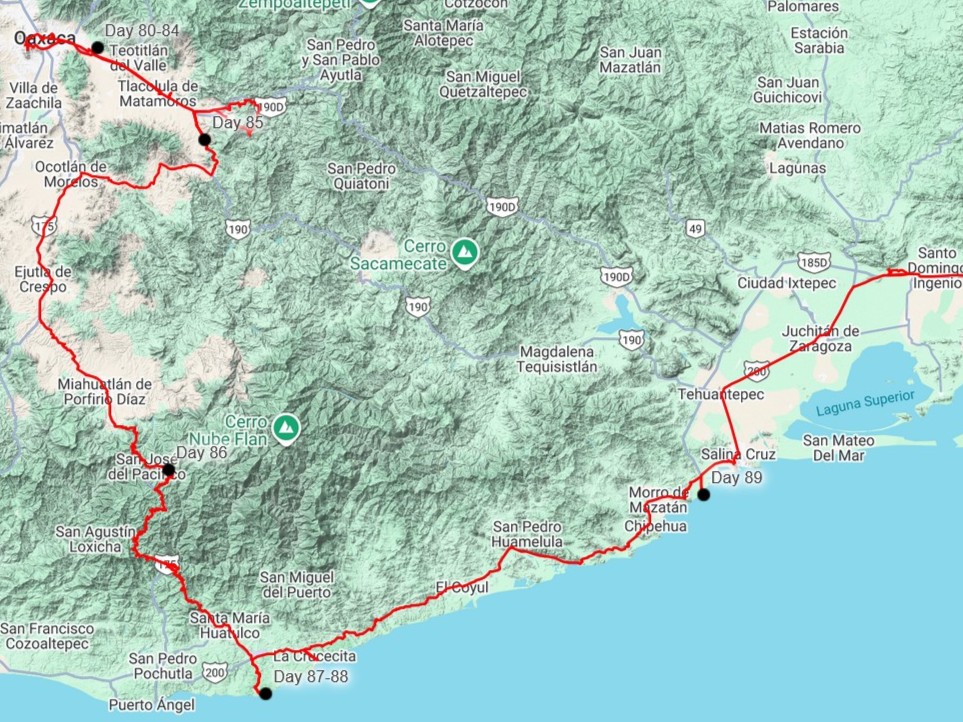
We pulled into our campsite in near Santa Maria el Tule on the afternoon of Christmas Eve, 2025. The campground was called OaxacaView, run by the German couple Stefan and Sabine. They were incredibly gracious hosts and showed us around their property- several flat clean places to park, bathroom, showers, dishwashing sink, amazing view of the Oaxaca Valley, and 5 dogs and 5 cats! We hadn’t had such amenities since our stay in a hotel in Mazatlan. We hadn’t quite settled in when in came two more vehicles- Tevin and Bri in their LandCruiser Troopy, and Paul and Kerry in their Toyota motorhome. We made quick introductions, and soon found ourselves walking into El Tule with Tevin and Bri, headed to a restaurant recommended by Stefan for a good Christmas Eve dinner.
We got to know each other as we walked the 45 minutes to town- Tevin and Bri are doing much the same thing we are on a similar timeline, in a similarly equipped vehicle. Their Troopy is right-hand-drive, which unfortunately means they have to ship their vehicle to Colombia from Mexico or Guatemala- RHD vehicles are not allowed in most of Central America. We had just ordered dinner when Paul and Kerry showed up to join us. The 4 newcomers had been traveling together since meeting on the La Paz – Mazatlan ferry, having taken it only a few days after we had. Paul, a retired college professor, and Kerry, a retired labor & delivery nurse, are from near Fresno, California, and are on Mexican road trip. They have both explored much of Mexico, especially Paul, who was a wonderful reference for all things cultural and historical.
By the time we all got to know each other and had gotten each other’s travel stories, the food arrived. I had shrimp and garlic, and Delaney had beef with molé. Molé is an Oaxacan specialty, and is made of chilis and chocolate. It is difficult to describe the flavor, but it is savory, chocolatey, and just a bit spicy. It has the color and consistency of barbeque sauce, but tastes nothing like it! It was very good. To cap off our meal, the waiter brought us each a shot glass of Mezcal, another Oaxacan specialty. It is made similarly to tequila, but it has a smokey flavor, and the stuff we had was as strong as gasoline!


After dinner, the 6 of us wandered towards the central plaza of El Tulé. There was an amazing Christmas display, with lights and decorations everywhere. The main attraction at El Tulé is the tree, named el Tulé, whose trunk has the largest circumference of any tree in the world. The tree isn’t especially tall, but even with the gathering darkness, the trunk looked like it was just a massive wall made out of wood. Right next to the tree, the Spanish had built a church, which was full and lit up, as Christmas Eve mass was being said. We stopped with a crowd of people outside the door and watched for a bit. It was very odd hearing the same intonations and tunes as I had heard back in the U.S., but now in Spanish! The mass truly is the same the world over.


Paul and Kerry caught a cab back to OaxacaView as we walked back with Tevin and Bri. Part of the Christmas Eve celebrations included a small mobile amusement park, similar to a state fair in the U.S., but with none of the safety features we take for granted. There was a viking ship that was being rocked back and forth to incredible heights, with only what looked like a lap belt holding the lone passenger in. Just like I don’t think we’ll be doing any ziplines here, we won’t be doing any amusement park rides either!
The next morning, it felt very strange waking up for Christmas Day without family around. Delaney had spent a Christmas in Malawi, but this was my first Christmas away from home. Compounded by this, there was no snow, and it was a balmy 75 degrees and sunny all day! We finally we able to hang our laundry to dry that we’d done several days ago, which was still soaking wet after sitting in the rain for 2 days.
Paul and Kerry began working on the AC unit for their motorhome- they’d had a frustrating time in Mexico City, and in the dark, had been directed down a street that had a low-hanging bar across. The AC unit was a bit mangled, and as I saw them beginning to take it apart, I couldn’t help myself, and soon found myself bending sheet metal back into place. None of the refrigerant pipes had been damaged, but the fans that pull air through the radiators no longer spun. For the next 2 days, Paul and Kerry worked tirelessly to get the mangled thing fixed, and by the time it was all said and done, it was better than new, though it definitely sported a few new zip ties and self-tapping screws. We were even able to get the bent mounting bolts to thread back in.
Other than fun with AC units, Christmas Day was pretty laid back. Our campground was easy to relax in- running water, perfect weather, and new friends. Talking with Tevin and Bri was wonderful, as they were the only other Pan-Am travelers we’d met so far, and we were the only ones they had met! We compared past experiences, future routes, and all sorts of tips & tricks.
The next day, Delaney and I had an appointment with a welder that Stefan had recommended. We had two things we wanted done. Firstly, our spare tire rattled like crazy, especially going over bumps and topes. It wasn’t going to fall off, but the mount for it was bolted in the same way that a trailer hitch pin holds a hitch in, which allowed too much movement. Second, we wanted a way to mount our shovel. We’d been just carrying it in the back, which was a pain in the rear- every time we wanted something, we’d have to move it or just take it out for a moment. Our aftermarket rear bumper had an unused mount that was supposed to be used for a hi-lift jack, and we hoped the welder would be able to turn it into a shovel mount. Communicating mostly by pointing, grunting, and some Google Translate, Francisco and his apprentice Alejandro were able to solve both of our problems in only a few hours, and we drove out with a firmly-mounted spare tire and our shovel mounted outside as well! We were only charged 1500 pesos, which is a little less than $100 USD. What a deal! They were an awesome team and we are super happy with the way things turned out.


We then met up with Bri and Tevin in El Tulé to walk around a bit. The tree was even more impressive in the daytime, and the city plaza was bustling with activity. We really hadn’t spent any time in a Mexican town up until this point, and really enjoyed all the chaos. We’re usually in and out of towns as quick as we can fill up with gas and get groceries, but this area was really nice. Bri and Tevin headed back to the campground and Delaney and I got lunch at a small restaurant on the edge of the plaza. I had some excellent quesadillas, which are not at all like U.S. quesadillas- Mexican Quesadillas are far better! Delaney had another Oaxacan dish, which were basically open-faced tortillas with refried beans, cheese, and meat. Both of us normally don’t care for refried beans, but every time we’ve had them with a meal here, they’ve been amazing, with a ton of flavor. Paul tells us it’s because they are made in an Olla, a tall clay pot. They are simmered for hours on a wood fire, and the clay imparts some of the smoke into the beans. Perhaps we’ll have to try this when we get home!


We then stopped at a fruit & vegetable market on the way back to the campground, all of which was amazingly fresh and local. The fruit and vegetables we get in Alaska are simply terrible compared to everything here. Back at the campsite, we had a bit of a farewell party. Bri and Tevin were headed out towards Guatemala, where they would spend the next month or two. I don’t think we’ll catch up to them before they ship to Colombia, but they’ll be spending some time in Colombia re-doing their vehicle’s interior. I’m sure we will see them again- they are on the exact same timeline as us, planning on being in Patagonia at the end of 2026 or beginning of 2027.
“Santa Paul” had shown up on Christmas Eve when we had gotten back from dinner, leaving sparklers and sparkling cider on both ours and Bri and Tevin’s vehicle. With Stefan’s blessing, we lit off the giant sparklers and enjoyed some amazing Martinelli’s sparkling cider, which had come all the way from California. We had such an amazing Christmas with some really amazing people!


The next morning, Delaney and I planned to visit a famous Sunday market at Tlacolula de Matemoros, and Paul and Kerry decided to come along with us! We convoyed the 10 miles over, and parked in the widest of the tiny streets we could find. Street parking in Mexico is pure anarchy- people park on each side of the street, even if it restricts a two-way street down to one lane. We walked towards the center of town and into the market. It was absolutely crazy- perhaps 10 city blocks full of vendors selling almost everything imaginable. The roads are all closed off every Saturday night for all the vendors to set up their stalls, and by the time we got there Sunday around 9am, the place was absolutely packed with locals and tourists alike. We wandered through the market, taking care not to lose each other- we would never find each other again, other than most of us Americans being much taller than many of the indigenous people here.


The wares being sold included hand-made wood furniture, bread and various baked goods, touristy trinkets, fruits & vegetables, electronics, power tools, cheese, shoes, meat, clothing, rugs, all manner of local art such as carvings and paintings, dried crickets (yuck!), chocolate, pottery, you name it! It was only loosely organized, so you’d have someone selling wooden chairs right next to someone selling cabbages. It was all cash-only with very few prices posted, so if you wanted something you’d have to haggle! Delaney picked up some vegetables while Kerry bought a pair of leather sandals, which were made of different leather strips all woven together. We saw lots of locals wearing similar footwear!
We then found a small stall with two women making quesadillas- completely from scratch. They would make the dough, press it thin with a special wooden press, put the fillings in, and then fry the whole thing in oil. We had to get some! We got one with cheese and one with chicken, and to date they were the absolute best things we’ve eaten in Mexico. The cheese in Oaxaca especially is incredible- it looks kind of similar to hand-made string cheese, but it is far more flavorful and indescribably delicious. It melts fantastically in quesadillas. We bought a small bag of it at the market, and it was fantastic, but the quesadillas we made paled in comparison to the ones that the old ladies at the stall made. I wish we could hire them as cooks for our whole trip!


After wandering through the open-air meat section (*urp*), Paul spotted a stall selling a special Oaxacan hot chocolate. We were a bit confused at first- the vendor, a young lady, was spinning a wooden agitator tool in a large shallow pot of hot chocolate, making it foam. She would then scoop the foam into tiny mugs with what looked like miniature canoe paddles in them, which were flat spoons for scooping up the foam. We had to try it, and it was incredible- I’ve never had anything like it. Despite it just being foam, it had an incredibly full and smooth chocolate taste. Delaney couldn’t resist and bought a small bag of the chocolate, as well as one of the wooden agitators! We will have to make our own when we get home.


Finally done with the market, we made our way back to the vehicles and after navigating the tiny city streets we were back out on the main road. We planned to meet up on the other side of Oaxaca City at Monte Alban, a massive archeological site, after each running some quick errands. Delaney and I filled up on gas, and drove through the main city for the first time. The traffic was manageable, but there were several city streets that were closed, presumably due to other Sunday markets. We finally made it to the base of a long winding road which took us up to Monte Alban. The road was super narrow and winding as it climbed up the hillside. We couldn’t believe that the tour busses coming down the hill had made it through! Mexican bus drivers are something else. After a failed parking attempt in a ditch, we met up with Paul and Kerry at the main parking lot. They’d taken the same road up as us, and had a rough time with their motorhome, but here we were!
Monte Alban is a pre-Colombian ruin perched at the top of a large hill in the middle of the Oaxaca valley. It was founded around 500 B.C., and was inhabited by the Zapotec culture, whose descendants still live in the valley. The market we’d been at in the morning had been a Zapotec market, with lots of people still wearing their traditional clothing. The site was abandoned by 1000 A.D, but from 100 B.C. to 200 A.D., it was apparently one of the largest cities in the Americas, and it was also one of the earliest cities in the Americas. It has one of the largest “ballcourts” of any Mesoamerican city- all the various cultures from Northern Mexico down to Honduras played the same game, or at least similar games with similar courts. Most ruins from here to Honduras have a massive ballcourt at the center!


We purchased our entrance tickets and wandered the ruins for the next few hours, until they closed. The center of Monte Alban is a massive plaza, 150m x 300m, which was created by leveling the top of the hill that the city is on. The plaza is surrounded by Mesoamerican pyramids and other monolithic structures, and in the center of the plaza are 3 buildings, including one called the “observatory” which has all sorts of amazing carvings on it.


It is clear that only a fraction of the city has been uncovered, with some of the pyramids still in a state of disrepair, with rocks falling off and trees growing on top. We were told that only around 10% has been uncovered, and that there just isn’t enough money in place to continue excavations for now. All the major structures have been uncovered and restored, and Monte Alban was a great start to all the other Mesoamerican ruins we will visit.


We had planned on camping in the mountains north of the city, but we realized that it was far too late to make it there. Paul suggested visiting a taco place downtown called Tacomiendo that he had visited 20 years before, and claimed that they were the best tacos he’d ever had. It would mean staying at OaxacaView another night and driving back in the dark, but of all the places we’d been so far in Mexico, Oaxaca felt the safest, and we decided to go for it. We found the “back way” down the mountain into town, which had a lot more traffic but was far easier for Paul and Kerry and their RV. We made our way into the center of town and parked right near the taco spot.
Paul claimed that in 20 years, the spot hasn’t changed a bit, and in fact, he’s pretty sure that the crude wooden stools were even the same! The place specialized in “Tacos al Pastor”, which you’ve probably seen before- the big stack of meat that rotates and gets slowly carved down. Kerry had to get one of the place’s single tacos to test Paul’s claim- only 14 pesos, or ~$0.75! On Paul’s recommendation, each couple ordered a plate of al Pastor meat, covered with melted cheese and vegetables, which came with tortillas and salsas on the side, so we could create our own tacos. It was almost the best meal we had in all of Mexico, second only to the quesadillas we’d had that morning. Paul and Kerry also ordered “Queso Fundido”, or “melted cheese”, which was Oaxacan cheese and sliced mushrooms melted together in a “molcajete”, which is a little 3-legged serving dish made out of stone. It was molten hot, and absolutely fantastic. Paul and Kerry both confirmed that the place had the best tacos in Mexico or California, and we do not doubt them. We had a great time watching the cooks make the tacos- they would carve the meat off the rotating stack into a tortilla, then slice a chunk of pineapple off where a whole pineapple was spiked on top of the meat stack and catch it with the taco in their other hand. It was fascinating to watch, and they never missed catching it. We had some tiny little bite-sized cheesecakes for dessert.

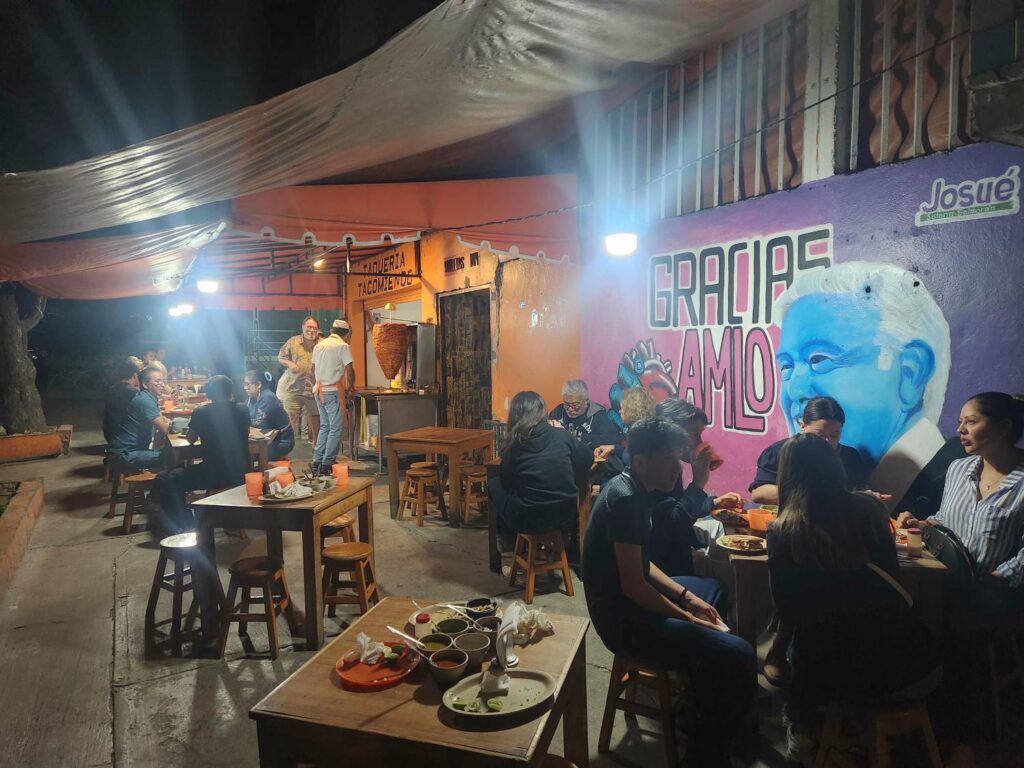
After dinner, we stopped at the grocery store just around the corner, and then had an uneventful drive in the dark back to OaxacaView. We don’t think we’ll change our soft rule about no driving at night, but it means we really don’t get to experience wonderful evenings like this out on the town, especially sit-down dinners. Our day with Paul and Kerry was our favorite day we’d spent in Mexico so far, and we will miss them dearly when we finally do go our separate ways.
In the morning, we did split up, but only for 2 nights- Paul and Kerry went directly south to the coast towards Huatulco, a famous beach and snorkeling area, while Delaney and I went further east. We first visited Yagul, another archeological ruin about 15 miles east of OaxacaView. Yagul was founded around the same time as Monte Alban, but reached the height of its power after Monte Alban was abandoned before 1000 A.D. The site features a high volcanic hill with defensive fortifications, with the main ruins below. The ruins include a large palace, some smaller pyramids, a ballcourt, and several tombs that can be entered. Delaney has been itching to get “inside” some ruins, and here she got her wish! It’s kind of unbelievable that anyone is allowed to go in, with the carvings and sculpture unprotected against vandalism.


The main adventure of the day was Delaney’s- she had been wanting to see how mezcal is made. I had some tedious phone calls to make relating to our house back home, so Delaney did the tour alone. Mezcal is an alcoholic spirit similar to tequila in that it is made from the agave plant. While tequila is made specifically from the blue agave, which is then steamed, crushed, fermented, and distilled, mezcal is made from any one of nearly 40 varieties of agave. The plant is not steamed, but cooked in a giant pit. First, a massive fire is set at the bottom of the pit, then rocks are piled on top of the burning logs. Then the agave plants are put in, and then dirt on top of that to keep the heat in. After this, the plants are crushed, fermented, and distilled, just like tequila. Instead of the pure and smooth taste of tequila, mezcal is very smokey and much rougher. Neither of us are big drinkers at all, and though we didn’t really care for it, we bought a small bottle anyways. I’m sure it’ll take us a while to get through!


We spent a very windy night in the mezcal place’s parking lot, and headed further east the next morning to Hierve el Agua. We drove in the back way, up a windy and switchbacked road, before descending down towards the entrance gate. Hierve el Agua is arguably Oaxaca’s best known tourist destination. It looks like a hot spring, but is a “cold spring” with lots of dissolved minerals in it, which precipitate out on the surface, forming some incredible deposits. It is often called a frozen waterfall. We did a hike around the whole area, walking along the lip of the waterfall before going all the way around to the bottom side of it. It is a really cool area with amazing views and amazing rock formations.


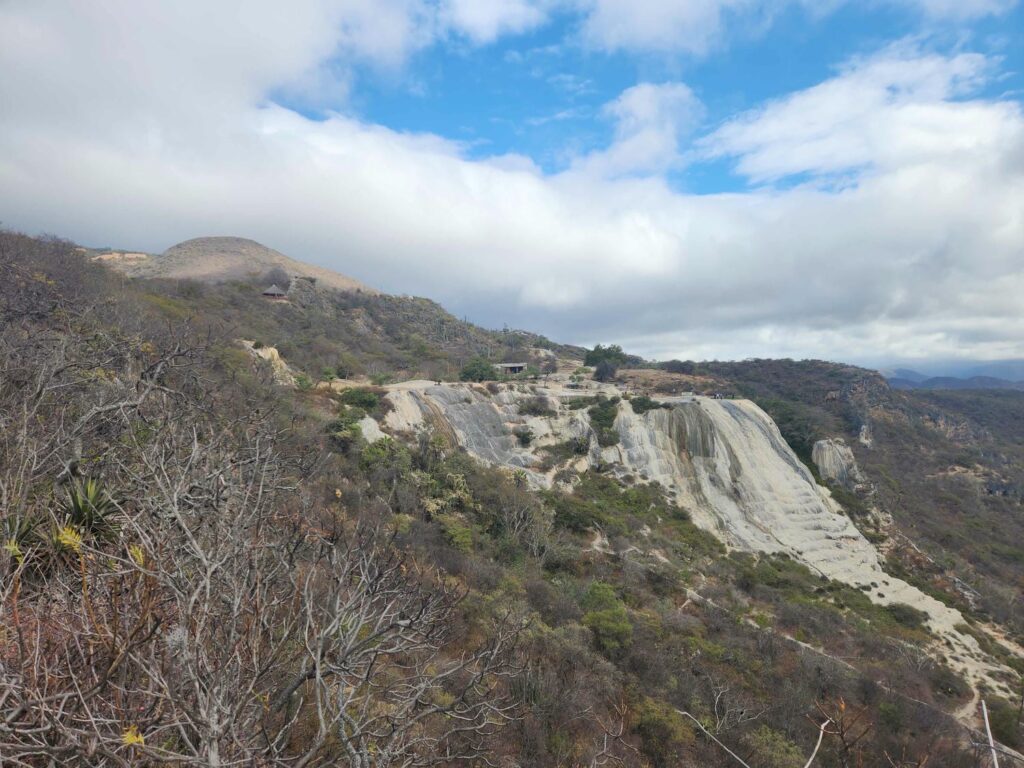
Tourist box checked, we headed back west, going through some more off-the-beaten-path roads. We love these roads- anything to get into the more rural areas and out of the more touristy areas! Even with the innumerable topes, it was worth it. We met up with the main highway south of Oaxaca City at Ocotlan de Morelos, and headed south on highway 175. The highway splits into a toll road, headed slightly southwest, and a free road, slightly southeast- we of course took the free road! When we drove into San Jose del Pacifico, we noticed that there were murals of mushrooms and psychedelic visions everywhere- it turns out it is a bit of a magic mushroom hotspot! We camped above the town on an old logging road. There was a heck of a windstorm that night, which had really started the night before while we were still near Oaxaca. We were at about the high point of the mountain range, and we could see the clouds whipping over us, moving faster than any clouds I’ve ever seen! We heard from Bri and Tevin, who at that point were near the border of Oaxaca and Chiapas, that they were afraid of their vehicle tipping over in the extreme wind. We were well below the top of the trees and didn’t feel much wind, but we sure heard it!


The next morning, we saw that the logging road we were on continued and met up with the main highway a bit further south, so we continued on the narrow dirt road. We passed through the village of San Mateo Rio Hondo, with the narrowest and steepest city streets we’d ever seen! It is amazing where some of these towns are built. The whole area was amazing, with giant pine trees and flowering underbrush, all on top of some very rugged and steep mountains. We continued up and down on highway 175, which rivaled any of the super windy roads we’d been on- highway 40 from Mazatlan to Durango, highway 182 in northern Oaxaca, and highway 85 in Hidalgo.


We stopped a few times on the way south, looking for the rare and endemic Blue-Capped Hummingbird. On our 3rd stop, we drove through a massive coffee plantation. We will see a lot more of this as we go further south! We thought the road through the plantation would get us through El Felix to Pluma Hidalgo, but it hadn’t been maintained and was completely washed out. We were tentatively planning on staying at the end of the road for the night, until we heard from Paul and Kerry. It was New Year’s Eve, and they were staying at a campground down on the coast at San Agustin. There was supposed to be a big party that night, and we were invited! We were glad for the jeep’s 4×4 capabilities as we turned around on a narrow dirt road. I didn’t realize it until I went through my camera’s photos later, but we had in fact found the hummingbird among the 10s of other hummingbirds in the area.


We headed down to the coast on Highway 175, taking the fork to the east, passing by Pluma Hidalgo. This highway was a spur off of the free road, so it was even less maintained than usual. There had been some big storms about a year before, and road repairs still hadn’t been carried out! There were landslides and washouts all the way down to the flatlands. The road was pretty crazy- a landslide would cover an entire lane, and the windy mountain road would go down to one lane, without any warning whatsoever! In other places, the other lane would simply be washed away down the mountainside, again with no signage at all. We were pretty glad to be done with it, but it was a ton of fun for Delaney to drive.


We pulled into the campsite around 4:30, with the party not starting until 5:30- we’d made it! The campground’s host, Hannel, a Dutch Canadian, showed us around. We were very thankful that she’d made room for us- the campground was very full, and it sounds like Kerry and Paul had worked some miracles to allow for a spot for us. We joined the rest of the campers for a walk down to the beach to watch the last sunset of 2025. We were all hoping for a “green flash”, which is a near legendary phenomenon that occurs on clear sunsets over the ocean, but no luck.
Back at the campground, we had to prepare something for the New Year’s Eve potluck dinner. With only 2 hour’s notice, we were only able to make some guacamole, but it turned out amazing due to the massive avocado that Delaney had bought at the Tlacolula market. It was nearly triple the size of a normal avocado, and very creamy. The campground had a large pavilion, normally set up for pairs or quartets to eat, but with several extra tables pulled out of people’s RVs, we made a massive table large enough for everyone. There were travelers from all over- Canadians escaping the winter, longtime Belgian overlanders John and Ellie who had been on the road for 27 years (with John being paralyzed from the waist down!), Mexican-Americans looking to relocate to the area, and a smattering of other Europeans. Us, Paul, and Kerry were the only Americans!
The food was all amazing, and we all filled our plates with a little of this and a little of that. The star of the show was shark curry, made from a shark someone had caught a few days before. The shark was a bit chewy, but didn’t taste fishy at all. Some of the group stayed up late drinking, but us Americans headed to bed around 10pm, only woken up at midnight by the thunderous fireworks from the nearby town.


We were up early as we usually are, and I think much of the campground was very hungover. Unrelated to last night’s festivities, Kerry had unfortunately been struck with some severe vertigo over the night, which was very sad as she’d badly wanted to join us snorkeling today. Hannel graciously lent Delaney and I each a snorkel and mask, and told us exactly where to go. We walked down to the beach and slowly walked into the water- it was the perfect temperature. We put on our masks and began swimming into the ocean. We began to see fish on the sandy bottom, and then the reef grew up in front of us. The reef was in the shape of a horseshoe, and we were in the center of it. There were fish of nearly every color- yellow, green, red, and the most vivid and intense blue I’ve ever seen in my life. We recognized quite a few fish from the aquarium in Mazatlan, only around a thousand miles north of us up the coast! We swam up the center of the horseshoe and along a small underground ravine, marveling at all the fish and colors. The water was nearly perfectly clear. We spent over 2 hours in the ocean, and though I’ve poo-pooed snorkeling in the past, I finally get it. I really wish our GoPro had been functional so we could share some pictures, but we have nothing but memories.
We walked back to the campground, our faces marked in red lines by the tight snorkel masks. We had a slow rest of the day- we swam in the campground’s swimming pool, did some laundry, and talked with the other guests at the campground. Ellie and John in particular were great fun to talk to- they were the only ones who’d done something similar to what we were doing in going all the way south. Many people we talk to are incredulous at what we’re planning on doing, and often scared for us, but Ellie and John made it seem normal. They are part of the “old guard” of overlanders, who have traveled before GPS, before the internet, before campgrounds in Latin America became more common. They were perhaps a bit arrogant about that, but I don’t blame them- by navigating with nothing but a paper map in a foreign country for years, they’ve earned it.


Though Kerry had improved enough to walk around a bit and get into the pool, she wasn’t feeling well enough to join us for dinner, so Delaney and I walked to a small restaurant Hannel had recommended. Most of the beach restaurants were outrageously overpriced, but this one was a few blocks back from the beach and seemed much more local. The food was cheaper, but it wasn’t terribly inspiring, though the margarita and pina colada we had were! We took some long-awaited showers the next morning, and enjoyed a lovely breakfast with Paul and Kerry. We stopped in nearby Las Crucitas for a replacement fuel transfer pump, as one of our secondary tanks had stopped transferring. We also bought a small inverter- my laptop is no longer charging off the voltage converter I installed. I need to do a little investigating, as it worked originally, and still powers the laptop just fine- it just won’t charge the battery. I’m sure it has something to do with the darn 3rd sensing wire that I tried to spoof. The inverter also turned out to not work properly, and I really don’t like inverters, so I may end up sending this laptop home and getting a smaller and less powerful one that can charge off of a USB cable.
We were just pulling out of the AutoZone parking lot when we saw Paul and Kerry, who kindly let us into traffic. We’d left the campground separately and now met for one last time to fill up on groceries. We would be heading into some more remote areas, so we really packed the fridge full! This was also our final goodbye to Paul and Kerry. They were amazing travel partners for the short time we were together. We loved getting to know them and we will certainly stay in touch! They are headed back north to California, but they plan to begin heading south again next year in a sailboat to explore the Sea of Cortez, and then head further south to the Huatulco area. We also started whispering a bit about a visit to Alaska- who knows?
By the time we’d had breakfast, showered, gone to AutoZone, and gotten groceries, it was already 2pm! We drove for about 2 hours to the east along the coast, before camping out on a very sandy beach at Playa Azul. We’d hoped to get further out of sight, but the sand was very soft and steep, and we really didn’t feel like going to the trouble of airing down for just half a mile of sand. Delaney slept ok, but the waves were quite large and irregular, and we’d parked pretty close to the water. I barely slept for a few hours. You’d think we’d have learned our lesson about parking right next to the ocean.


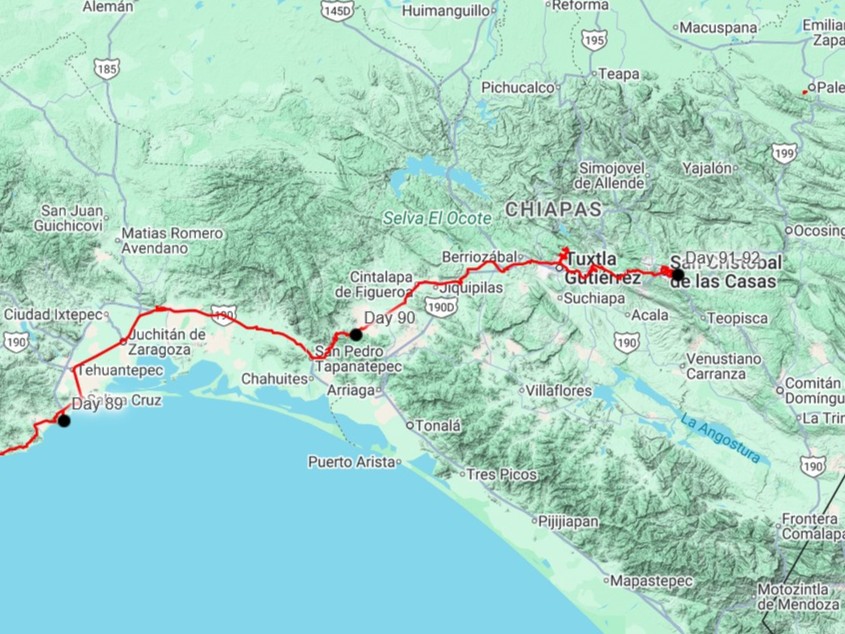
In the morning, we drove back town the beach and through Salina Cruz. Salina Cruz is a large port city, which is the southern terminus of the “Interoceanic Corridor of the Isthmus of Tehuantepec,” a recently completed railway project. The Isthmus between the Pacific and Atlantic oceans is only around 140 miles, and Mexico has invested a vast sum of money into building freight transportation infrastructure to rival the Panama Canal. The Isthmus has long been a potential freight transportation route- it was considered as a possible location for the Canal along with an isthmus in Nicaragua before the French settled on beginning construction in Panama. A railway across the Isthmus of Tehuantepec was completed in 1910 and was quite profitable, but with the U.S. finishing the construction of the Panama Canal in 1914 (the French attempt went bust in 1889) business plummeted, and the line fell out of use. In 2018, design work was started to rehabilitate the mostly-unused railway, and it opened in 2023. Freight train speeds increased from 12mph before modernization to 45mph, and the Mexican Government claims that they can transport goods from the Pacific to the Atlantic Ocean cheaper than the Panama Canal can. I remain skeptical as unloading a boat, loading a train, unloading a train, and loading a boat seems far less efficient than simply traversing the Canal, but canal fees have apparently become very expensive. More likely perhaps is that the watershed that supports the Canal continues to receive less rain, reducing the number of ships that can pass, as has happened in recent years. Then maybe the Isthmus of Tehuantepec will receive more business.
I digress- I find the history of the Canal fascinating, and read several books about it before we left. We drove through Salina Cruz, which like most port towns seemed a bit rough, before driving on a small ranch road to Tolistoque Ojo de Agua, a small spring in a canyon. It’s a local swimming hole, but as you might guess, I was here to find a bird. The Rose-Bellied Bunting occurs in only a few small canyons in this area, and only in canyons with permanent water. There are only 3 or 4 spots where the bunting can be seen, and this was one of them! We walked around in the stifling heat for several hours with no luck, though the area had lots of other birds. Birds are usually the least active in the heat of the afternoon, so by 1 or 2pm I’d pretty much given up hope on finding it this day. I really wanted to find this one, so we planned to stay the night if we had to and look again in the morning. Delaney stayed back at the jeep reading a book while I wandered back into the forest. A few minutes later, at a small hidden creek, there was a tiny electric-blue bird drinking. It was the bunting! I was able to get some amazing pictures of this very rare bird.


We were both very happy that I’d found it, as it meant we wouldn’t have to camp here! The place was fine and shady, but more and more people were showing up to the swimming hole, and it was Saturday night. Not a great place to be if you want a good night’s sleep! We drove a few hours further, fortunately gaining a few thousand feet of elevation to get out of the hot and sticky lowlands. We found a great camp spot right by a lake near Rosendo Salazar, and had a very nice night’s sleep after the previous night’s struggle. I replaced the faulty fuel transfer pump in the morning, and we were back to having our full fuel range again! Our crazy fuel range is one of my favorite things about the jeep- we can theoretically go over 900 miles between gas stations.


We drove to the town of Tuxtla Gutierrez, and passed the entrance station for Sumidero Canyon. The road climbed and climbed, and took us to a series of overlooks down into the canyon. The canyon is kind of like Mexico’s Grand Canyon, and geologically speaking they both formed at the same time. Sumidero is not as deep, but it is much more vertical than the Grand Canyon, with the highest vertical cliffs into the canyon over 3300ft high! There were 5 viewpoints in all, each with a slightly different view of the canyon. The final viewpoint had a visitor center, restaurant, and a viewing tower that was unfortunately out of service. There are also boat tours that go up the canyon, and the view is reportedly more impressive from the river than it is from the rim, but the prices were a bit more than we were willing to pay. Perhaps next time!


We drove east from Tuxtla Gutierrez, and again chose to take the free road. We were in the state of Chiapas now, which was the site of the bloody Zapatista uprising in the 1990s. I’ve heard the analogy that Chiapas is a bit like Texas- they’d really rather be their own country. The Zapatistas still exist, but are more of a political entity than a revolutionary one at this point, and Chiapas has been quite safe for the last few years. The free road, highway 190, was very scenic and curvy, winding its way higher and higher into a pine forest. I’m not sure why I expected our destination to be a tropical lowland town, but I was very surprised when we never began a descent, and we instead found San Cristobal de las Casas to be a high mountain town in a wide valley, at 7200ft above sea level!
We’d chosen to visit San Cristobal on the strong recommendation of Paul and Kerry, who had visited it on a different trip, and we can’t thank them enough for their advice! The town is beautiful and historic, and while it is no longer the political capital of Chiapas, it is thought of as the cultural capital. The city streets are all incredibly narrow for such a large town, and the streets are lined with colorful buildings. The city is bustling with activity, with colectivo vans, taxis, motorbikes, and trucks headed in every direction. Most of the city streets are one-ways, which someone alleviates the issues we’ve found in many Mexican cities around street parking.
We drove on through the town, planning on camping at El Arcotete, a park with a cave and limestone tunnel. We took a wrong turn on our way, and inadvertently stumbled upon an unused road above the park. It hadn’t been used in years, and was very steep, but with the help of an old stump we managed to get the jeep level. It was chilly that night- down to 45F at our high elevation! We had a blissful night of sleep after our stint in the hot lowlands of southern Oaxaca. We’d planned to only stay one night, but after looking online at the various attractions around town, we decided to explore the town for the day and come back to this same campsite the following night.


I found a great surprise for Delaney: a tour of a chocolate museum at an artisanal chocolate maker, as well as a chocolate tasting after! The tour wasn’t until 1pm, so we parked downtown and wandered the city streets until then. I nearly screwed up the surprise- we’d parked very near to the museum, and I had to walk past it to get to the central city plaza. I thought we were walking down one street south of the museum, but I was shocked when we walked right past the open door! Delaney thankfully only caught the word “museo” as we walked by, and the surprise wasn’t blown. The city plaza was interesting, with a massive Spanish church in the center. The church was open for anyone to walk through, and it was gorgeous inside, with high white plaster arches and ceilings. We walked back to the chocolate museum, and Delaney was shocked when we turned into the same building we’d passed an hour before.


“Tours” really aren’t our thing, but the tour was interesting, going into the history of the initial indigenous development of chocolate, followed by the Spanish further making it into what we know today. It seems that most ancient chocolate was made into a drink, but it was the Spanish who had the bright idea of adding sugar to it. On display there were several authentic chocolate grinding tables that had been found at the various Maya ruins, as well as a display on how cacao beans were be used for money in the area. After the tour was the tasting- the part Delaney was most looking forward to! We got to sample 5 different kinds of chocolate made here, all at least 70% dark. I’m not a huge chocolate fan, especially not of super dark chocolate, but this stuff was really good. One sample was 100% dark chocolate- and it really wasn’t bad! My favorite was one that was 80% dark, only made of chocolate, milk, and sugar, but had some incredible fruity tastes from the way that they prepared the cacao beans. Delaney’s favorite was one that had notes of coconut in it. Because the tour had been cheaper than I’d anticipated, we bought more bars of super high-quality chocolate than we otherwise would have. They will be delicious!


At this point in the day, we were getting pretty hungry. We had several choices: wander back towards the central plaza in search of street food, head back to our campsite and make dinner, or go eat at a pizza place that was about a mile away. We chose the pizza. We had a lovely walk through the narrow streets of San Cristobal, before entering the pizzeria. Some of the workers were obviously Mexican, but the people in charge there looked 100% Italian- but they all spoke Spanish! The pizza was some of the best we’d ever had. It cost us only 470 pesos for breadsticks, two 12” pizzas, a glass of wine, and a small serving of tiramisu (my favorite) each. That’s less than $30!


Happy and full, we wandered back to the jeep before returning to our spot outside of town. We had another blissfully chilly night (frost in the morning!) before heading down into the heat in the morning. We were headed to Palenque, our first of many Mayan ruins. Thanks again to Paul and Kerry for this recommendation as well!