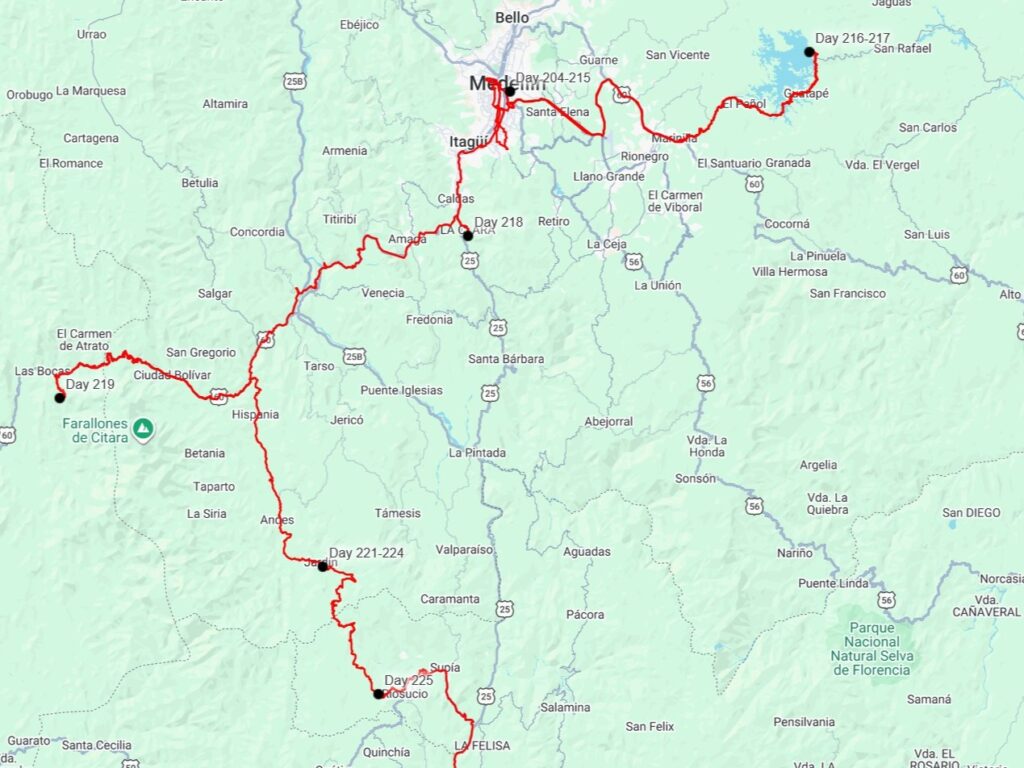
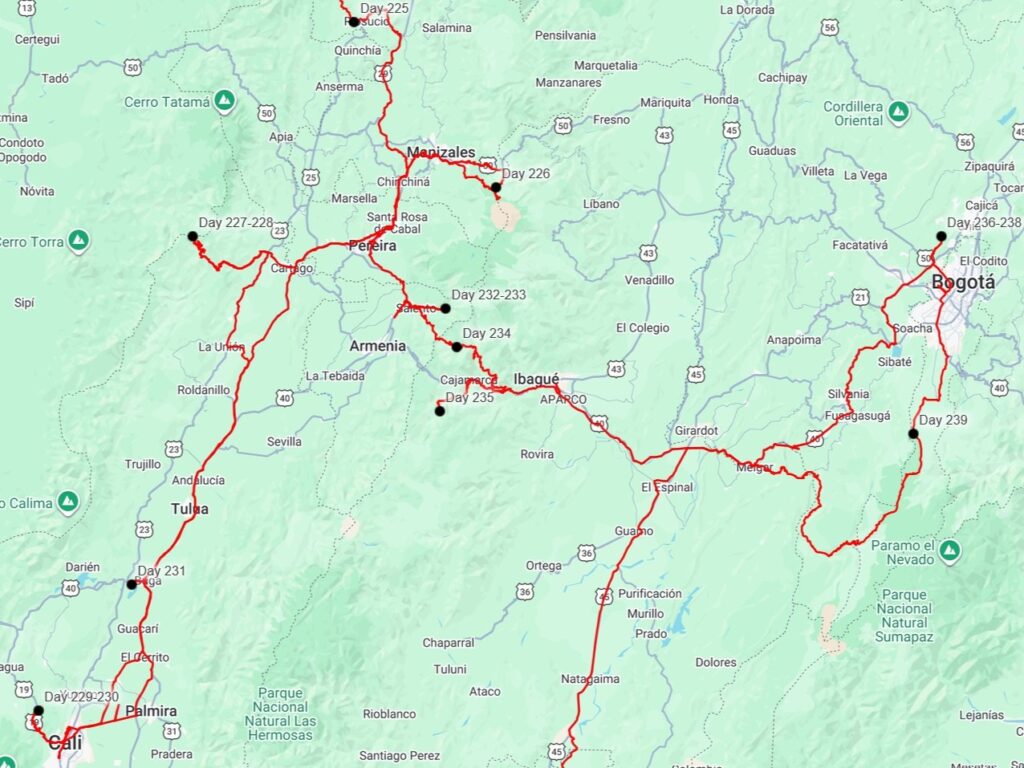
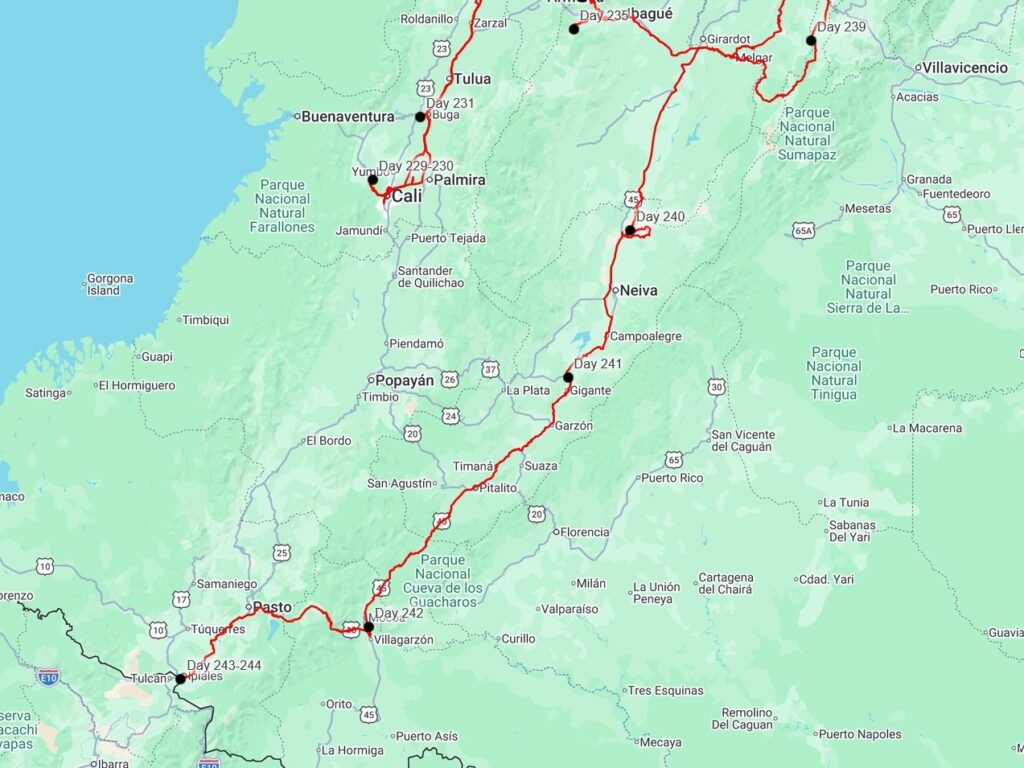
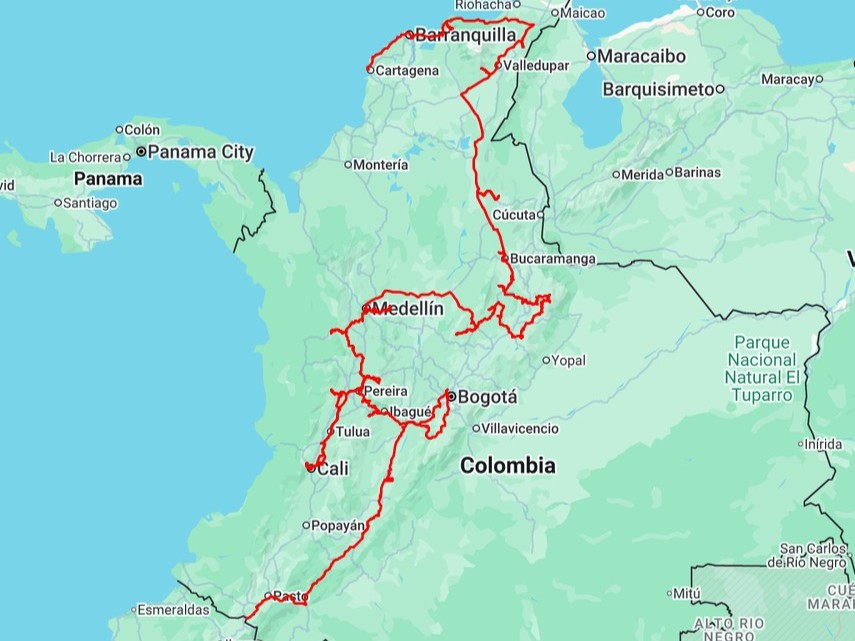
Our Airbnb in Medellín was a beautiful little rooftop apartment with a great view over the northern part of the city. Medellín is a city of over 2 million, with houses crawling all the way up the valley on all sides. The buildings are mostly red brick, making for an interesting contrast with the green vegetation. We settled into the apartment with the help of our host, Yami. The townhouse-style building we were in was a multi-generational affair, with Yami and her husband in the apartment below us, a sister in the apartment below that, and a brother-in-law in the apartment behind us. The apartment itself was simple, with a single bedroom, bathroom, small kitchen, and living room. Outside the large sliding glass doors was the rooftop of the apartment below us, with amazing views to the north. Yami had decorated it with all sorts of potted plants. The apartment was a great place to relax from the hustle and bustle of the city. We went to bed early, exhausted from two long drive days.

The next morning, we slept in, and began getting ready for Delaney to leave. We did many loads of laundry, unpacked the jeep to get it ready to go to a mechanic for a check-up, and Delaney started packing to go back to Colorado for her friend Torri’s wedding. Another important errand was getting a Colombian SIM card for my phone. Delaney has an international plan on her phone, which makes things very easy, but it is a bit expensive. I’ve opted for the much more complicated, but much cheaper method of getting a SIM card in each country I want to have cell service. With our Starlink and Delaney’s phone, we’ve only bothered to get a SIM card for me in Mexico. However, with Delaney gone, and with my plans to get errands done all over the city, I absolutely needed cell service. We found a small store with pre-paid SIM cards (they’re sold at nearly every convenience store), and got everything working. It took a bit of fiddling- the cell service provider would only accept a Colombian credit card, or a Colombian payment app called Nequi which is similar to Paypal or Venmo. Fortunately, the storekeeper was very friendly and patient, and paid with his Nequi account, with us giving him cash in exchange. A month of cell service with 30GB of data was less than $10USD!
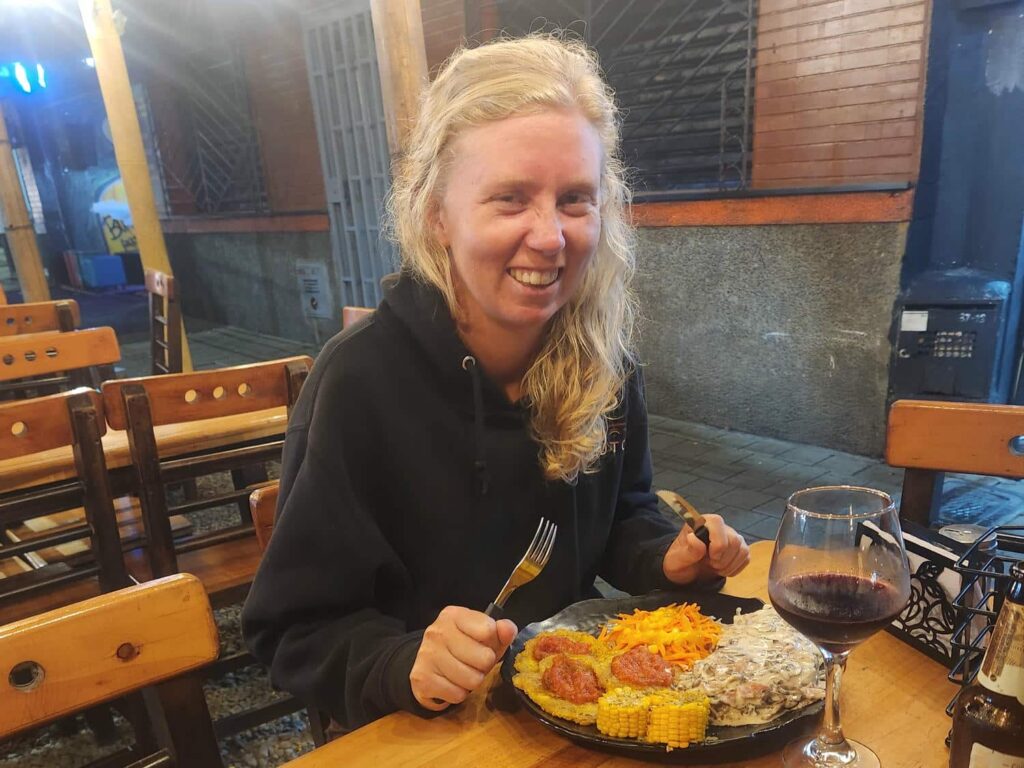
Delaney and I had gone to a hamburger place the night before, and that evening we went to a small steakhouse, as a farewell dinner for Delaney. It definitely wasn’t fantastic, but it was the best steak we’d had since leaving the U.S. The sides were much more interesting- Colombian delicacies like Patacones (twice-fried plantains) and fried “queso fresco”, which is a kind of cheese. We again went to bed pretty early after doing chores and packing all day. Delaney got an Uber to the airport in the morning, and I bid her a sad farewell. It was a very strange feeling being alone in Colombia- we literally hadn’t been apart for more than 15 minutes since leaving Alaska 6 months earlier. I finished emptying the jeep out, and drove it to a mechanic that I’d scheduled to have a look at it. I like to do all the maintenance on the jeep, but I felt that it would be a good idea for someone with a vehicle lift to pick it up and give it a good once-over. I had been quite apprehensive about driving across Medellín by myself- having a spotter is invaluable in the tight streets of Latin America, especially for a vehicle as big as the jeep. It continually amazes me how the jeep is basically the largest non-commercial vehicle on the road. There are no F350-sized vehicles, or even F150-sized vehicles- the largest we normally see is probably a newer Toyota Landcruiser, which are quite rare but about the size of the jeep, and the ubiquitous Toyota Hilux, which are definitely smaller. The drive fortunately was without incident.
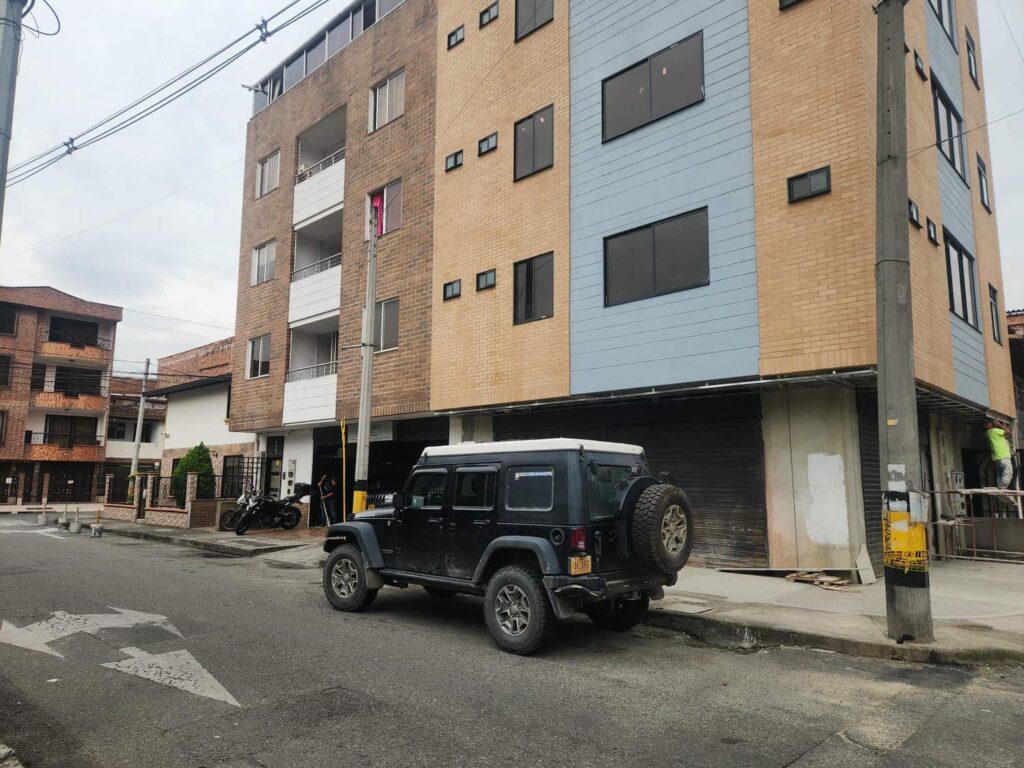
Right as I pulled into the shop, I realized that when I’d emptied out the jeep the day before and that morning, I’d pulled out all the tools- which included the lug nut keys that the mechanic would need to get the tires off. I tried getting a normal Uber back to the apartment, but I waited nearly half an hour with no takers, which was quite strange for such a big city. I noticed that there was an “Uber Moto” option, which was taking a motorcycle- I figured that I may as well try it! It was much quicker, and the driver soon showed up on a motorcycle, or “moto” as they are called here. All the Uber Motos have helmets for their passengers, and mine thankfully fit- my head is quite large. I climbed on back, and off we went! The motorcycles in Latin America are crazy- they split lanes, weave in and out of traffic, and do all sorts of things that we in the U.S. would think are quite unsafe, but it is normal and everyday here. I got back to the apartment, and the driver was happy to wait for me to get the lug nut keys and then take an “off-market” ride back to the mechanic- I paid cash, and gave him much more than he would have gotten from Uber for the ride, but less than I would have paid Uber! Drivers only get about half of what the passenger pays, and Uber takes the rest. It was a great deal for both of us, and I didn’t have to wait for another ride! After giving the mechanic the lug nut keys, I walked towards a pizza place that I’d scoped out- I’m always looking for good pizza. It was a long walk through the city towards the El Poblado district, one of the wealthiest and most touristy. The pizza was pretty good, but not exceptional. It was so strange to eat by myself at a restaurant! I realized I was only a short walk from Parque Lleras, which is well-known in Medellín for being both a tourist attraction and a hotspot for petty crime, despite being in a very wealthy area of town surrounded by upscale high-rise hotels. I walked by, and saw nothing but about 20 policemen in the tiny little park. I’m sure it is quite different at night, but during the day, there was absolutely nothing going on. It was now rush hour, around 4pm, and I struggled to even get an Uber Moto! After half an hour of waiting, I finally flagged a normal taxicab, and was treated to a very aggressive drive back to the apartment. I was charged about twice what an Uber would have cost, but at least I’d made it home well before dark. It was an adventure of a day!
Sleeping in a bed without Delaney for the first time in well over 6 months was very strange. I didn’t sleep well at all for each of the 5 nights she was gone. The next day was pretty slow, but I did meet up with David and Regula, the Swiss cyclists we’d first met on the Baja ferry and then ran into again at the Honduras-Nicaragua border. They were just passing through Medellín, but had gotten an Airbnb for two nights. We caught up at a little coffee shop and shared all sorts of stories we’d accumulated. They also provided me with some invaluable help- right after I’d gotten off my Uber (moto again) to meet up with them, my cell phone service stopped working. I’d just gotten it a few days ago and it was already broken?! Fortunately they’d been through something like this before- when they had cycled through Russia, they had needed to register their new Russian SIM with the government. David walked me through the same process, which was just done through the phone, and I input my passport information. Immediately, I had service again! It would have been a long walk back to the apartment without being able to call yet another Uber moto. They also gave me a metro card, which had been given to them by another traveler- this would make it much easier to ride the metro system. It was great to see David and Regula again, and I’m sure we’ll run into them again further down the road.
The next day, I met up with our German friends Dominic and Pia, whom we’d first met in El Salvador and then ended up shipping our vehicles to Colombia in the same container. It was good to see them again. We met at Plaza Botero, which definitely felt sketchier than Parque Lleras had. I didn’t realize it at the time, but big protests had been planned for that day, and the U.S. government had specifically warned Americans in Colombia to not go to Plaza Botero. There were tons of police and military with riot shields, but the only unsafe thing I saw were lots of homeless people wandering around. The focus of the Plaza is a collection of 20 or so statues by the same Colombian artist. The statues were mostly of mostly horses and people, which the artist had depicted as all being incredibly fat. It was quite underwhelming, and the plaza just sort of seemed dirty. We decided to then get on the metro, to see the famous Metrocable system. Medellín has a quite extensive metro, which includes a system of gondolas, or “metrocable,” to go up the valley slopes to the higher neighborhoods. It is all part of the same system- you get off a train, and right onto into the line for the gondolas. And what a line! The system had had a maintenance issue, which we were told was relatively common. We waited for nearly an hour before finally getting on a gondola. We quickly rose up the valley slopes, high above the city. The view back towards the valley was spectacular, with the city sprawled up every nook and cranny of the massive valley. We passed several stops on the way up, and just stayed in the gondola at the top stop, going around and riding it all the way back down again before getting back on the metro to go find some lunch. The system is set up so that you only pay one time to get into the metro system, and as long as you don’t leave, you don’t pay again. In fact, Dominic, Pia, and I rode from Plaza Botoro to the base of the highest gondola, rode that all the way up and back down, and then down to the El Poblado stop, all for the equivalent of about $1.25USD each!


We ended up at a Philly Cheesesteak place for lunch, which was fantastic. Dominic and Pia hadn’t had one while they had been in the U.S., and I was happy to be able to share what was some quite excellent and authentic American food with them. It was great to see them and I’m sure we will meet again! After parting ways, I ran some errands. Our GoPro, which we’d had for years, had finally failed, before we’d even left on the trip. I stopped at a large grocery store which had some electronics, but no GoPro. I then stopped into MonteRey, which is a massive electronics mall. It was shockingly huge, with maybe 100 shops on different levels, all selling some sort of electronics- phones, cameras, computers, computer parts, drones, lights, you name it. It felt quite futuristic- all lit with colorful neon and LED lights. I found a shop that had GoPros, but they wanted much more than you could get one for in the U.S.- even used! I ended up asking Delaney to pick one up at a Walmart while she was in Colorado, and they happened to be having a huge sale at the time, so there was that sorted! I also needed to find a tiny screw for my camera lens, which had fallen out months ago. I tried a camera shop, but their repair person hadn’t arrived yet. I then went to a drone repair place, and they had the perfect replacement screw! I then realized that our drone also had a small issue- the cooling fan had grown louder over the last year or two. I’ve had the drone forever, and it doesn’t owe me anything, but wouldn’t it be cool if it could be fixed? The repairman assured me he would have whatever parts I needed, so I Ubered back to the apartment, grabbed the drone, and Ubered back to MonteRay to give him the drone. I picked it up a day or two later. He had completely cleaned the interior and exterior of the drone, and had found a tiny dry blade of grass stuck in the internal cooling fan, which had been making the noise. All for around $20USD!
I’d had a bit of trouble with the jeep shop- they were awesome, but didn’t speak English, and car parts really do not translate well. A “tie rod end” in English could translate to Spanish as “knot dowel stop” which is absolute nonsense. I had to go back to the shop several times to clarify what parts I wanted them to look at (brakes, suspension, wheel bearings, etc) and what things I would approve for them to fix. In the end, they replaced a few bushings, tightened a loose bolt, and replaced a steering component that was just starting to wear out. The second time I stopped by at the shop, an older gentleman stopped by in a beautiful jeep TJ just like mine back home, except his is stock and spotless and mine is heavily modified and filthy! His name was Carlos, and he was fascinated by the jeep and the fact that we had driven it all the way here. I showed him a few pictures of my TJ back home, and he showed me a few pictures of the other vehicles he had at his house- a 1967 Chevy Corvette, 1970 Dodge Charger, 1971 Chevy Camero, and 1985 Jeep Wagoneer. They were spotless, all-original, and extremely well cared for. We exchanged phone numbers, and he invited me to come see them! We decided to wait until after Delaney returned, so that she could see them too. I had a few more days to wait for Delaney to return, and I really didn’t do much. In fact, I was honestly quite depressed, being in the apartment all by myself. I did a bit of photo editing and blogging, as well as watched some NBA playoff games, but I was pretty bored. Our apartment was close to a few decent restaurants but not really close to anything else, and Medellín in general was a bit underwhelming. We’ve heard the whole trip about what an interesting and fun city it is, but there really isn’t much to do in the city unless you like to party- which we do not.
Delaney finally returned late the night of May 5th. We’d built in a buffer day, so we did very little the following day at the Airbnb. The next day was our last day at the apartment. One small difficulty in leaving was that the jeep wasn’t quite done yet! With all the misunderstandings and translation issues, it had taken the shop a while to actually start work on it. We packed everything up as best as we could, and the Uber driver must have been quite confused taking us and all our stuff to a different apartment- Bri and Tevin’s! We had met them in Oaxaca, and they were staying in Medellín for a few months to work, and had invited us to stay with them. Tevin’s mom had also come to visit for a few weeks, so it was a party! We moved our things into their spare bedroom, and had a great time catching up with them. That night, Bri had a surprise for Tevin- his birthday had a been a day or two ago, and we all went out bowling! None of us were very good, but we had a great time. It was a very fancy bowling alley, with massive statues and a very impressive alcohol selection at the bar. We then went out to a great Asian restaurant- Delaney and I had both been craving Asian food, and fortunately for us, it is also Bri and Tevin’s favorite.
The next morning, the jeep was finally ready, so I went out to pick it up. Delaney was still tired from traveling, so she stayed home. I had a fun time driving it back alone, but I made it ok! Later that afternoon, we went out to visit Carlos at his place. It was all the way on the south side of town, in a beautiful area up a small valley. His property was incredible- a gorgeous house, giant garage and shelter for his cars, and he even had a waterfall in a small ravine behind his house! He and his wife were so hospitable- they made us coffee, maracuya smoothies, and brought out some incredible pastries for us. Neither of them spoke English, but with our poor Spanish and google translate we had a wonderful afternoon together.
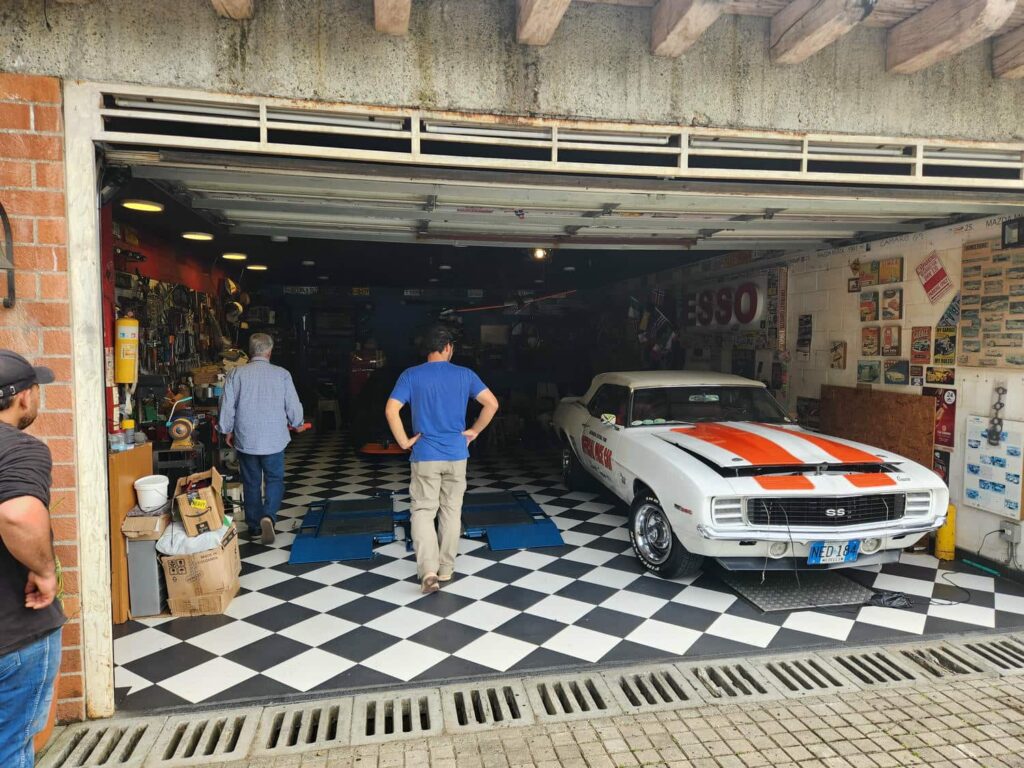
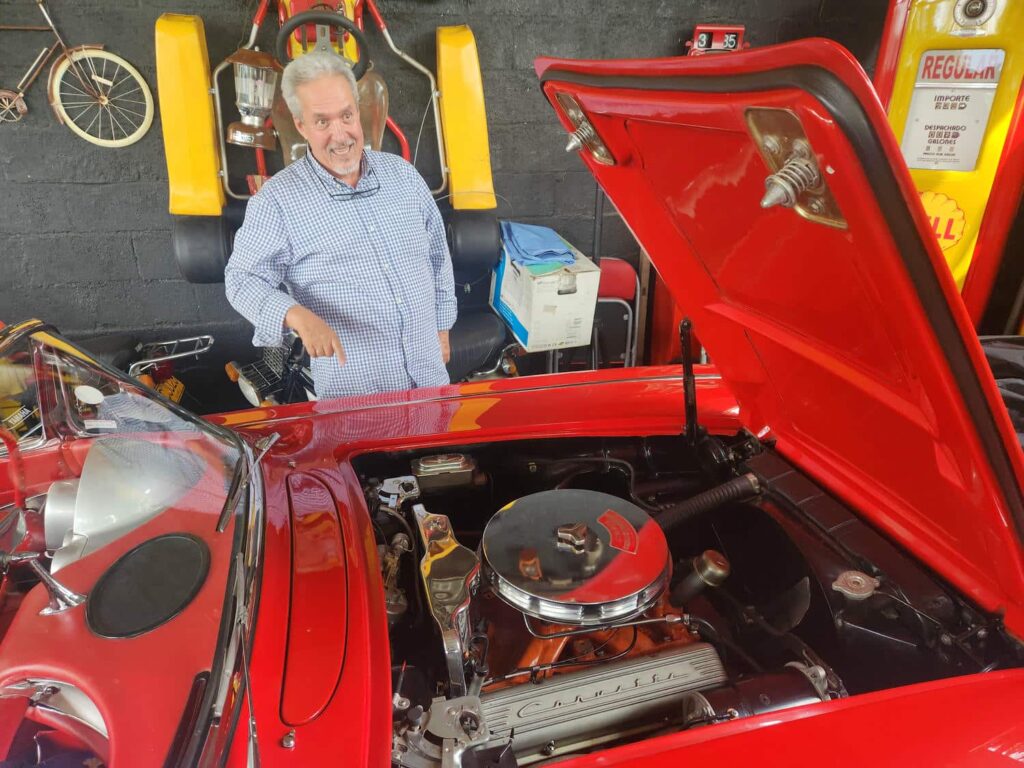

Carlos employs a man named Victor to wash and wax his cars, and he insisted on having him wash the jeep as well- we’d been meaning to get a carwash anyways, and after a bit of protesting, Carlos won us over. Victor did an incredible job- the jeep didn’t quite look like a 1967 Corvette, but close! Carlos also noticed that our front license plate holder had been damaged- we’d lost a bolt to it in our debacle being stuck in the mud hole up at El Cocuy. He told us he’d find a replacement for us, and have it when we passed back through southern Medellín. It was a fantastic afternoon, and we made a great new friend. Hopefully he comes and visits us in Alaska someday!
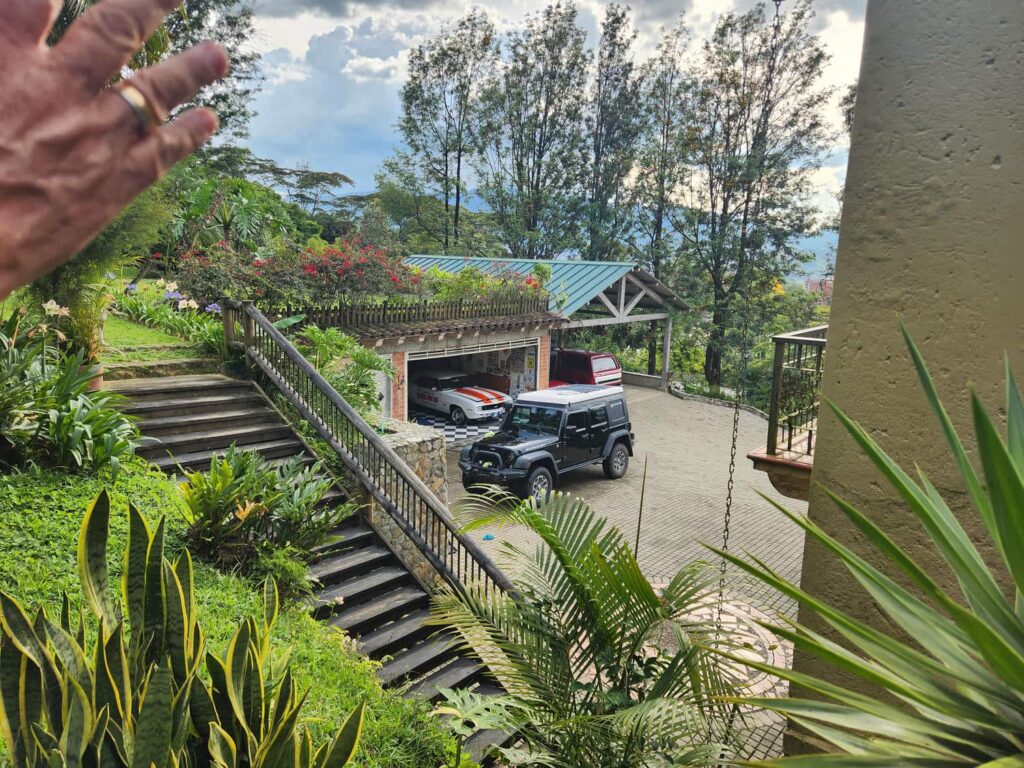
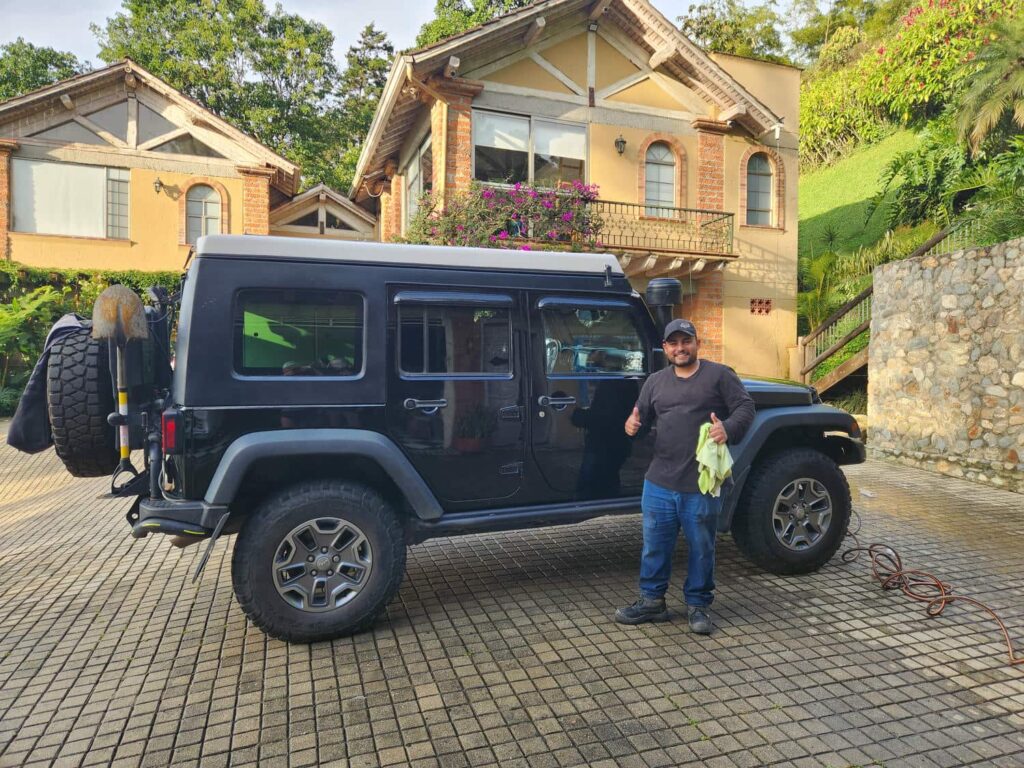
What had been a 30 minute drive to get to southern Medellín turned into over an hour headed back north. We’d told Bri and Tevin that we’d be back at 6pm for another surprise with them, and we were unfortunately 15 minutes late. The traffic was absolutely crazy. We finally arrived to the meeting point, and joined them for a surprise cooking class! We learned how to make a local drink with the Lulu fruit, mint, sugar, ice, and water. It was quite delicious. We also made empanadas, which are like mini calzones with all sorts of different fillings, and arepas, which are cornmeal cakes. I enjoyed it much more than I thought I would, and we’ll probably do another one further south. We spent three nights with Bri and Tevin, mostly relaxing. We’d go out and get a late breakfast, come back to their apartment and hang out, and then go out again and get dinner. We did finally find an excellent pizza place, which turned out to be quite popular- we had to wait half an hour to get in, which we haven’t encountered at all in Latin America! We did have a small misfortune while at their apartment- we had parked in the built-in parking garage at the bottom floor, which was very tight- too tight to turn around in, and barely big enough to back out of. While backing out, we accidentally caught the edge of a small tile stairway with a tire and broke a tile. We were a bit concerned about how expensive it would be to fix, but after letting the building maintenance people know they said it would only be $60! We are continually grateful for how cheap things are here.


We did go out to do the Metrocable again- I’d done it with Dominic and Pia, but no one else had yet. It was mostly uneventful until we were changing trains at the main downtown station to get back to the station closest to the apartment. We were in line with a bunch of other people waiting for the next train, who all started pushing us from behind when it showed up. At most stations, only one side of doors opens on the train, but at this one, a much busier station, the exit doors open first, then the entrance doors. In the split second that both doors were open at the same time, I saw a young woman move quickly past us, and then Tevin in hot pursuit. In the commotion of getting onto the busy train, she had unzipped his pocket and taken his phone out. He’d thankfully noticed, and chased after her and grabbed her by the shoulders. She threw the phone down, and Tevin let her go and grabbed the phone, making it back on the train just before the doors closed. I thought it was quite bold of her to chose Tevin as a target- he’s a big guy and could have really hurt her if he’d wanted to!
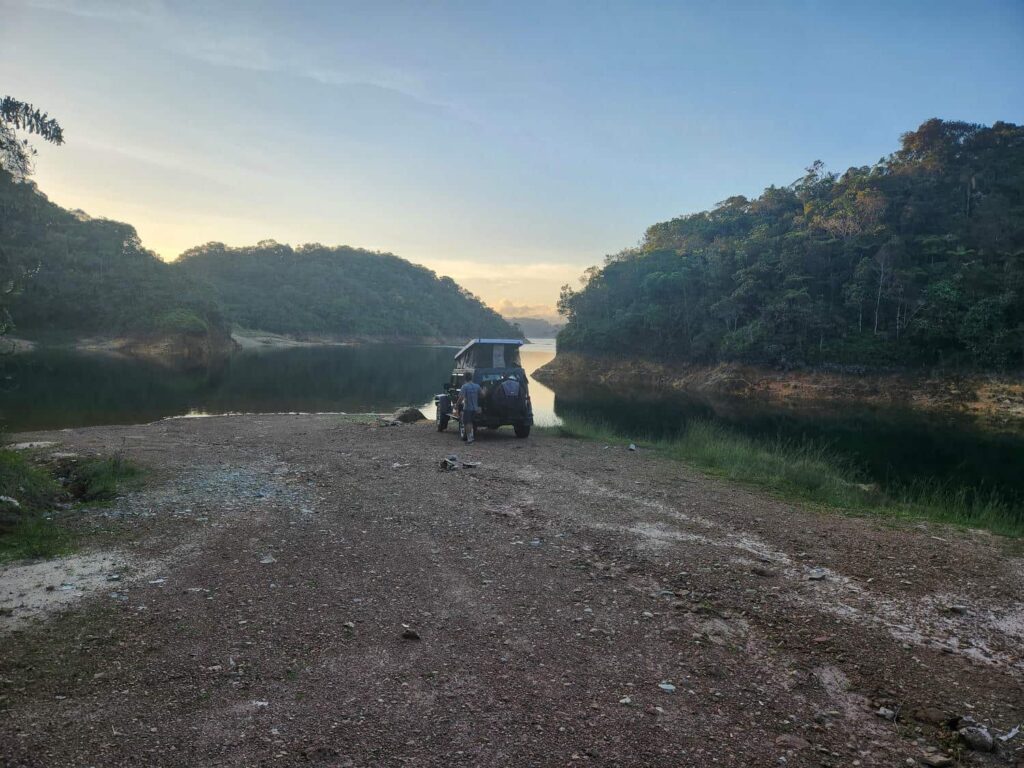
We left Bri and Tevin after three relaxing days, other than the pickpocket attempt. We were headed to Guatapé, just northwest of Medellín. It is a big local tourism destination, and for good reason- there is a massive water reservoir there, with all sorts of little bays and coves. There are all sorts of restaurants, tours, jetski rentals, and vacation homes. Pablo Escobar famously owned a massive house on the lake. There is also the Piedra del Peñól, also called El Penon de Guatapé, in English the “Rock of Guatapé”. Two neighboring towns, Peñól and Guatapé, both claim the Rock as “their” tourist destination! The rock is a massive granite outcrop, formed from a large bubble of rising magma which solidified into rock that resisted erosion much better than the rock around it- very similar to Vedawoo in southern Wyoming. The monolithic stone rises more than 700ft above the surrounding terrain, nearly as tall as Devil’s Tower in Wyoming, and can be seen for miles around. We drove past the rock and on to a campsite that Dominic and Pia had recommended, right on the lake. It was a great campsite with a cool breeze off the lake, a great view, and some solitude for our first camp in two weeks. It felt so good to be sleeping in the jeep again! It really feels like home for us. We slept in a little bit before heading back to Guatapé to visit the Rock. It is a real tourist trap, with all sorts of street vendors and trinket sellers, and even a mini-mall at the base of the rock. The whole property is privately owned, and has been by the same family since the 1930s when the bought the land, recognizing its tourism potential. It is rumored that Escobar himself tried to buy the property, but instead developed a friendship with the owners when they politely declined to sell.
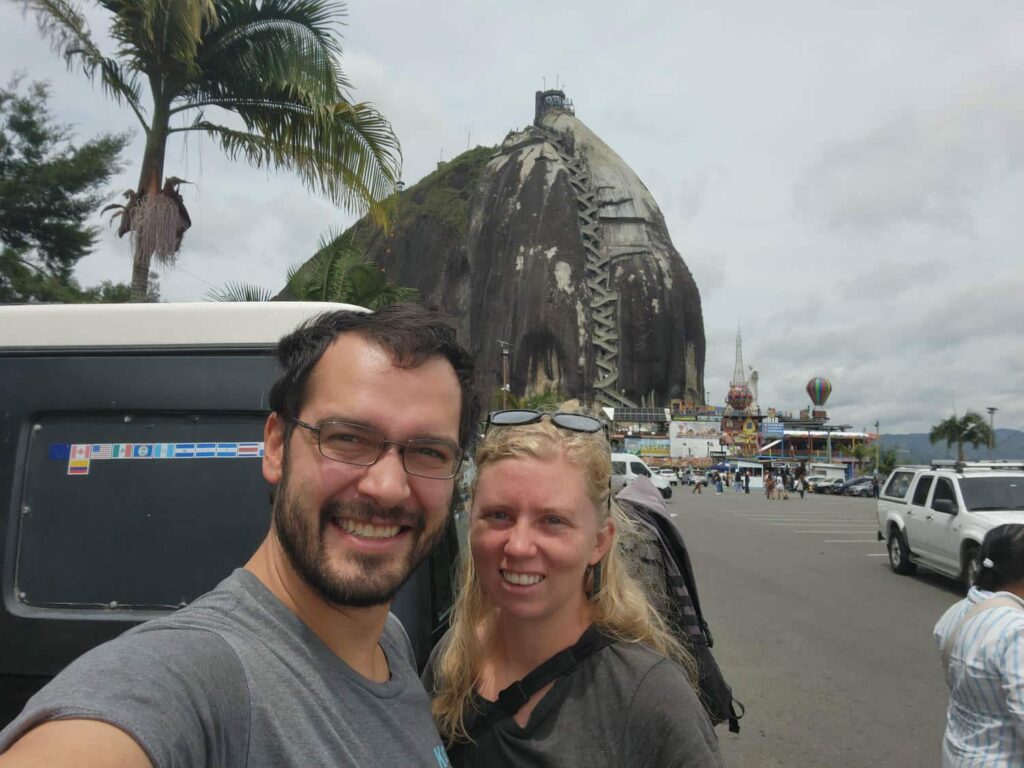
The main reason that the rock is such a tourist destination is that it can be climbed. The first accent of the rock was similar to the first ascent of Devil’s Tower- a daredevil spectacle, complete with crudely built wooden ladders. Nowadays, two massive interweaving concrete stairways have been built up a small imperfection in the rock’s otherwise smooth surface- one for going up, and one for coming down. We paid our entrance fee and began heading up. Some friends of ours timed their ascent, and we were determined to beat it! The 700-odd steps (the equivalent of a 45-story building) took us around 10 minutes to go up, even slowed down by the hordes of other tourists headed up. The view from the top of all the bays and coves of the lake was fascinating. We could see tons of jetskis and other types of boats cruising around the lake, as well as all the vacation homes. We wandered around the top for a while, checking out the view in each direction. Climbing back down the Rock was much faster than going up! We drove back to the same campsite again, relenting and buying our new favorite Colombian treat- Fresas con Crema, strawberries and cream, from a street vendor. Dan and Patricia had introduced it to us at Los Estoraques, and we’ve found it everywhere in Colombia.


Later that day at the campsite, I had a chore I’d been putting off for a bit- rotating the tires. I’d decided to do it myself rather than have the mechanic do it, as I have a specific rotation pattern that I use, and it had been difficult enough to figure out what a “tie rod end” is in Spanish. Plus, I wanted to make sure they hadn’t tightened the lug nuts too much! It is a good thing that I didn’t have them rotate the tires- I could only get a couple of the lug nuts off, and only one of the four “locking” lug nuts we have, one on each tire. The shop had over-tightened them so much that I ended up breaking my 18″ ratchet, slightly bending the tire iron that comes with the factory jack, and then breaking the locking lug nut key trying to get them off. We would have been in quite the pickle had we gotten a flat tire in the middle of nowhere- I couldn’t get a single tire off! The next day, we drove back into Medellín as planned to meet with Carlos again. Instead of taking the jeep back to the same mechanic, we just went to the jeep dealership in town. I should have gone there first- not that the jeep shop I’d gone to had been unprofessional (other than over-tightening the lug nuts), but this place was a much more modern shop. They were happy to have us come right in- in fact, most of the mechanics dropped what they were doing to come look at the “foreigner’s” jeep! They were blown away that we’d driven it there from the U.S., and immediately got to work removing the lug nuts. They were able to get all the normal lug nuts with a larger breaker bar, but they had to weld new nuts to the locking ones to be able to get them off. We’d bought a second set of locking lug nuts ages ago, intending to swap out the ones we had the next time we rotated the tires, so we were able to replace the old locking ones immediately. I made sure that I was able to loosen all the lug nuts with my surviving smaller ratchet before we left the shop. The lead mechanic there didn’t even want to accept any money, but he was very grateful when I insisted on paying him the equivalent of about $30USD. We were so glad to have this problem solved in such short order.
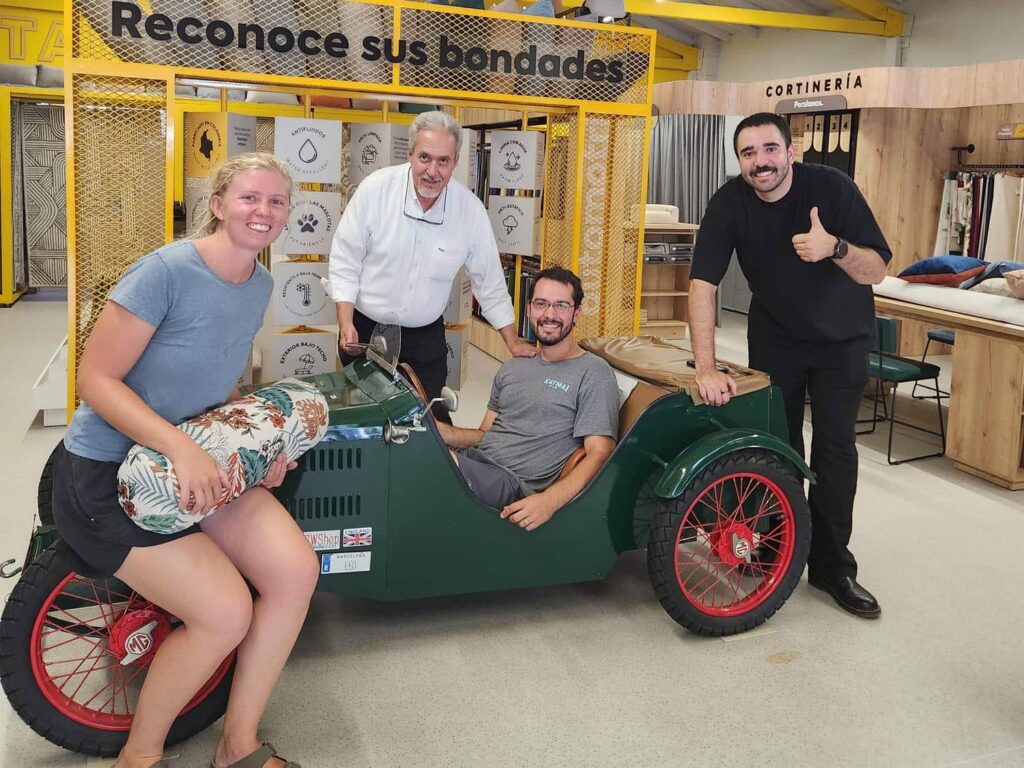
Our next stop was to see Carlos again. He really wanted us to meet his son Gabriel, who spoke great English and had dreams of doing some sort of international trip someday on a motorbike. We met Carlos and Gabriel at their fabric showroom in southern Medellín. Carlos immediately got to work on reattaching our front license plate- he’d gone out and found a very long and narrow bolt which fit perfectly. Gabriel told us that he’d been stressing out about it all day! They then showed us around the showroom. There were over 800 fabric samples there, mostly for commercial use- from heavy canvas to flowery outdoor furniture coverings to fabric for sailboat sails. It was a dizzying assortment of colors and textures. They had some small throw pillows that they used for demonstrating the different fabrics, and offered us one. Delaney picked one out, which has become quite nice as an additional pillow for our “upstairs” bed. We then sat down for a quick coffee and chatted about Medellín, Colombia, and our experiences traveling Latin America. I really hope that they come to Alaska someday, and if we are ever back near Medellín, we will definitely visit them again.
We sadly left Carlos and Gabriel and headed south out of Medellín. It had been a really long day already, and a massive rainstorm started up as we were leaving. We couldn’t resist stopping at a Papa John’s pizza on our way out of town! It was quite strange to see one in Colombia, and it was a great late lunch for us. Unfortunately, with U.S. pizza comes U.S. prices, definitely the most we’ve paid for a meal in a while, even eating at all sorts of restaurants in Medellín the last two weeks. We drove south in the rain and found a campsite at La Playa, a small tourist attraction with a swimming hole and some waterfalls. It wasn’t very busy with the pouring rain and chilly weather, and we found a great spot further up the creek from the swimming hole. We had a peaceful night, and we watched some workers the next morning harvesting gravel from the riverbed. It is fascinating how they do things here- labor is so cheap and equipment is so expensive. The workers arrived, about 6 in total, riding in the back of an ancient dump truck. They parked the dump truck in the river and got to work throwing shovelfuls of gravel from the riverbed into the dump truck. It took them about two hours, but they filled it all up by hand and drove back off, with the workers sitting on top of the gravel in the back of the truck. We left not soon after they did, and got back on the road.

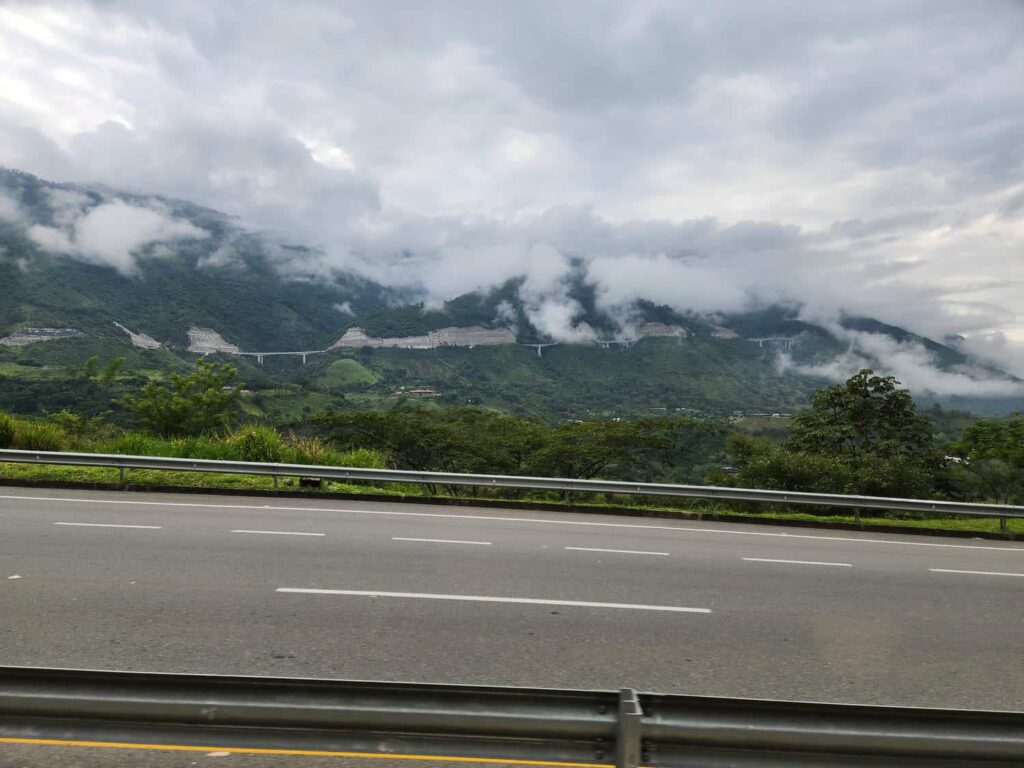
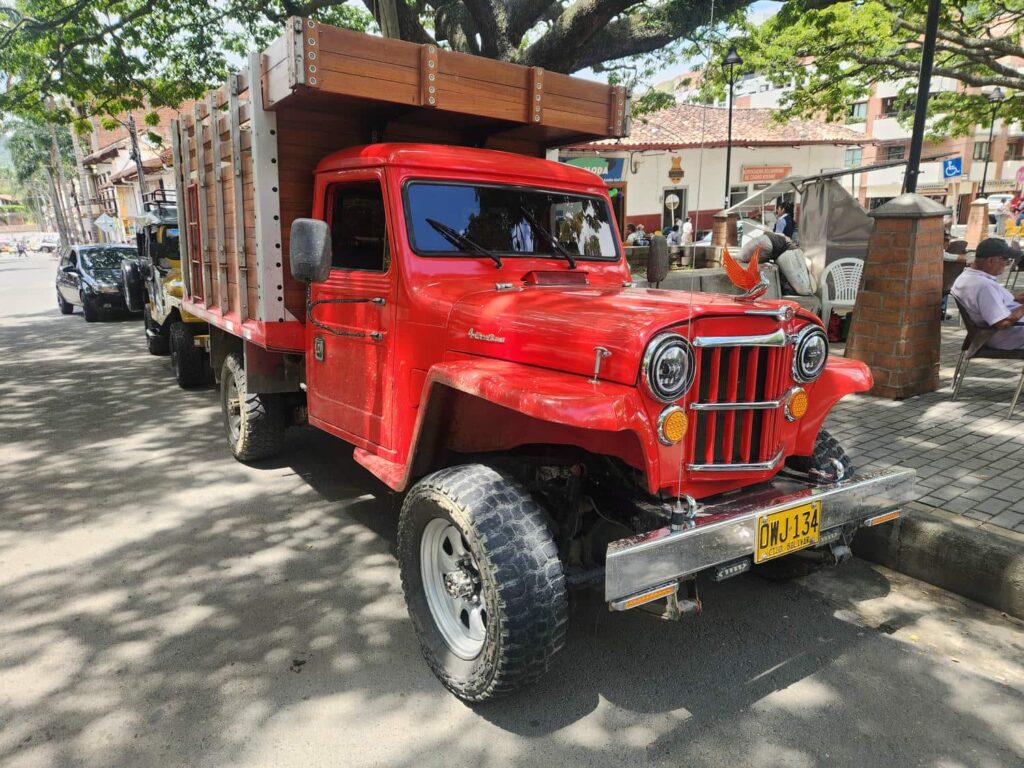
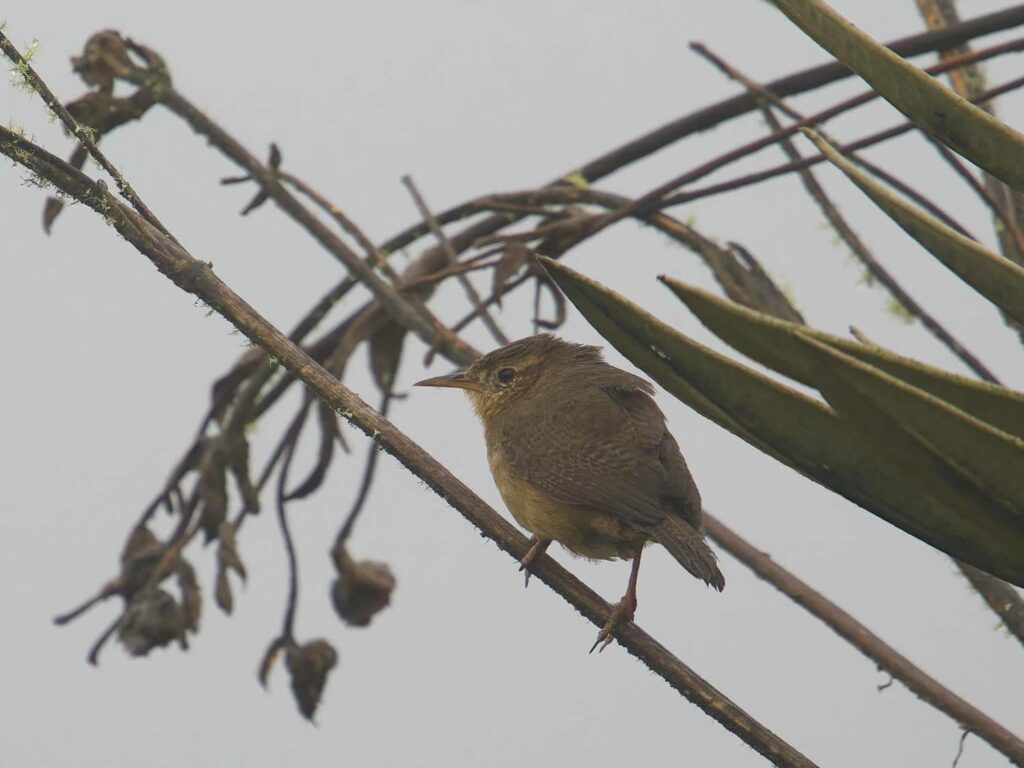
We were headed to Ciudad Bolivar to meet Diego, a friend of Carlos’s who had a Landcruiser and had traveled in it all over Colombia. The road we were driving on changed rapidly- one moment it was a normal two-lane country road, the next moment a narrow back road riddled with potholes and patches, and the next moment a massive interstate highway. It was clear that they were spending a lot of money to improve the road- most of the highway was under construction, complete with huge bridges and long cantilevered stretches along cliffs. We stopped briefly at two different places to find a rare bird (the Antioquia Wren), and continued on to Ciudad Bolivar. We arrived a bit before we’d planned on meeting Diego and his wife, so we drove into the city square to walk around a bit. The city square was gorgeous, one of the most beautiful we’d seen so far. There were huge, broad trees creating shade for most of the square, and tons of tables and chairs for people to relax on. The square was surrounded on 3 sides with restaurants and shops, with the fourth side being a gigantic church, as is usual for city squares here. One of the shops surrounding the square was “Alaska Ice Cream”- we told the shop owner we were from Alaska, and I don’t think he knew what Alaska was other than a brand of ice cream! We’ve seen it in stores on and off.

After walking around the square for a bit, it was time to go meet Diego and Vicky, friends of Carlos. Their house was right outside of town, a gorgeous estate with horses, coffee plants, and a beautiful house with an interior courtyard. Diego had been a Mechanical Engineer in both the steel industry and the fuel industry, and now they owned a large coffee plantation on the other side of Ciudad Bolivar. They had traveled all over Colombia with their 70 series Landcruiser, and had dreams of driving to Bolivia someday. They took us out to lunch back at the city square, at a place called El Taller- “The Workshop”. They had all sorts of old automotive memorabilia on the walls, including license plates from around the world. There were plenty of U.S. plates, but no Alaska! The meal was a delicious traditional soup with beans, rice, sausage, and pork. We said our goodbyes and headed further west up the hill to the east of town.

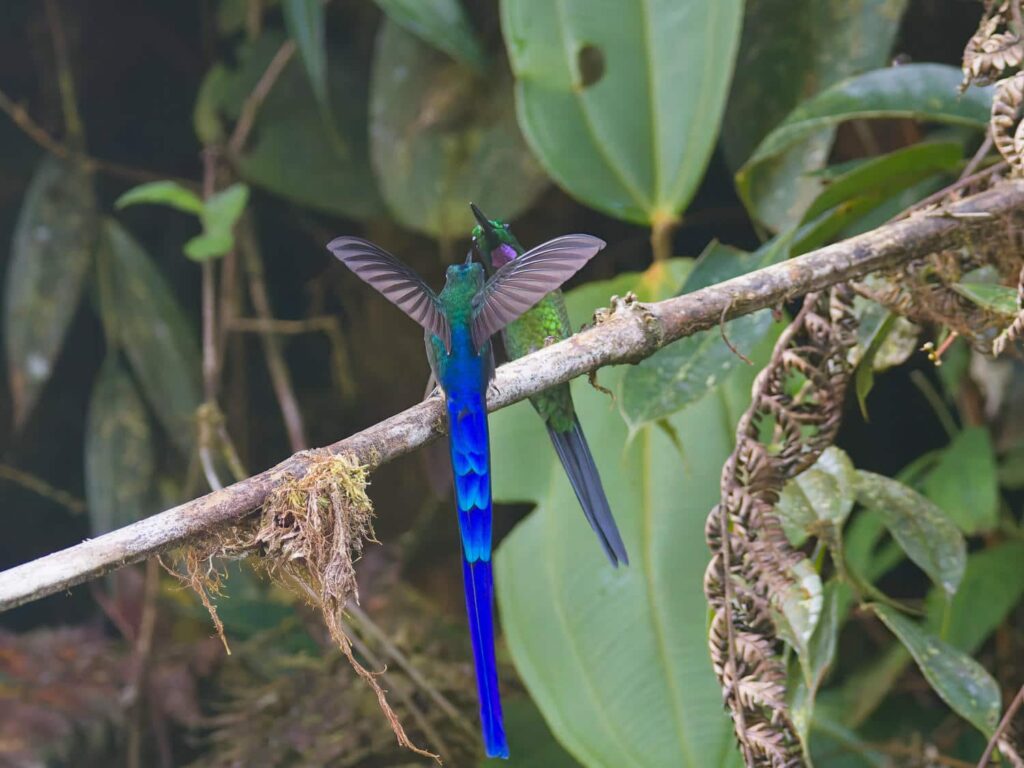
We descended down the other side into a pristine cloud forest, and drove up a back road into Reserva Las Tangaras, “Tanager Reserve”. We spent two idyllic days there at a roadside pullout. There was very little traffic, the temperature and weather was perfect, and there were tons of birds! There were some hummingbird feeders a few hundred yards from our camp spot, and I spent quite a few hours there, watching them buzz around. We only found one of the two rare tanagers (a type of bird) that the reserve was protecting, but we had a spectacular time there. On our second night there, it poured rain all night.

In the morning, while we were making breakfast, a young women on a motorbike rode by, and then returned shortly afterwards. We flagged her down, and she said that there had been a huge landslide on the road and that no one could pass- the only way out! We gave her access to our Starlink for a bit so that she could alert the correct people. Before she left to go back to the small town at the end of the road, she showed us a picture of the landslide- it was only a bit of dirt and a medium-sized tree across the road, which we were confident we could drive across.


We must have misunderstood her talking about a “huge” landslide with our terrible Spanish- or she had over-exaggerated it by quite a bit. We packed up and drove down, expecting to have to pull the tree out of the way with our winch and maybe winch across the landslide, but by the time we had gotten there half an hour later it had already been cleared, tree and all! Delaney and I have talked about what might happen if we got stuck behind a landslide on a dead-end road, but the locals in the more landslide-prone areas seem quite adept at clearing them quickly.


After getting back down to the highway, we drove back through Ciudad Bolivar, and took a back road through endless coffee plantations. It is incredible how the coffee is planted on incredibly steep hills, and then all cultivated and harvested by hand! It is an incredibly labor-intensive crop, but it must be quite profitable as the farms are everywhere in the correct environment. We eventually arrived at the town of Jardin, which several people had told us that we had to visit. We found a great paid campground on the north side of town, and settled in for what we thought would be a night or two. We ended up spending four nights there! The first afternoon, we visited “Jardin de Rocas”, or “Rock Garden”- a reserve for the iconic Andean Cock-of-the-Rock, a bizarre bright red bird. The species breeds by “lekking”, in which the males all gather in one location to display, and the females watch and choose which one they like the best. These lek locations are relatively static year-to-year, and can last for decades, and there is evidence of some other lekking birds (ptarmigan, grouse, etc) using the same locations for centuries. Jardin de Rocas was built around a specific Cock-of-the-Rock lek, and is one of the best places in the world to see them- despite being bright red, they are almost impossible to find away from their leks! It was a beautiful place, with all sorts of flowers and trees, as well as a well-stocked coffee shop. There were around 10 males around us the whole time, squawking away.


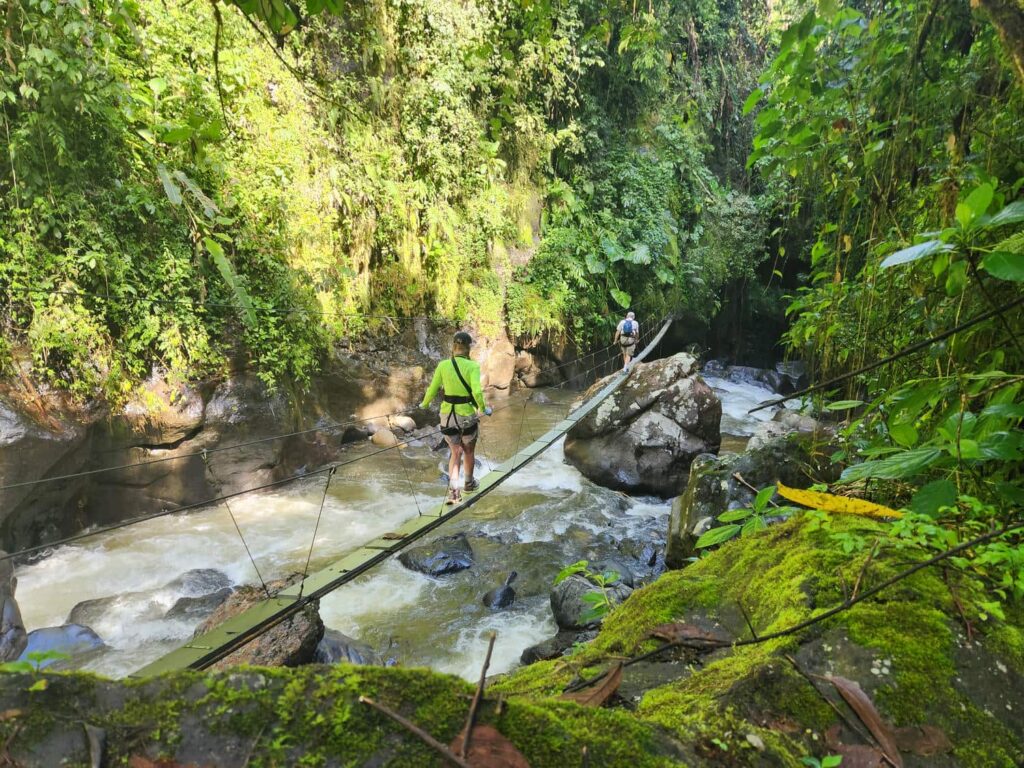
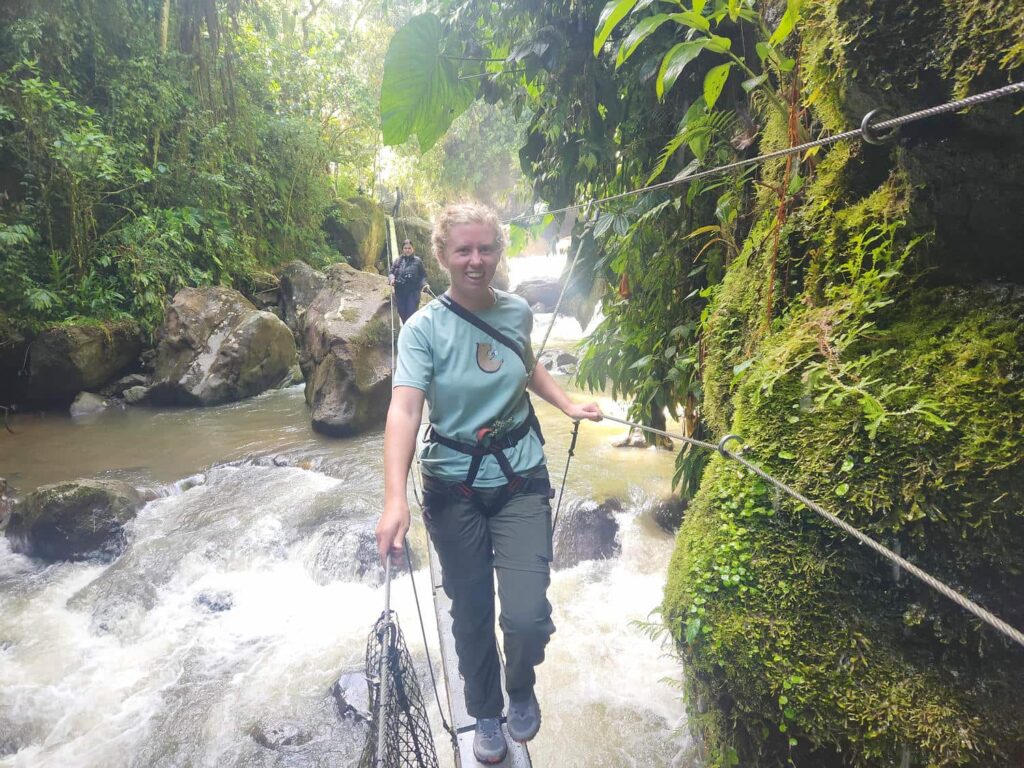
While we were there, we ran into Andrew and Anne, a retired couple from Canada. We were going to another birding spot tomorrow, just next to our campsite, and they were interested in joining us! We met the next morning at Reserva Los Guacharos, and spent the morning watching all sorts of birds come in to a fruit feeder as we got to know Andrew and Anne. Andrew was a retired lawyer and Anne was a retired environmental professional. They now lived in Vancouver and were enjoying all things outdoors in their retirement. We connected quickly, and had many great conversations together. After a few hours of drinking delicious Colombian coffee, we hiked down to the river with the property owner, before we put climbing harnesses on and crossed a super narrow cable bridge. The bridge crossed a raging river in a tight and narrow gully, and led to a small platform built into a cliff on the other side of the river, before the river really necked down into a slot canyon.
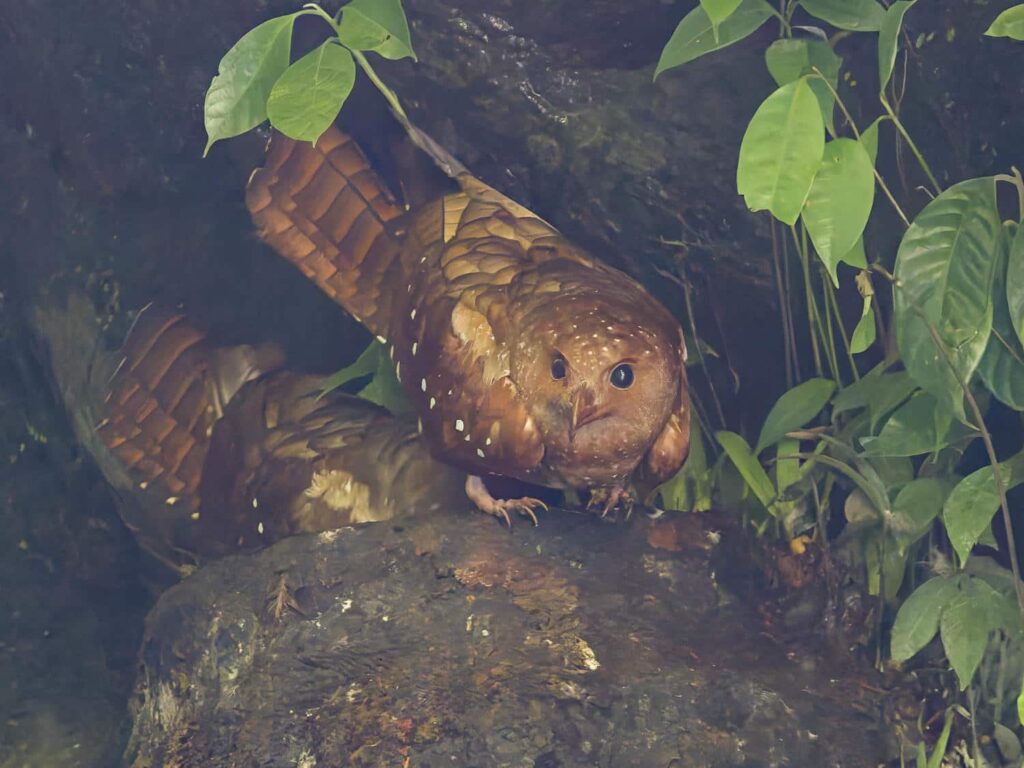
The platform had been built to view Oilbirds, a unique nocturnal bird that we’d seen near Barichara in a sinkhole. This was a much better eye-level view of it, and in a much more interesting environment! We all hiked back up to the top, and watched the birds for a while longer before wandering off in search of lunch. We found a small restaurant up the road with a great view, but uninteresting food. We went our separate ways, with us returning to the campground and them heading into Jardin to their hotel. We met up later that night for dinner at a small pizzeria, and continued the earlier conversations. Anne is hoping to visit 7 South American countries in 7 years, and is on country and year 3/7! Andrew is incredibly well-traveled, having traveled around the world in the 80s. He had endless stories of various shenanigans in out-of-the-way places around the world, including South America, the Middle East, and Southeast Asia. We were never left wanting for more to talk about!
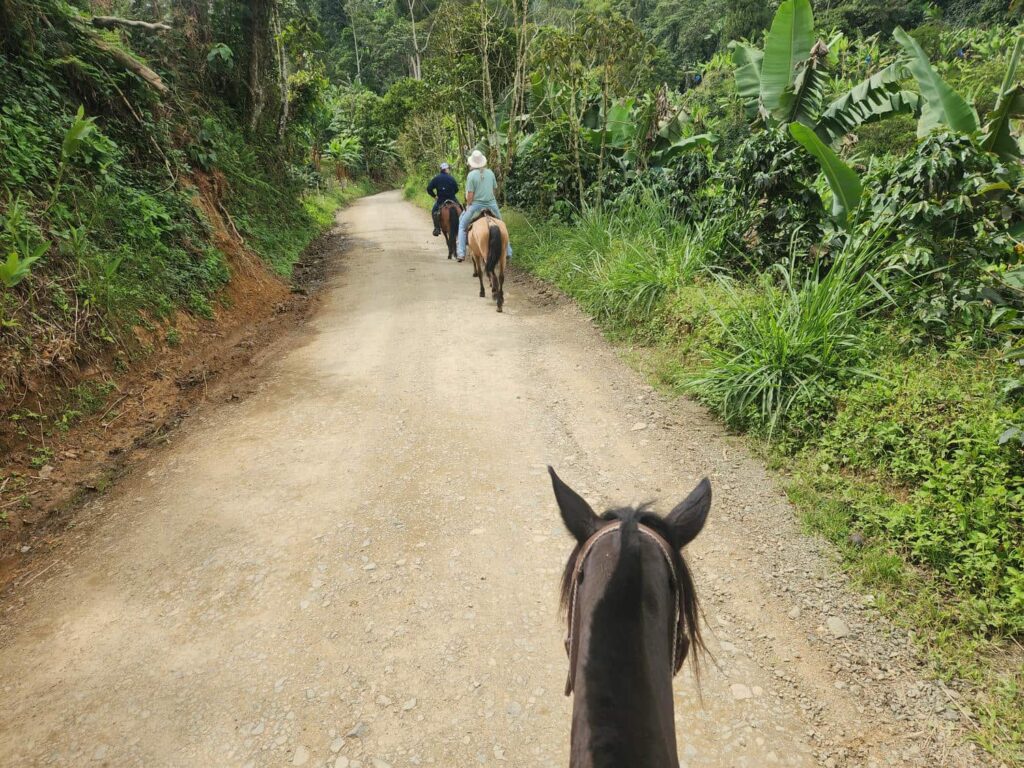
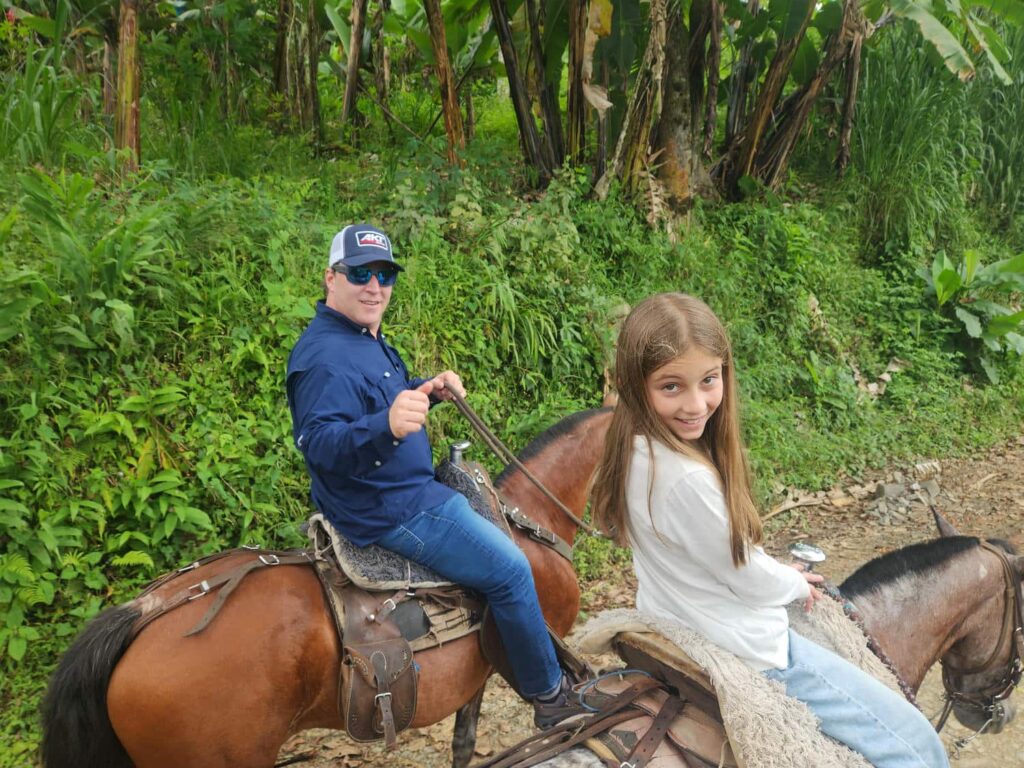
The next day was Delaney’s birthday, May 16th. I’d been trying to come up with a surprise for her for a few weeks, and had really struggled. We are on the trip of a lifetime, doing all sorts of cool stuff that we’ve always dreamed of doing. What could I possibly surprise her with? Fortunately, I’d seen a tourism office in Jardin while looking around Google Maps that offered horseback riding tours. That was it! I’d contacted them a week ahead of time, managed to sneak away from camp long enough to run into town and prepay the day we’d arrived, with Delaney none the wiser. She did eventually guess what we were doing after telling her what to wear for the day, as well as having seen tons of horses around town, but it was still an awesome surprise for her. I’m really quite terrible at surprises, but this one worked out very well. We walked down to the office and filled out the obligatory liability paperwork, before hopping into one of the Frankenstein jeeps that were ubiquitous around town- old CJ-5s and CJ-6s with Nissan diesel engines and Ford 1-ton rear axles. We’ve seen them all around Colombia, and Diego in Ciudad Bolivar had finally explained what the deal was- they had been super cheap in the 60s and 70s, and Colombia had imported tons and tons of them for use in the coffee industry, hauling workers and bags of coffee beans up and down the insane hills of the coffee plantations. The engines and axles had not quite been up to the task, so they’d been replaced with diesel engines from old Nissan Patrols (apparently the rest of the Patrols weren’t good enough for coffee work) and the rear axles from old Ford trucks. The front axles had either been left stock or been replaced with Toyota Landcruiser axles. The CJ-5s (the old short-wheelbase jeeps that many of us Americans are familiar with) had been extended to match the length of the much rarer CJ-6s. After having all of this explained to me, it was remarkable to notice how all of these “Frankenstein” jeeps were actually very similar to each other!
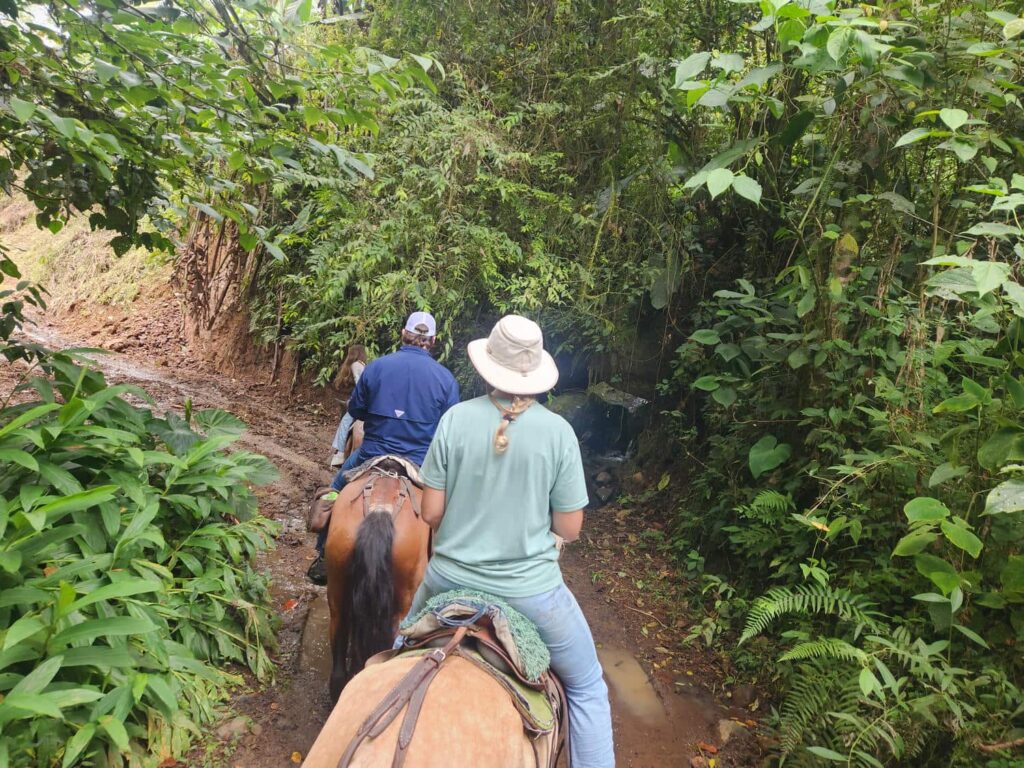
I digress. Also on the frankenjeep ride to where we would meet the horses was a Colombian family, Ricardo and Mariana, with their precocious 10-year old daughter Matilde. They all spoke great English, and we got on very well together. We met the guide, who came with two other riders, to make 8 of us total. We mounted our horses and headed off down the hill. We rode around the south side of Jardin for nearly 5 hours, and stopped at a swimming hole at a river, a beautiful viewpoint of the town, and a small restaurant for lunch. The two other riders had brought beers for the whole group, which we gladly accepted on the hot day. Who knows if drinking and riding a horse counts as a DUI in Colombia?
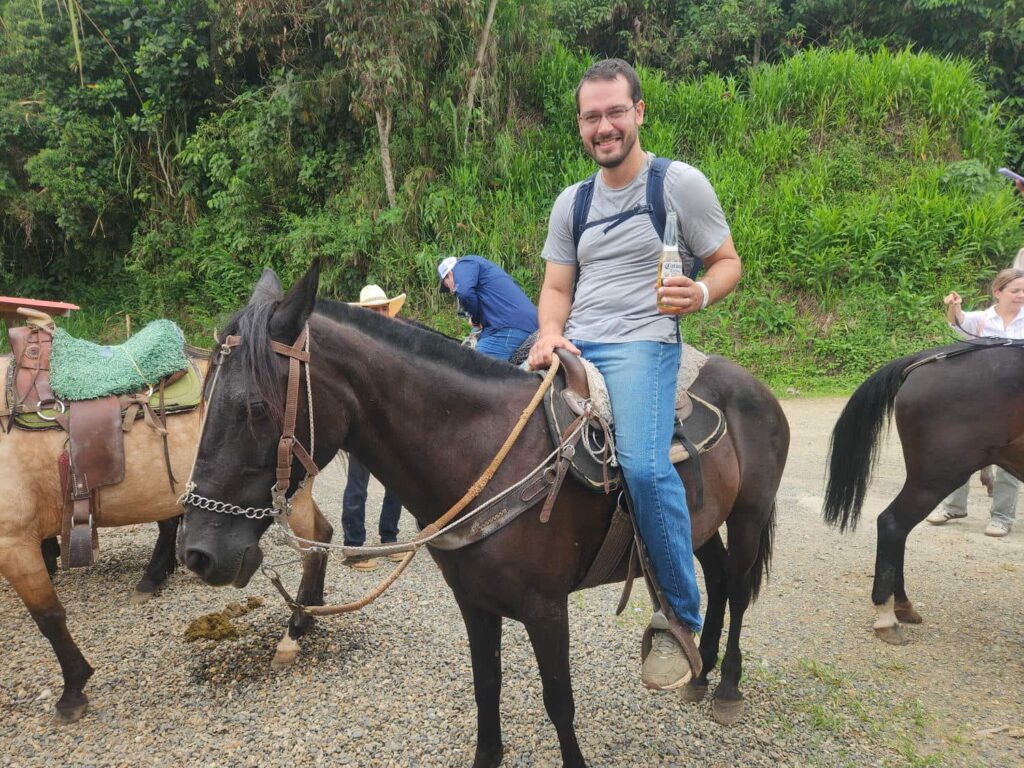

As we rode, we told Ricardo’s d family about our adventure, and they told us about their life in Medellín- Ricardo worked for a motorcycle company, and had started his own company with some friends on the side manufacturing coffee roasting equipment. They have been quite successful and now supply Colombia’s most prestigious coffee company, Juan Valdez, with roasters! Matilde was in a very demanding school, and was learning both French and English. Her English was already outstanding- she barely even had an accent. Our lunch was a fun time, with all of us sitting down at one table and talking together. We then rode down the hill back into Jardin. It was a fantastic day spent with good company, and I actually surprised Delaney for once!

We were pretty bushed after bouncing around on the horses all day, and didn’t do a whole lot until we walked into town once again to meet Andrew and Anne for dinner. We met at a small Asian/Italian fusion place, which had my favorite Asian dish- Drunken Noodles. It was fantastic! Delaney got Pad Thai and it was similarly great. We had another conversation-filled evening, before wandering back out to the main city square where they’d set up a massive concert. It was the anniversary of the town’s founding and they pulled out all the stops. It was a huge production with a massive stage. We saw a young child singing some 80s American Rock hits, and then a competition of who could sing the best rendition of what seemed like a folk song, but with different lyrics every time. It got quite repetitive after seeing 5 different people sing the same song, one after another!


We went out for breakfast the next morning, and I ordered a drink that I’d had a few times, cherry limeade. This one was fantastic and is now the bar by which I judge all fruity drinks. We then wandered into the city square again to see a parade that our guide at Reserva Los Guacharos had told us about. There were all sorts of different groups, from the police to the Jardin de Rocas reserve to the Catholic Church. We couldn’t believe how many people were there- the whole city square was full as the parade wound its way around the square on three sides. Later that afternoon we met up with Ricardo, Mariana, and Matilde again, who wanted to see the jeep- especially Matilde! She was entranced as Delaney showed her all the little things we’ve built into it- running water, the refrigerator, and our kitchen. We learned also that the three of them are headed to the U.S. soon to see Colombia play in the World Cup. They’ve planned to follow the team around for at least the first three games, and for as long as the Colombian team stays in!

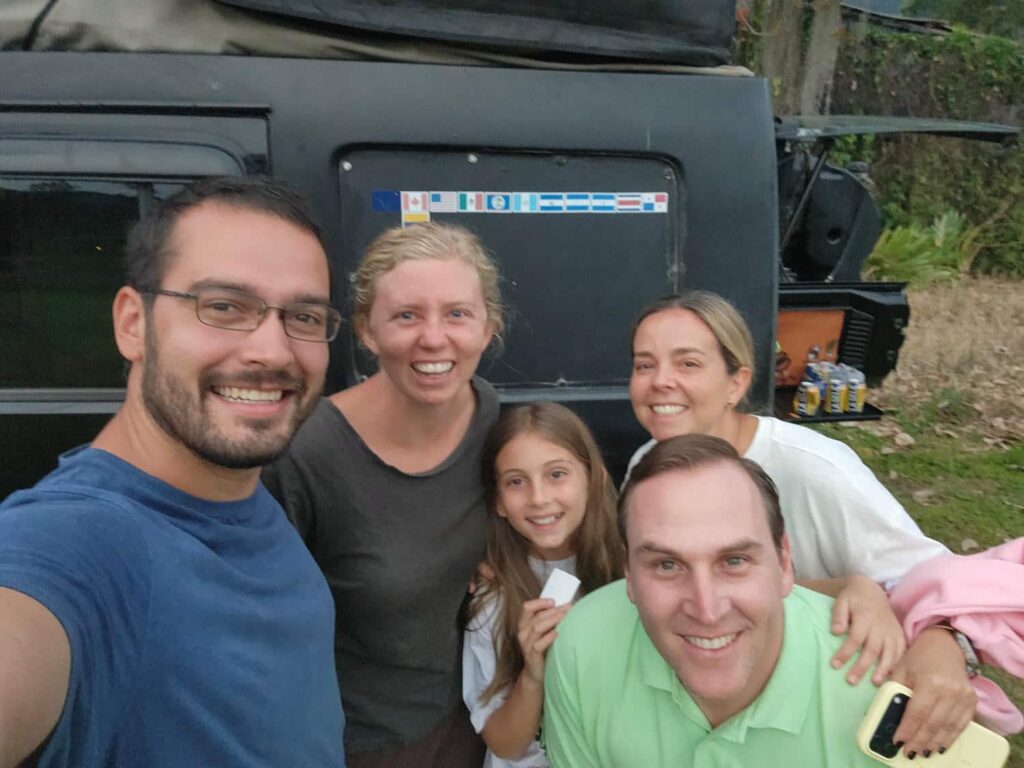
We had one final breakfast in town before leaving, and happened to run into Ricardo and family while walking in to town, so we made plans to eat breakfast together. We ended up at a small coffee shop where Ricardo explained to me the finer points of coffee roasting. He ordered a very special pot of coffee for the 5 of us, which was apparently quite fancy and only prepared that way in Colombia. Colombians all seem to be coffee fanatics, and it’s a shame that Delaney and I really have no taste for it at all. We’re often looked at funny when we tell people that we don’t really drink coffee! We had a great conversation about books that Delaney and I loved in childhood- Matilde is a voracious reader and her parents are always in search of age-appropriate books. We strongly recommended the Redwall series, which I’m sure they will get when they return from the World Cup! We said our final goodbyes and headed out of Jardin on a little-used back road. We drove thorough a torrential rainstorm on the bumpy road for most of the day. We camped near a tree farm, which had acres and acres of the same exact tree, laid out in a perfect grid. We’ve seen this for lots of pine trees as we’ve gone south, but not for deciduous trees as we saw here.

The previous night, I’d plugged in my laptop to charge it, and heard an unsettling “pop” and then smelled burning coming from the inside, beneath the keyboard. The laptop screen immediately went black and wouldn’t respond to anything. It was fried! I’m not sure if it was the laptop or my homebrewed charger- I later read that the laptop had some issues with motherboard failure, but then again, the charger that I’d built for the laptop (so I didn’t have to use an inverter in the jeep) was quite experimental. The black brick in a normal laptop charging cable changes the electricity from 120-volt alternating-current power to 19.5-volt direct-current power, so I’d just bought an adjustable voltage converter to boost the 12v power that the jeep interior runs off of to 19.5v, then chopped the laptop cord to plug into it. I’ll never know what did it for sure, but I was now without a laptop, and that was a problem! We drove down to Pereira, the nearest large city, which had a circuitboard-repair shop, but they were closed when Google said they’d be open. We changed some plans to try and visit them the next day, and headed up to Nevado del Ruiz, a large volcano.
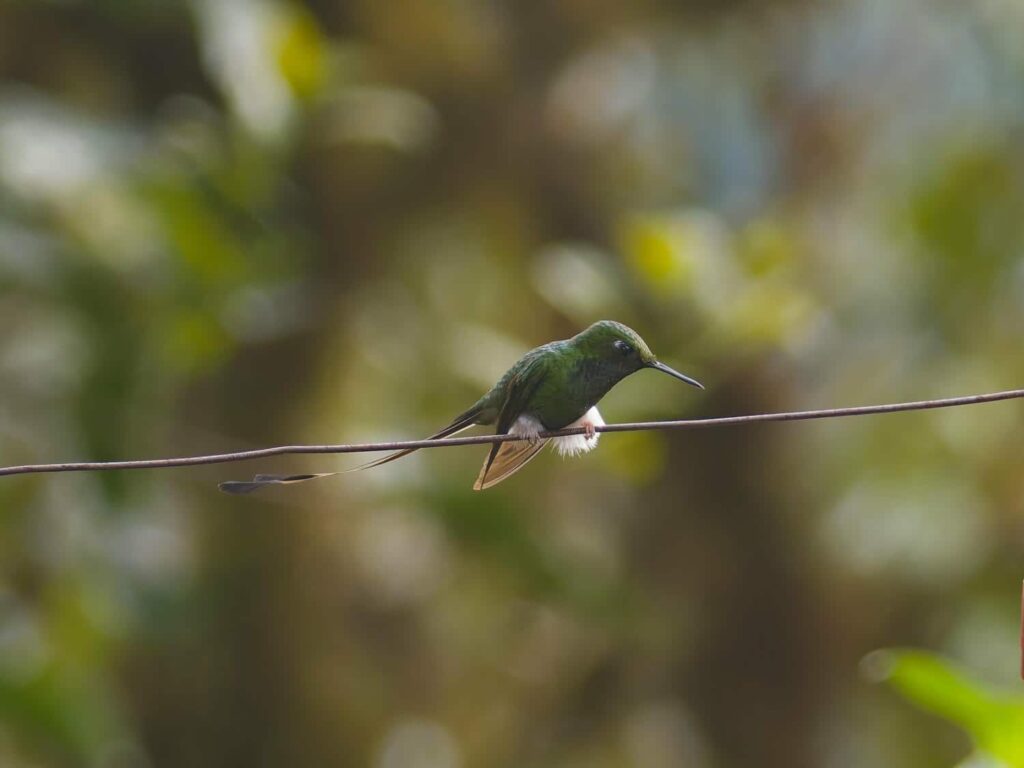
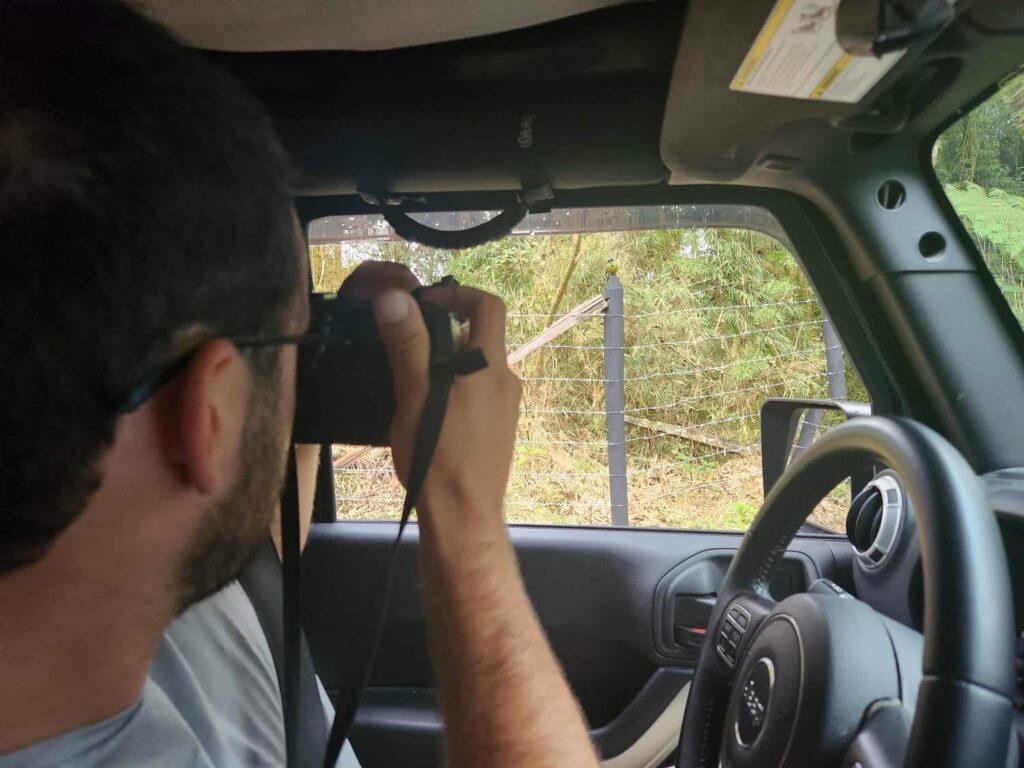
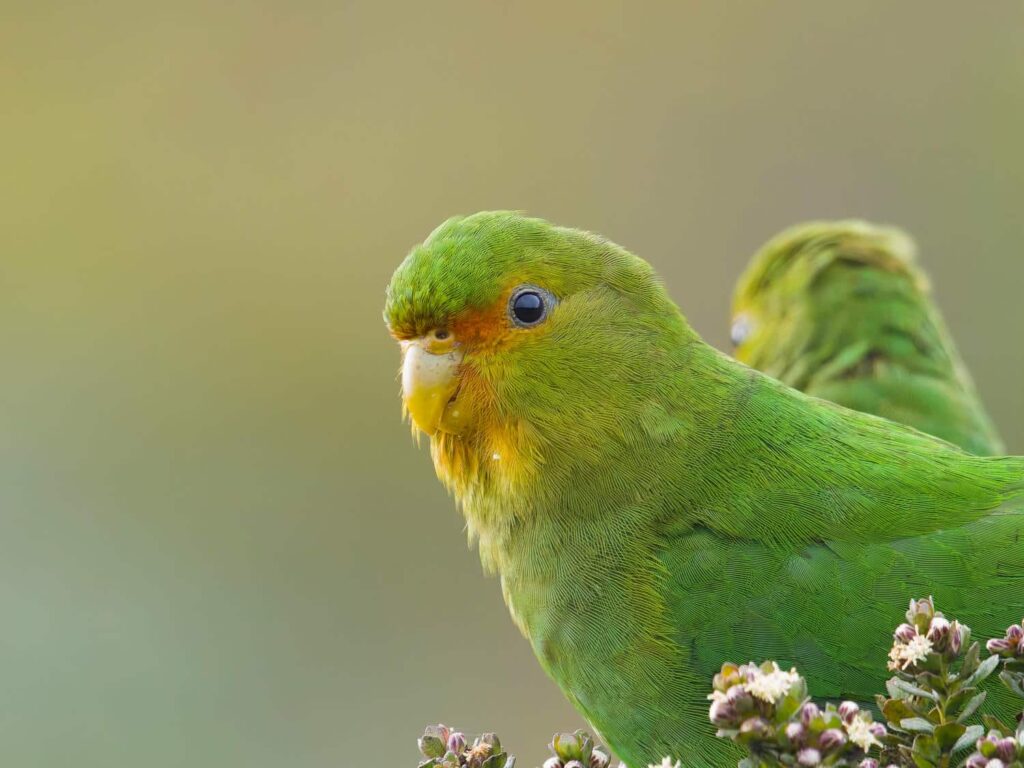
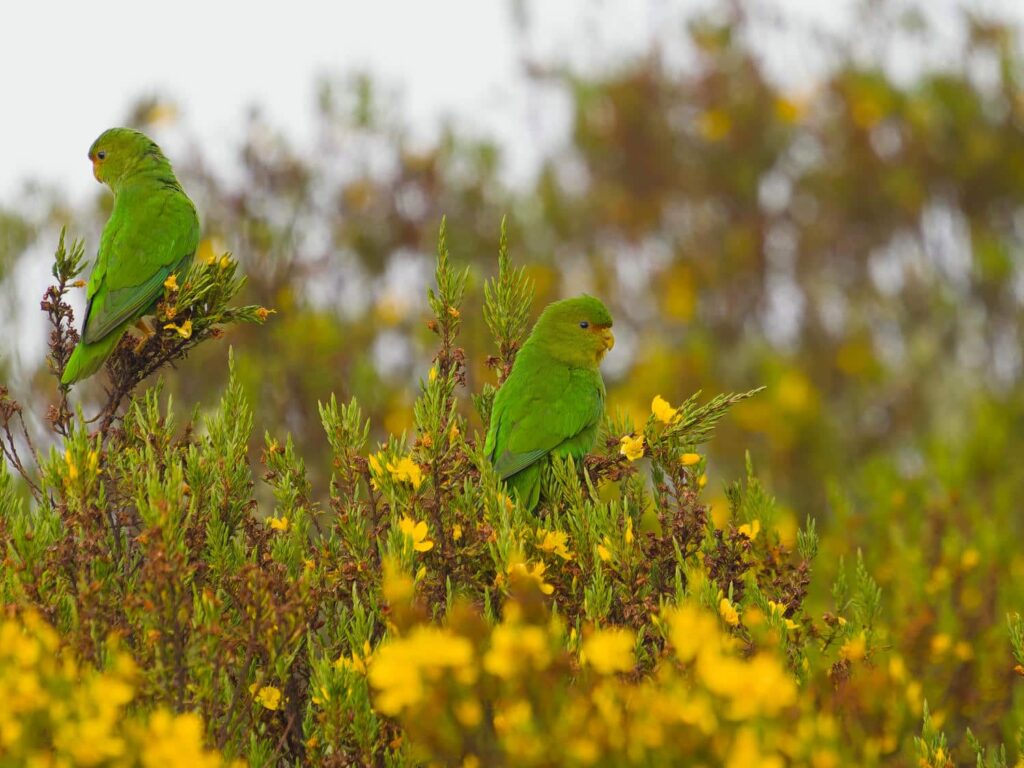
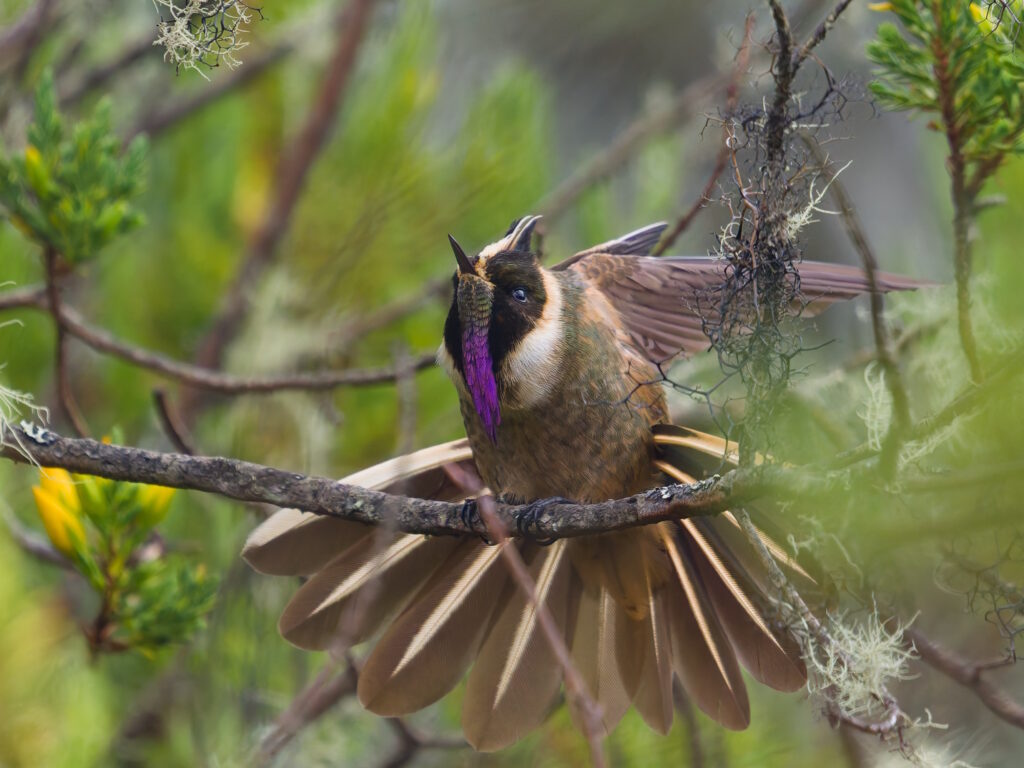
There was a bird I wanted to find here: the Buffy Helmetcrest. When I’d first gotten into birds, and learned about some of the rarer or more difficult-to-find birds in South America, this one consistently came up. It only lives in the high-altitude environment around this one single volcano. As an added plus, it looks really cool, so I just had to find it! We drove the winding road up the volcano and spent a few hours looking around at the frailejon plants that it feeds on. I spent an hour or two hiking around in a frailejon forest far off the road, without success. We found a good camp spot near a huge field of frailejons (that were unfortunately fenced off) and set up our chairs to sit and hang out with a beautiful view in front of us. We heard a loud squawking sound, and in came a small flock of another rare bird in the area that I hadn’t even though we had a chance of finding- the Rufous-Fronted Parakeet, which also only lives in this high-altitude environment. We watched them squawk and hop around the bushes right in front of us before they flew off. Five minutes later, a large van full of people with giant cameras pulled up, a group of birders on what I’m sure was a very expensive tour. They were here specifically to find the parakeets, and we sadly told them that they had just missed them. They said that this was the best place to find it!
They’d found the Helmetcrest earlier, up in the National Park, and told us exactly where they’d found it. Their guide then told us that if we went under the fence in front of us, walked about 50 feet, turned left, and then saw two frailejon plants, one taller than the other, that we would find it. He told us that it was fine to go under the barbed-wire fence. I figured if a local said it was OK, it was OK! We followed his directions, and were shocked when the bird was somehow right where he said it would be! I got some awesome pictures of it, which was an immensely satisfying experience- out of all the birds in South America, this was possibly the one I wanted to find the most!
We chatted with the birders some more before they headed off- they never saw the parakeets! They were quite jealous of our trip- it is quite a different experience to look for birds with guided tours from hotels versus being able to sleep right next to where you want to find birds in the morning. One of them was going to be guiding a trip in Ecuador the following month, and offered to give us some tips for where to find some Ecuadorian birds. We decided to still stay where we were at for the night, as it was a great spot in the middle of nowhere, and off the main road. In the morning, we headed down to Termales del Ruiz, a nearby hot springs that also had a bunch of hummingbird feeders.
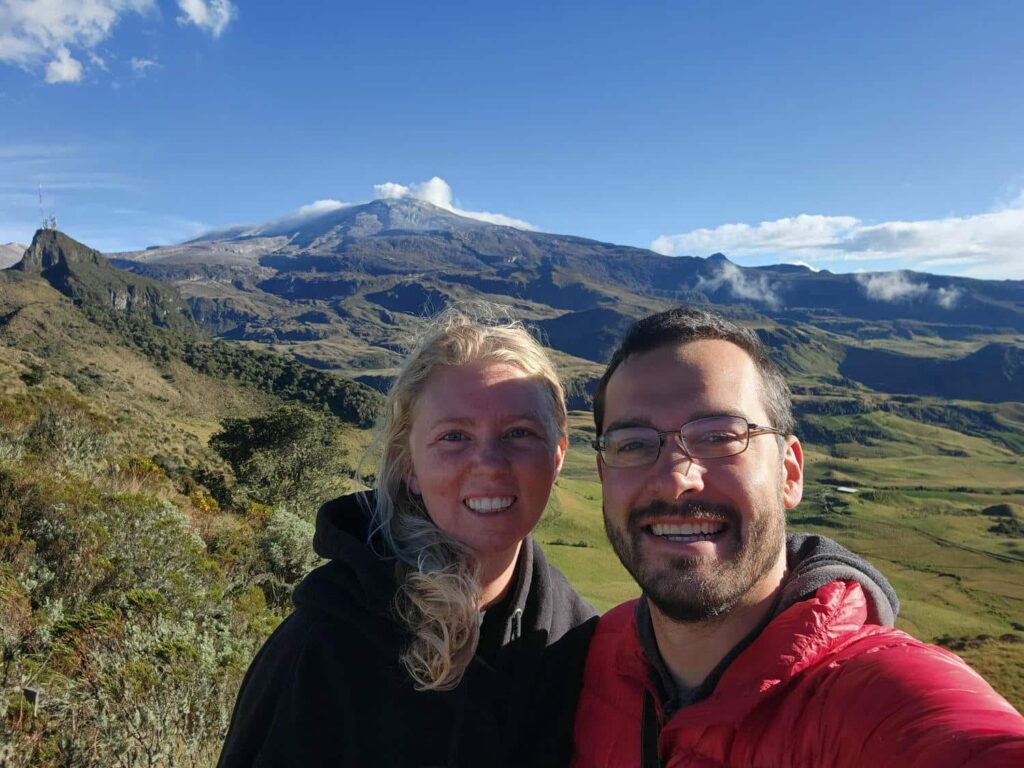

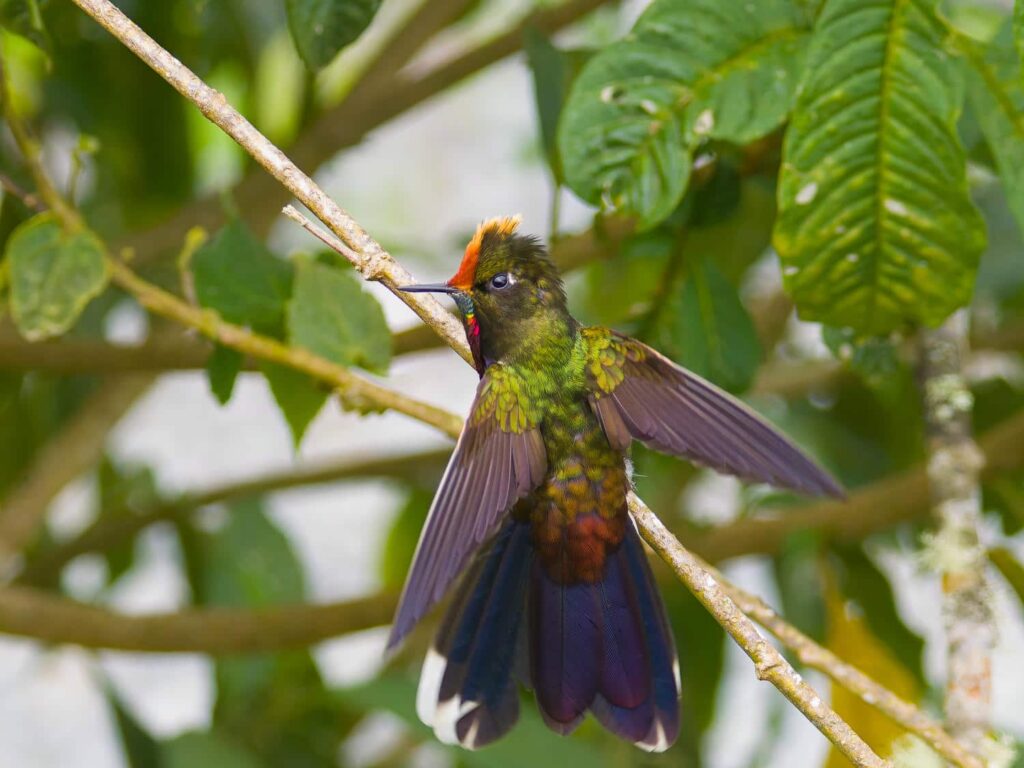
Right as we were walking in, who should be walking out but Andrew and Anne! They had come up here after their time in Jardin, and we stood in the hotel lobby for nearly an hour chatting with them. If we pass through Vancouver on our way back north I’m sure we’ll go visit them! We then went in and sat near the hummingbird feeders, watching the teeny birds zoom around in pursuit of nectar. There were a bunch of different species, most of them new to me! We also explored a gorgeous waterfall and hiking trail nearby. Our time with the hummingbirds finished, we headed down the road past the hot springs, which rapidly deteriorated. It was clear that this was the “old” road up the volcano, and maintenance had mostly stopped. We did make it through, but we felt bad for the other cars we met headed up!

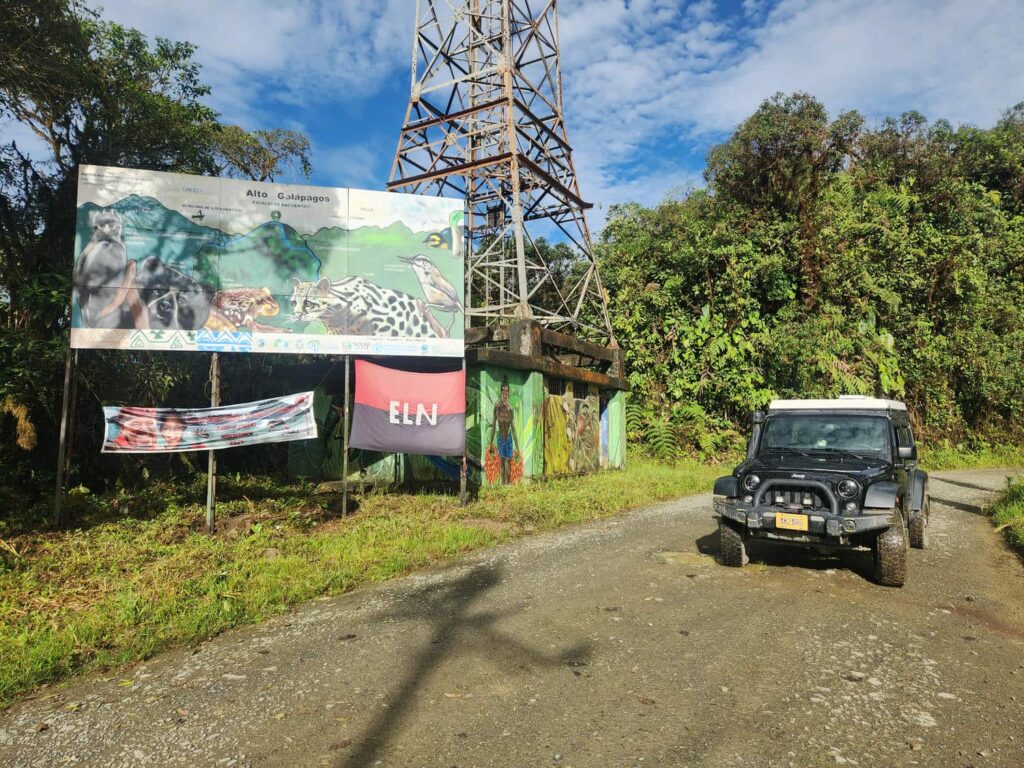
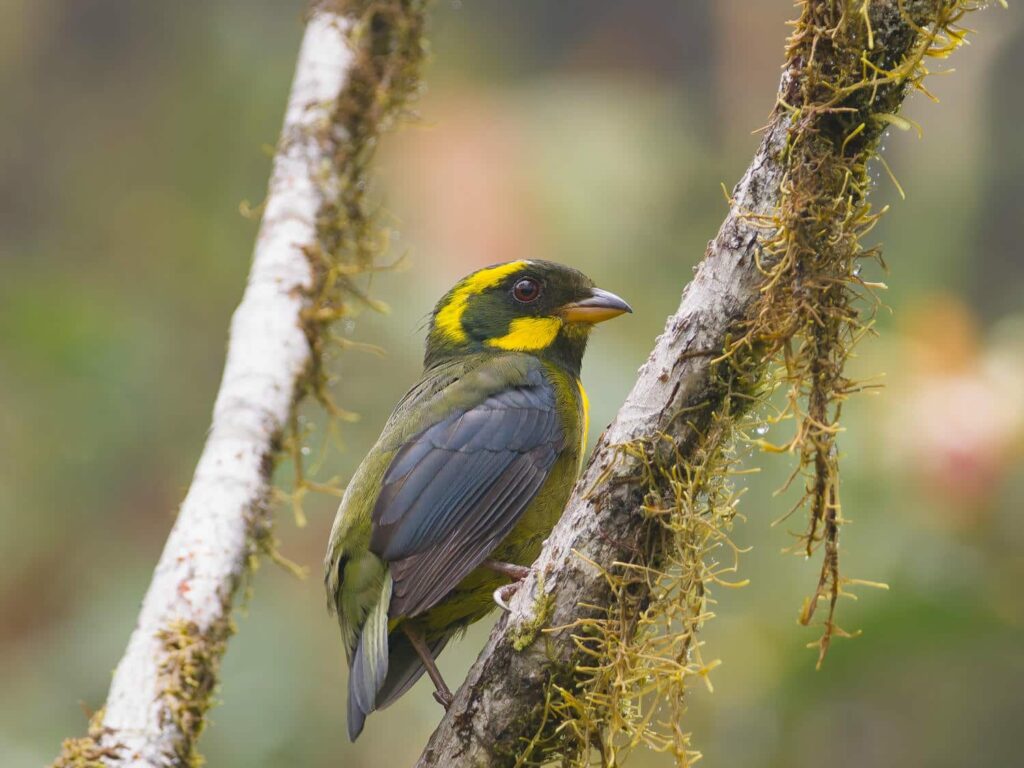
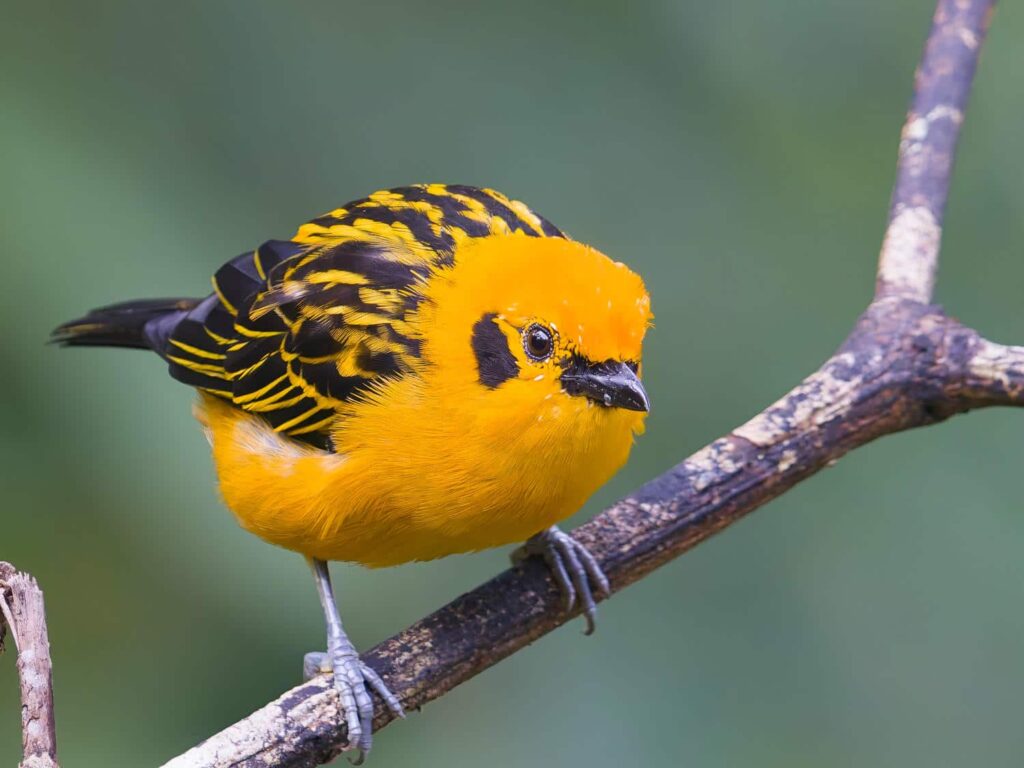
After leaving the Nevado del Ruiz area, we headed back to Pereira to drop off my laptop at the repair shop. We were hoping that if he couldn’t save the laptop, he could at least save the data on it! I back up our data to external hard drives, but I hadn’t done it for a month or so. The shop was thankfully open when we stopped by, and the technician said he would get right on it, but that it would be a few days. From Pereira, we drove west to an area called Galapagos Pass. The area was supposed to be very remote and beautiful, in the cloud forest environment that we’d come to love so much. It was a long drive through increasingly unpopulated areas, punctuated by massive coffee or banana plantations. We drove up and up into the mountains as the plantations finally fell away. It was getting dark and rainy, and we really hadn’t found a good spot to camp, so we were quite relieved when we got to the top of the pass and found a big flat area, along with a covered pavilion. It was part of the Reserva Natural Comunitaria Galapagos, which protected a large area of the forest to ensure both a supply of clean water for the village far below, as well as to protect some of the habitat of the Gold-Ringed Tanager, the other of the two tanagers that we hadn’t seen in Reserva Las Tangaras a week or so before. The bird can only be seen in three places: the aforementioned reserve, the point on the road where we were now standing, and a birding lodge that charged over $200 a night between the two places. Delaney wasn’t feeling great, so we mostly stayed in the jeep for the night. I did wander around a bit in the fog, and found something a bit unsettling- flags and recruitment banners for the ELN, or Ejercito de Liberacion National: The National Liberation Army. It is a far-left rebel guerilla organization that has largely funded itself from the kidnapping and ransom of locals and foreigners alike. They used to be quite active in southern Colombia, but are now mostly active on the border of Venezuela and Colombia. We thought about leaving, but Delaney really wasn’t feeling well and the people we’d run into so far on the road seemed quite friendly, so we stayed.
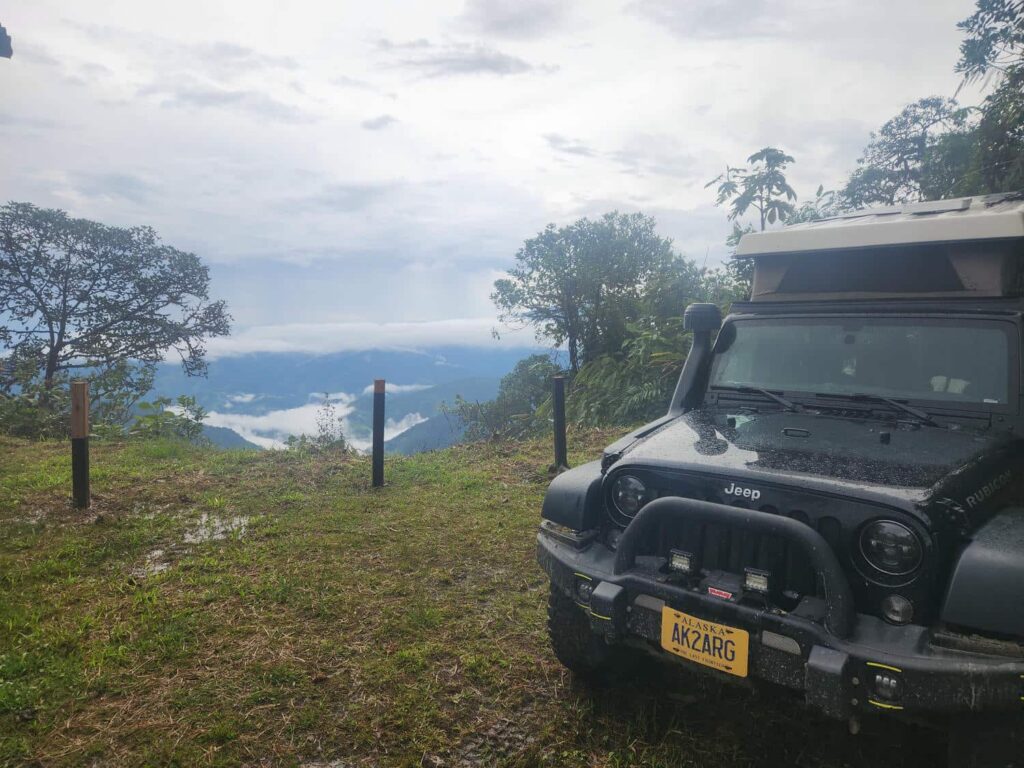
The next morning I went out looking for the tanager, and managed to find it within only an hour or so. We ended up staying in the spot the whole day, and even another night as Delaney recovered. There really wasn’t much traffic on the road, but everyone who passed by seemed very friendly. I spent the day walking up and down the road, finding all sorts of birds, including more of the tanagers. I got some great pictures of them in the midday sun, which was great as the pictures I’d gotten in the morning were very foggy. We left early the next morning, planning a long drive day south to Cali. The area south of Cali had seen some terrorist activity recently from the other guerilla group active in Colombia, the FARC or Fuerzas Armadas Revolucionarias de Colombia: Revolutionary Armed Forces of Colombia. They had blown up a bus on the main highway between Cali and the next large town to the south, Papayon, about a month before. We’d been told that Cali was perfectly safe, so we headed down for a few nights.

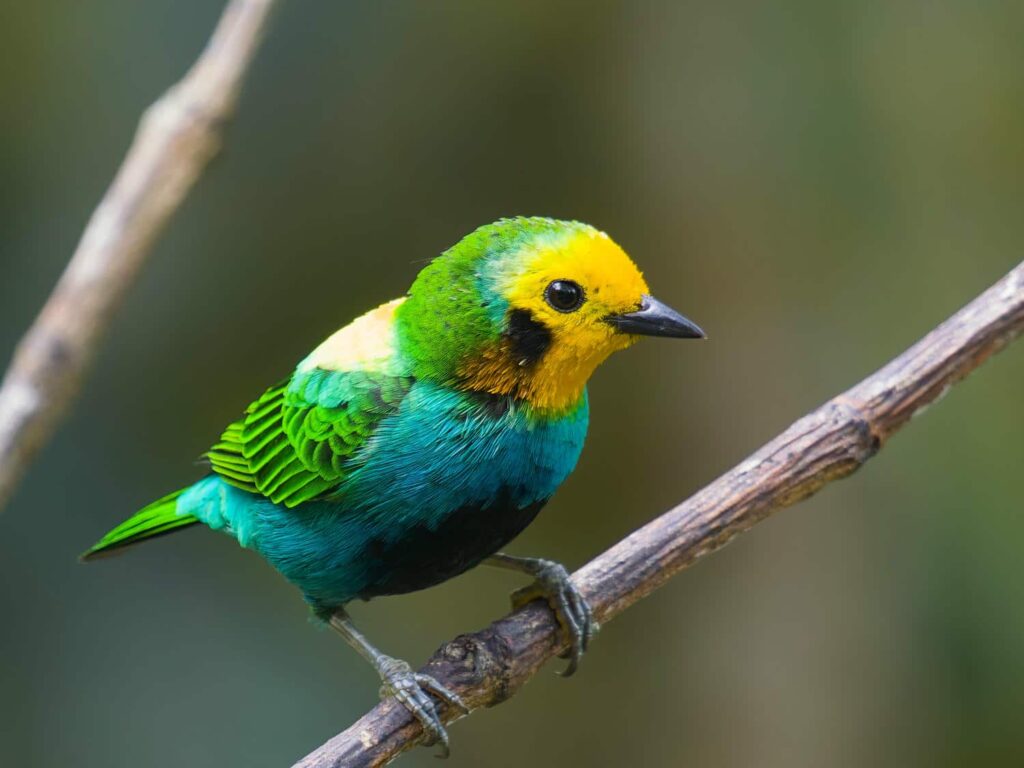
\We had some time to kill, as we planned to meet back up with Dan and Patricia in 4 more nights, and we also needed to wait for the laptop repair. We spent two nights at Finca Alejandria, which had tons of hummingbirds. It also had some rare Multicolored Tanagers that would regularly visit. They allowed campers to stay there, and the person running the place, Heidi, was so nice and accommodating. She would make us tea or coffee in the morning, and she knew all the different birds that would come in. There was also a hiking trail, which led through a pristine cloud forest environment. We’ve found that many of the bird reserves that we have visited used to be coffee or banana plantations before the owner renaturalized them, but this one was a bit unique as it had never been anything else. The owner, Raul, bought the place as raw, untamed land 20 years earlier, and had turned it into a paradise of hummingbirds. We spoke with him a bit the night before we left- he had led quite an interesting life. He was Argentinian, and had served in the Falklands War, when Argentina attempted to retake the Falklands Islands from the British. They briefly succeeded, but the British soon took it back. Raul had been captured when the British re-took the island, and had suffered a few injuries, including many broken front teeth when a British soldier had hit him with the butt of his rifle in the mouth. The Falklands conflict has remained an extremely sore spot for Argentinians ever since, and each successive president since then has claimed that they will take it back. Raul left Argentina after his service in the army and came to Colombia with nothing but the clothes on his back and a few thousand dollars. He is about to retire to travel the world, and will sell his property to a bird reserve for a hefty sum- he will have a very comfortable retirement.


After a blissful two days watching hummingbirds and drinking coffee, we drove back through Cali. We’d heard from the computer repair shop that the laptop was toast, but that he’d managed to save the data. With this information in hand, we went to a massive mall in downtown Cali and managed to find a new laptop. There are a few problems with it, mainly that it is running a version of Windows that only allows one language: Spanish. My file system, settings, and start menu are all in Spanish, and cannot be changed unless I pony up for a new operating system! The second issue is that Latin America uses a different keyboard. All the letters are in the same place, but all the special symbols, such as #$;’%&, are in different places. Fortunately, I can change the keyboard programming to use the U.S. layout, but the paint on the keys remains the Latin American way. I’ve been able to work through these issues- the keyboard issue is easy, as I have pretty much everything memorized, and the language issue hasn’t been nearly as annoying now that I have everything set up. I just have to remember that instead of “new file”, it reads “Nueva carpeta”! After getting the new computer, we stopped at a Homecenter, which is kind of like a Home Depot combined with the home goods section of Target. We got a few new things, including a new breaker bar after I’d broken my previous one attempting to rotate the tires at Guatapé. We then started looking for some new Jetboil fuel. I hadn’t really realized it, but Delaney had been avoiding making tea, as it took too long with our normal stove and we were trying to hold on to a full canister of Jetboil fuel for our future backpacking endeavors in Peru and further south. It’s been difficult to find, which isn’t too surprising as backpacking is pretty much non-existent in Colombia. We started at a nearby sporting goods store, which was sold out. They kindly directed us to their store in south Cali, right near where we’d left the mountains after leaving Finca Alejandria. We drove the half-hour straight through the middle of town, and Delaney ran in and bought three of the large canisters. It felt great to not have to worry about it anymore! We then drove back through Cali and northeast out of town- the Jetboil detour had only cost us an hour or so.
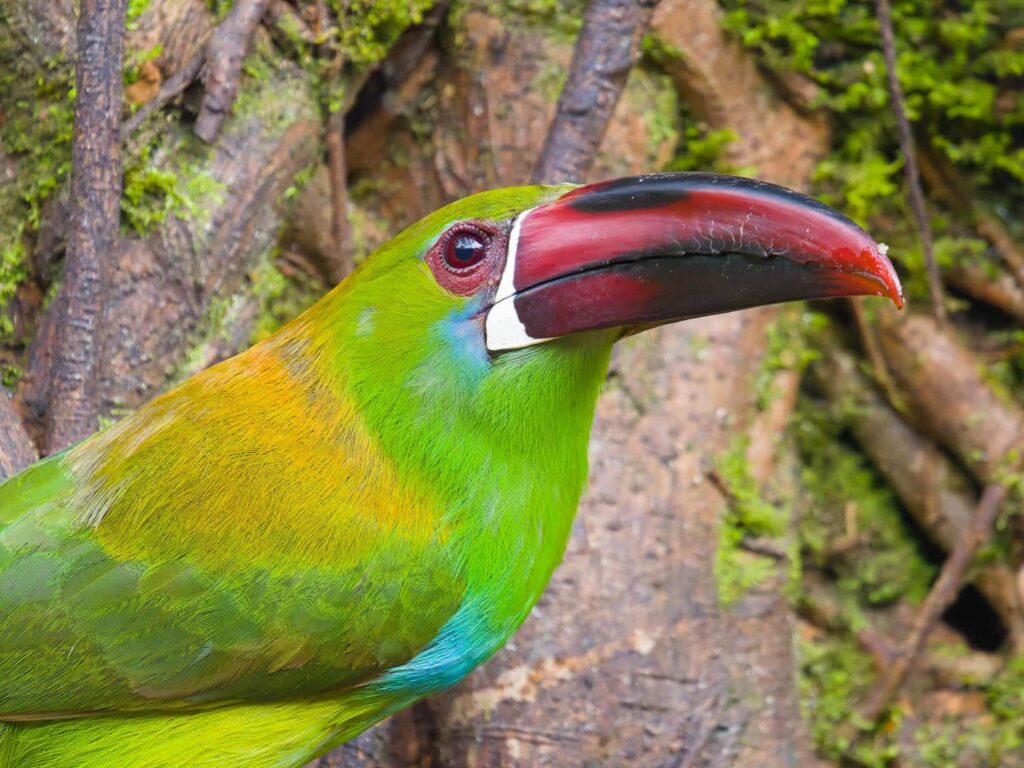
We were headed to Museo Aereo Fenix- a massive transportation museum. I’d heard that they had a massive model railroad, which I really wanted to visit. They claim that it is the 3rd largest in the world, which it may have been at one point. It was situated right next to the Cali airport, so we drove out of town and up to the airport. In the parking lot were two old steam engines rusting away, which had been used in Colombia’s once busy rail line between Cali and Buenaventura on the coast. We went inside the dimly lit entry office and paid our fee, before walking into the main hanger. What a massive surprise! The place was absolutely huge, and filled with all sorts of airplanes, cars, and models. There were two enormous DC-3s, a few Cessnas including a Super Cub and a 195, a Russian biplane, an Antonov AN-2, which is basically their version of a de Havilland Beaver. There were some 1940s US cars (one with Minnesota plates!) as well as some old automotive engines out on display. The most striking part of the museum though, was the amount of scale models that had been built.

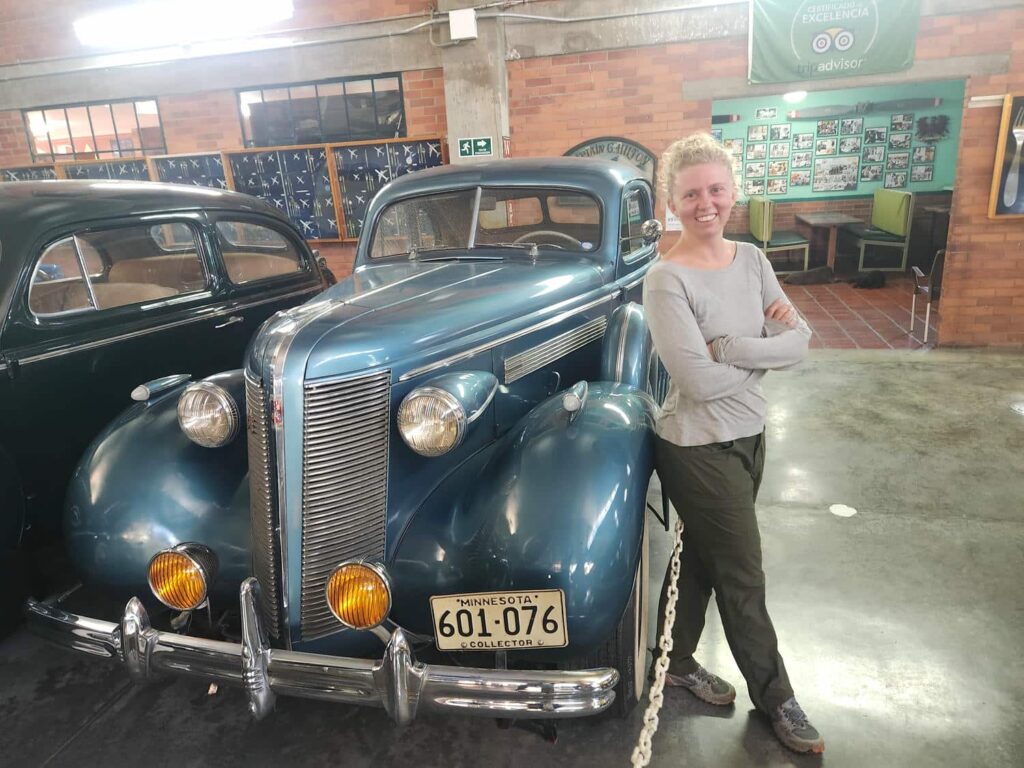

There were three huge dioramas each displaying a scale model of a different airport in Colombia. They were all huge- the largest was probably 20 feet by 50 feet, with the smallest being about half that size. They were all at such a scale that even the largest plane was no larger than my hand. There were cases and cases of model cars, all sorts of 1960s and 70s American cars and trucks. They were all beautifully painted, and looked amazing. There were also multiple dioramas showing historical battles, from medieval times through World War 2 to the present. The museum also had a very unique collection- cutlery from every airline they could find around the world. The exterior walls of the entire building, which housed all the aforementioned planes, cars, and dioramas, was covered with case after case of cutlery. It’s hard to remember now, but airlines used to serve complimentary meals with complimentary metal cutlery! They even had a few displays of cutlery from different passenger trains. They encourage anyone who has any train or airplane cutlery to contact them and see if they have it in their collection yet.


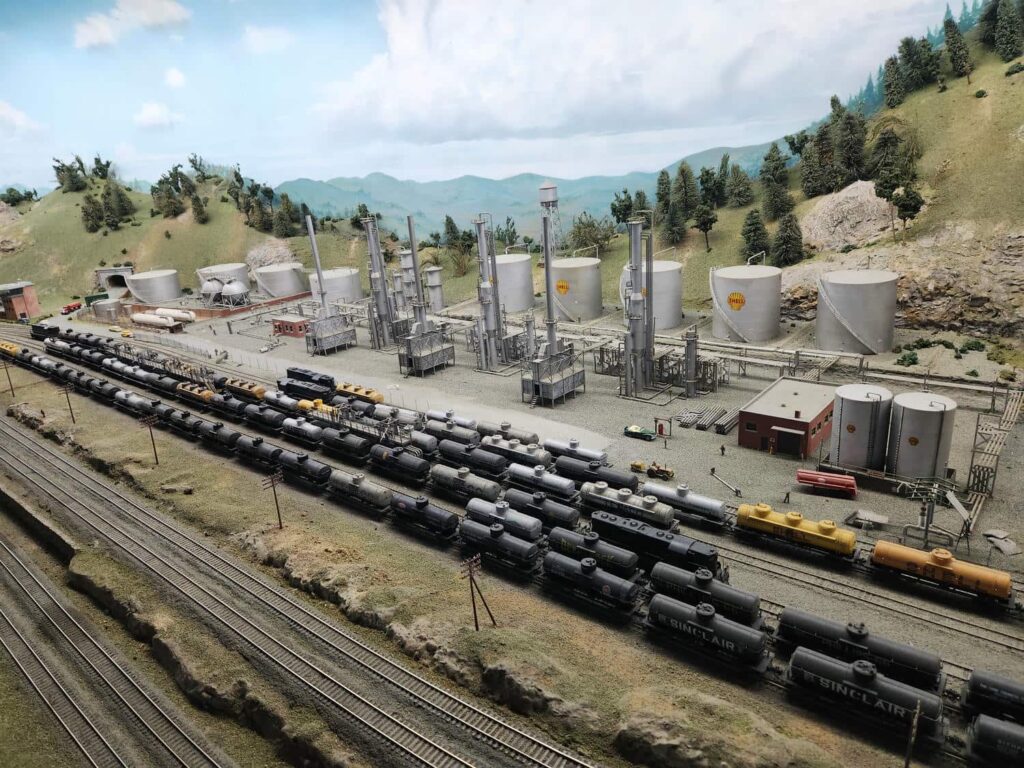
The most interesting part for us was the model train room. They had a few worn displays of trains in the main room, but the really special model train display is in its own room. The museum curator asked us to let him know when we were ready to go in, and in we went! It was a massive room of HO scale trains, modeling the Pennsylvania Railway. The curator explained that a group of 3 of them had started this project 15 years ago and the massive layout had been mostly built by the three of them. They had wanted to model a Colombian railway, but they would have had to make or repaint everything from scratch- the locomotives, rolling stock, buildings, etc. If they modeled a well-known U.S. railway, they could buy many of the railcars and building kits, as well as have much more information on the railway itself- many U.S. railways are well documented for modelers, but outside the U.S. it is much harder to find information such as what kind of locomotives and railcars were used, what the passenger stations looked like, what industries are served, etc.
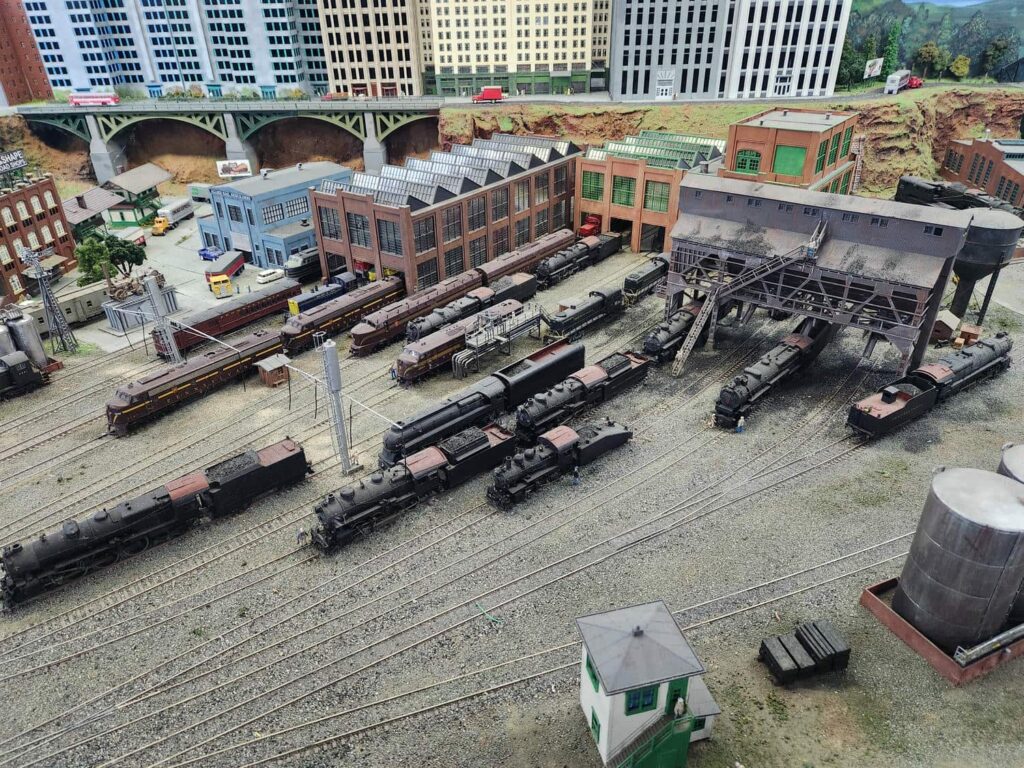

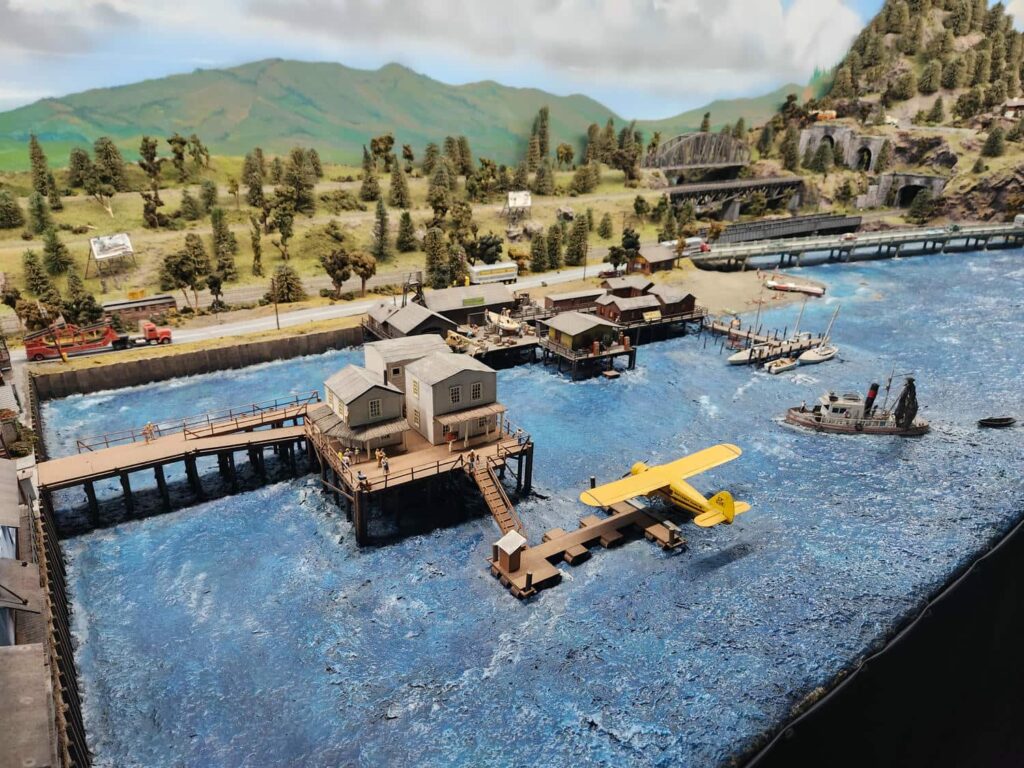
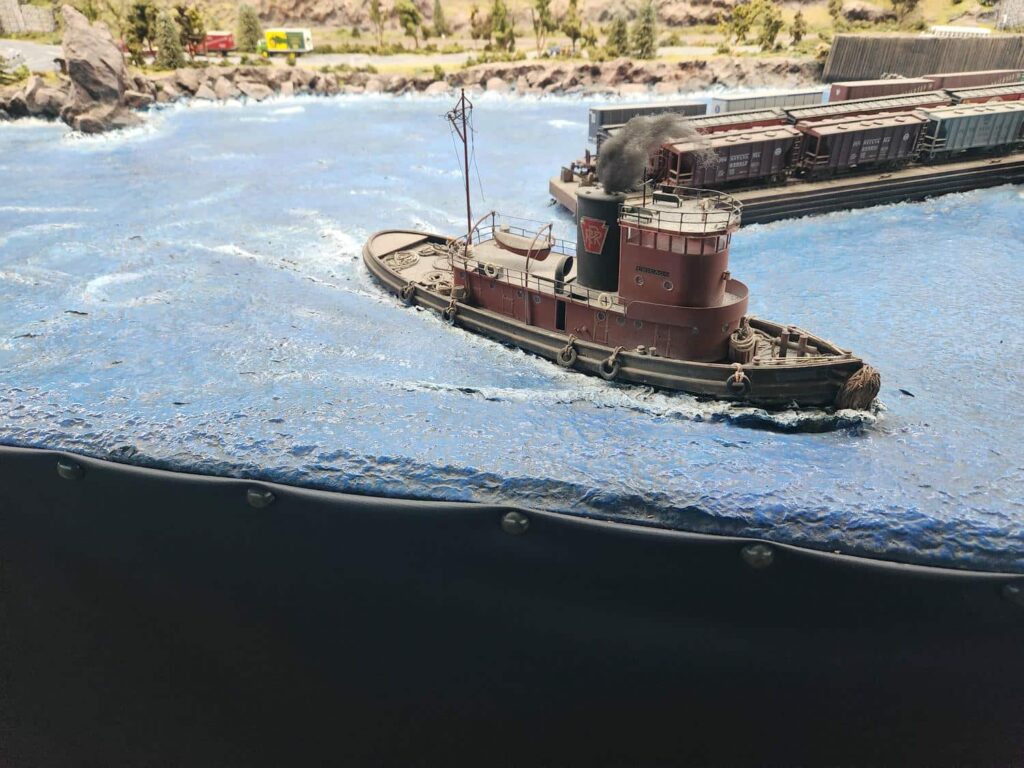
The curator started up a train and we followed it around the massive layout. The layout was massive- it filled what seemed like a 50ft x 50ft room. It was all incredibly detailed, with scene after scene in breathtaking detail. There was a massive city modeled after Chicago, a ginormous steel mill, a sawmill, logging camp, several mines, a rural city, and that was only on one side of the layout! The other side had some harbor scenes, with some Great Lakes freighters modeled- the 1:87 HO scale freighters were still huge at over 5 feet long! There was also a huge mountain that we watched the trains spiral up.
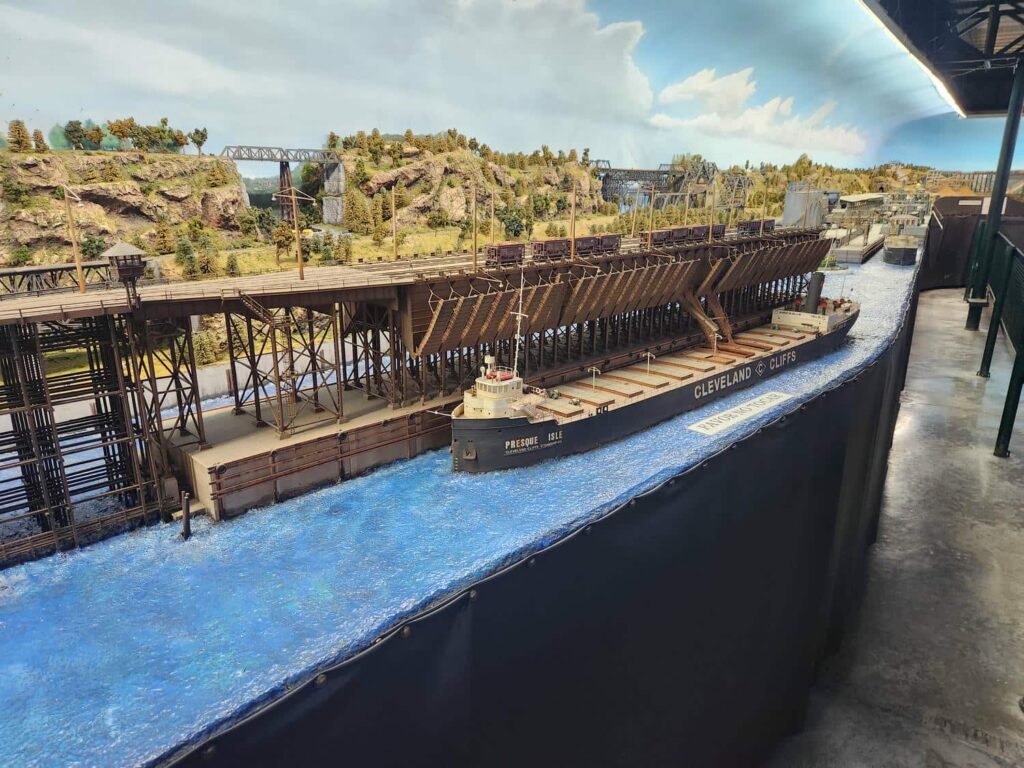


The whole operation was simply incredible, and more incredible still to think that it had been mostly build by just three people. Seeing something like this museum definitely awoke something in me- Delaney and I have both been craving “home hobbies”, where we get to build something or create something. We both really enjoyed all the aspects of building the jeep, which involved fiberglass work, carpentry, metalworking, plumbing, electrical, and plenty of other stuff. Who knows what we’ll get into next, knitting? Or maybe even model railroading! We stayed at the museum until it closed. The place really doesn’t look like much from the outside, but on the inside it’s got to be one of the best and most interesting transportation museums I’ve ever been to. I would go back in a heartbeat.

We headed to a spot we’d been told about by Andrew, who had been in the area years ago. It turned out to be a great spot to camp, even though it was a bit hot. It was just outside of a nature reserve, right along the massive Magdalena River, which we’d now crossed three times- once in the far northern coast, once between the Tisquizoque Waterfall and Medellín, and now here in the center of the country. It really is Colombia’s Mississippi! We had a slow morning there, before heading north again back to Pereira. We picked up the fried laptop, as well as the external hard drive he’d exported the data to. Thank goodness the data was saved! I have a very good data-storage system back in Anchorage- a home Network Attached Storage (NAS) which automatically backs all my data up on two mirrored hard drives. I also keep an external drive or two at my parent’s place in case of some sort of disaster at our house. Being out here with nothing but a few external hard drives that I have to remember to back up frequently is much more worrisome than I would like, but there really isn’t much that I can do about it besides begin uploading data to the dreaded Cloud, which I refuse to do.
After passing through Pereira, we drove up into the Cocora Valley, a popular tourist location for locals and foreigners alike. There are lots viewpoints, horseback riding, hiking, and other tourist activities. We were a bit disappointed by the valley itself- it really wasn’t anything special. The big selling point though is the Wax Palm trees, the tallest palm trees on earth. They only exist in a small area of central Colombia at high elevation, and are quite striking. They have tall, bare trunks that look a bit like massive telephone poles, which are topped by a relatively small bunch of palm fronts at the top. We met Dan and Patricia at a small restaurant that offered camping near the top of the valley, and went out on a hike through the forest. Their dog Brody loved being off-leash and running through the streams! We returned back to the campsite, getting some Fresas con Crema (strawberries & cream) on the way back down. We spent the rest of the afternoon, and the entire next day sitting at the outdoor restaurant, enjoying some down time. I mostly worked on editing photos, which is much slower with my new laptop. My old one was quite the powerhouse, and this new one (that I’m typing on now) is much lower-performance- but at least it can be charged by USB-C, which my old one could not.

The afternoon before we left, Dan and Patricia had pulled off to a corner of the property to plug in their van to charge it. When they tried to drive back up to flatter ground to sleep for the night, the van would crank but it wouldn’t start! It is a brand-new 2025 Sprinter, so it really shouldn’t be having problems like that. We used the jeep to pull it back up onto flatter ground, and we were planning to pull it backwards with the winch to get to a flat spot. Once the van had been pulled back up to flat ground, Dan tried to start it again, and it fired right up. They’ve been having issues with their aftermarket fuel tank, which doesn’t accurately show how much fuel they have. Being at a very slight tilt had meant the fuel pump couldn’t get to the little fuel that was remaining, even though their gauge still showed a quarter tank! We’d planned to go our separate ways in the morning, but we instead drove the half-hour with Dan and Patricia to the gas station, in case we needed to tow them the rest of the way. They coasted in and put 43 gallons of diesel into their 45 gallon tank. That was a close one! We then drove back up into the mountains, and took a back road from Salento, the major tourist town of the Cocora Valley, into the mountains behind it. The drive was a bit boring at first with most of the mountains concealed by thick tree cover, but close to the top of the road the trees fell away and we had a spectacular view of the mountains, which were bare except for thousands and thousands of wax palms. It was a much better view than the Cocora Valley, where most of the wax palms were hidden behind paid viewpoints. We drove for hours through the spectacular forest, eventually finding a small pullout on the side of the road where we spent the night. Only one small pickup truck, a few motorbikes, two cows, a pig and piglet, three horses, and a rancher passed us in the 15 hours we stayed there, marveling at the view. In the morning, we drove into the tiny town of Toche, and continued on towards the main highway to Itague. However, there was construction on the tiny road, completely blocking our path. There was one more road out of Toche which we really hoped would go through- if not, we would have to go all the way back to Salento to find a way out of the mountains! Fortunately, the road did eventually go through. We went up and down through the mountains, passing waterfalls, coffee and banana plantations, and teeny mountain towns. We finally got back onto the main highway after spending most of the day driving through the back roads.

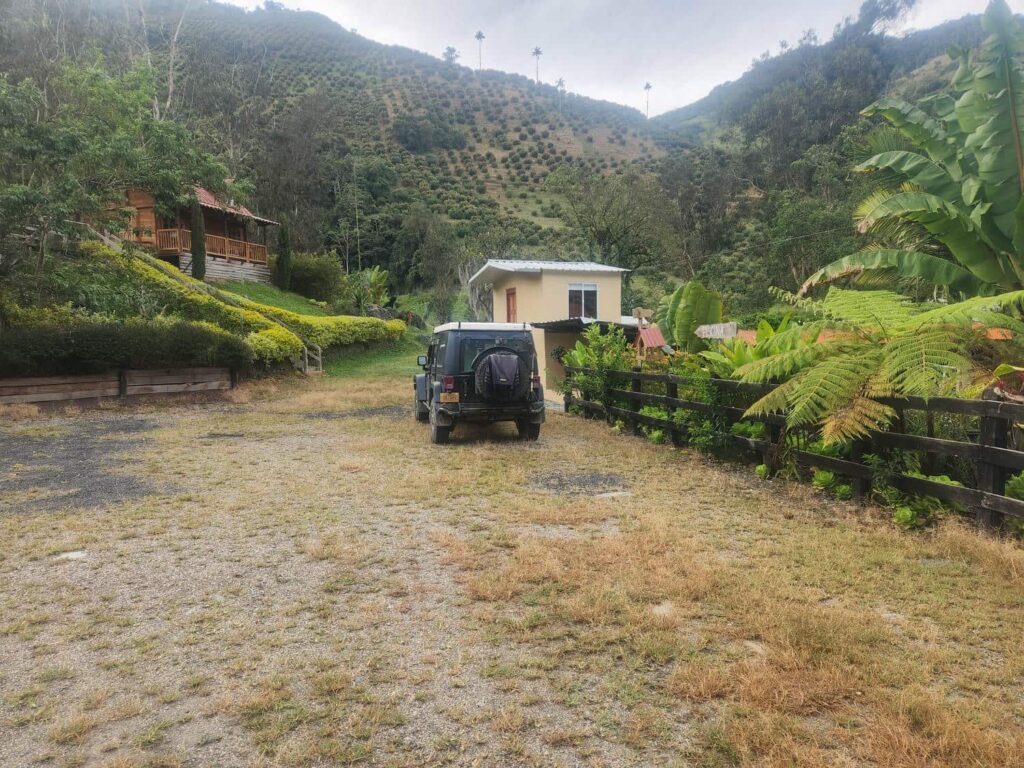
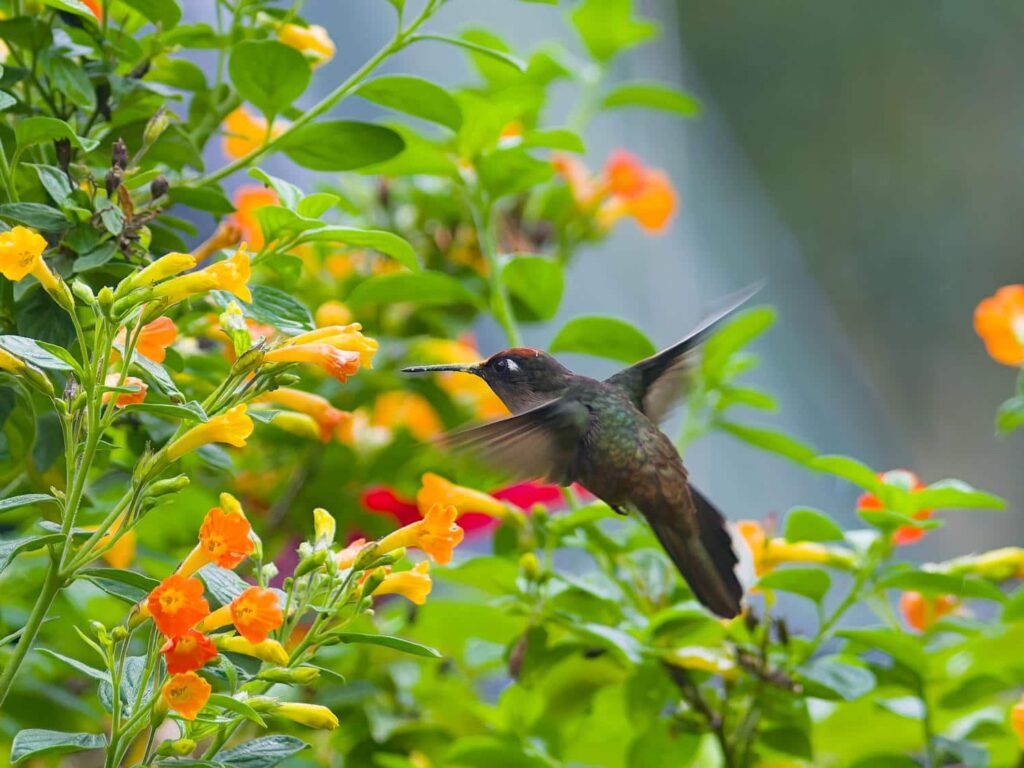
Instead of heading east towards Bogota, we drove west back into the mountains once more, heading to a small ranch, Finca Martina, that I’d found that had a few of the endemic birds in the area- especially a hummingbird called the Tolima Blossomcrown that I really wanted to find. It was a beautiful property, over 200 acres, which included a massive covered area for weddings and other parties, several small cabins, a main house, as well as a few other outbuildings such as a goat stable and farm worker housing. The property had started off as an avocado farm, which stretched for acres and acres up the steep hills behind the main buildings. We were welcomed by the hosts, and they sadly told us that they were selling the place soon to be able to spend more time closer to their children, who lived in Cali. They served us coffee as we sat down by the hummingbird feeders, where I soon found the Blossomcrown. It is only found in a small area of central Colombia, and mostly in this one valley. The next morning we went on a hike through the avocado farm, which was incredible. As we left, they gave us a several beautiful avocados which were perfectly ripe. It was such a beautiful place, and I can’t imagine having to sell it.

We drove back out to the main highway, stopping for groceries in Itague before finally heading east to Bogota. We climbed from below 900ft to over 8000ft at Bogota in just a few hours on a crazy highway, full of tunnels, switchbacks, and bridges. There was tons of truck traffic- sometimes we felt like we were the only passenger vehicle on the road! We were stopped for 45 minutes or so at a tunnel for construction, but other than that it was a smooth ride. We pulled into a campground north of town where we once again met up with Dan and Patricia to spend a few days. The first round of the Colombian elections was imminent, and we had been advised to stay put during the election just in case. Election time in any Latin American country can be uncertain, so we were glad to be with friends in one place for it. In the end, nothing happened, and we had a great time being in one place for a few days. The place we were at was a restaurant/petting zoo/hobby farm/rental cabins combo, with tons of open flat space. Also at the campground were Dan and Patricia’s friends Ronnie and Sabrina, a young German couple who they had met back in Costa Rica. There were also the Schanderbecks, a couple with two young children, including a newborn, who were similarly doing the Pan-Am. The father, Alex, is an OB doctor in Grand Junction, so we compared notes about western Colorado and southern Utah. He takes contract work there, so the family is in Grand Junction for a few months, then heads to South America for a few months. We spent the next three nights doing big joint dinners together, looking over each other’s vehicles, and relaxing in the sun. Bogota is at such a high elevation that even in direct sunlight, it really wasn’t that hot. It was a great break from the road.

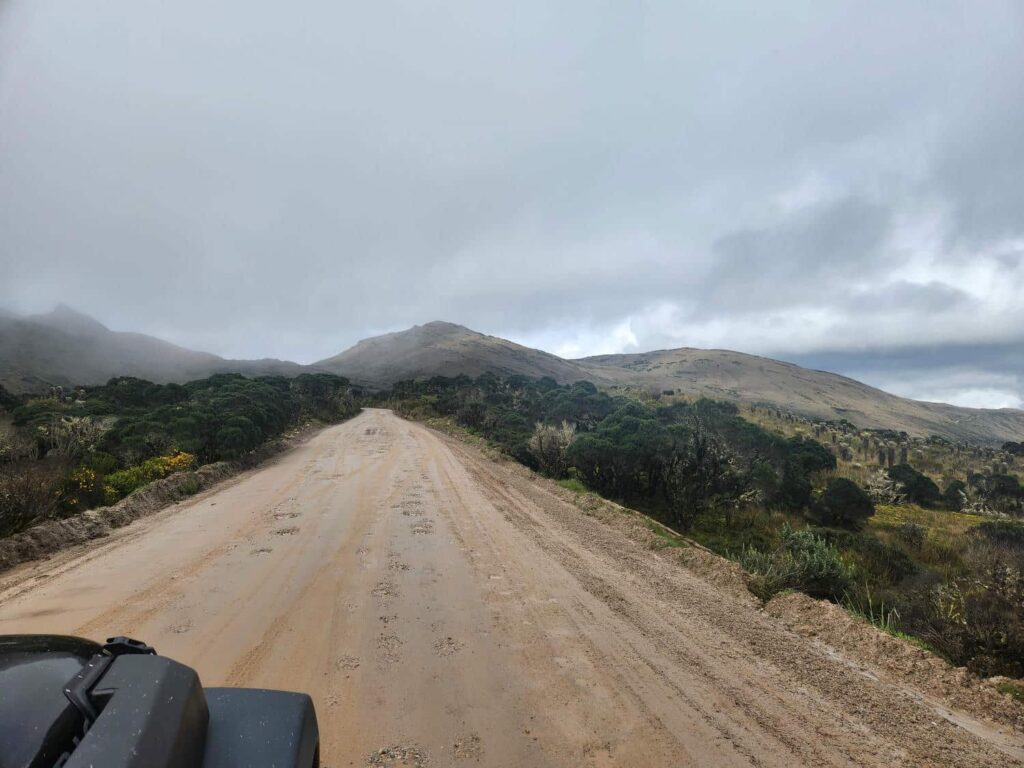
After the uneventful election weekend, we were ready to leave the campground. We said goodbye to Ronnie, Sabrina, and the Schnaderbecks, and headed to the Bogota Airport. We weren’t flying out- I needed to get a Yellow Fever vaccine before moving on. Delaney already had hers from her time in Malawi, and I’d risked it a bit in Central America not having it, as it is sometimes required to cross borders- but I think only if you are going south-to-north, not north-to-south like we were. It sounds like proof of the vaccine is sometimes required for entering Ecuador or Peru, and definitely anywhere in the Amazon. The vaccine is quite expensive in Central America, but free to get in Bogota! There are several clinics around town, but the easiest one is apparently at the airport. We parked at airport parking and walked in, eventually finding the clinic. It was packed with people, and it seemed like it took a while to give each person a vaccine, especially considering that they were free! After two hours though, it was finally my turn. I absolutely hate getting shots, but the nurse was quite skillful- I barely felt it. We headed back out into the sun and drove south through the heart of Bogota. It definitely wasn’t as nice as Medellín- there was a lot of poverty and trash around, but it didn’t necessarily feel dangerous. We made it out of town after a long time in stop-and-go traffic, and headed back up into the mountains. We camped just outside of Sumapaz National Park, in the fraliejon-filled paramo once more. The next morning, we found a rare bird around a small lake up there (Apolinar’s wren), and headed on through the park. It was a gorgeous drive through the high, treeless mountains, and we took our time and enjoyed the view. The road did get much smaller and narrower than we had expected, and it took a while to get back down to the highway.
Tevin and Bri had contacted us a few days earlier, and had a big problem: they had been unable to renew their entry visa, which would have given them another 90 days in Colombia. They had really been counting on it, and had planned to spent another month or two in the country. They had left the country to visit the U.S. for a few weeks, but hadn’t paused their vehicle paperwork, which automatically disqualified them from renewing their time. Delaney and I had been aware of this issue, but only Delaney had returned back to the U.S. while we were in Medellín, and all the vehicle import paperwork was in my name. Bri was heading back to the U.S. for a bit for work, so Tevin had to get himself and their Landcruiser out of the country within 10 days. Worse still, they’d been told that if someone at a police checkpoint noticed the discrepancy between their passports and vehicle paperwork (not entering the country at the same time) it was possible that their vehicle would be impounded. Tevin had left Medellín that morning, and we met him at a gas station in El Espinal. It was a very long drive day for him, but we continued on together down to the Tatacoa Desert. We were planning on meeting Dan and Patricia there, and they warned us to take a back road in, as the main road involved getting on a ferry that closed at 5:30pm, which we would have missed. We followed an old dirt road off the highway, which unexpectedly entered a long tunnel. We hadn’t known about this at all, and it was quite a surprise! The tunnel daylighted out onto a long rickety bridge, much like the Puente Negro bridge we’d crossed north of Bucaramanga, but this time thankfully with guardrails on it. The bridge crossed a huge river, and we were just stunned at how interesting this “back route” had turned out. It was definitely an old railway route, just like the Puente Negro. As darkness fell, we sped along through the dusty track, finally reuniting with Dan and Patricia at a sort of “spa” that allowed camping.
The “spa” was really just a mud pit with a swimming pool- you were supposed to roll around in the mud, which is apparently good for you (none of us did it), and then rinse off and jump in the pool. Even several hours after dark, it was still quite warm, so we enjoyed the pool for a bit before heading to bed. It was a hot sticky night, but not nearly as bad as some other places we’d been- being a desert, it thankfully wasn’t humid. The Tatacoa Desert is a quite unique desert, being quite small and isolated in the center of a massive valley. Only a small portion of the valley is desert, and it is surrounded on all sides by either cloud forest or lowland jungle forest. We took a long driving loop through the desert in the morning, and it looked exactly like areas we’d been to in the American West, such as New Mexico or Arizona. It had saguaro-like cactus, small sand dunes, and wide-open hilly expanses. One could easily imagine a cowboy driving a herd of cattle, with an ancient steam engine chuffing by out in the distance. We completed the loop, which it seems almost every overlander who passes by does, and headed on down the highway after crossing the little 4-car ferry across the river. We were astonished to see that the entire ferry was powered by a single 40-horsepower Johnson outboard motor!

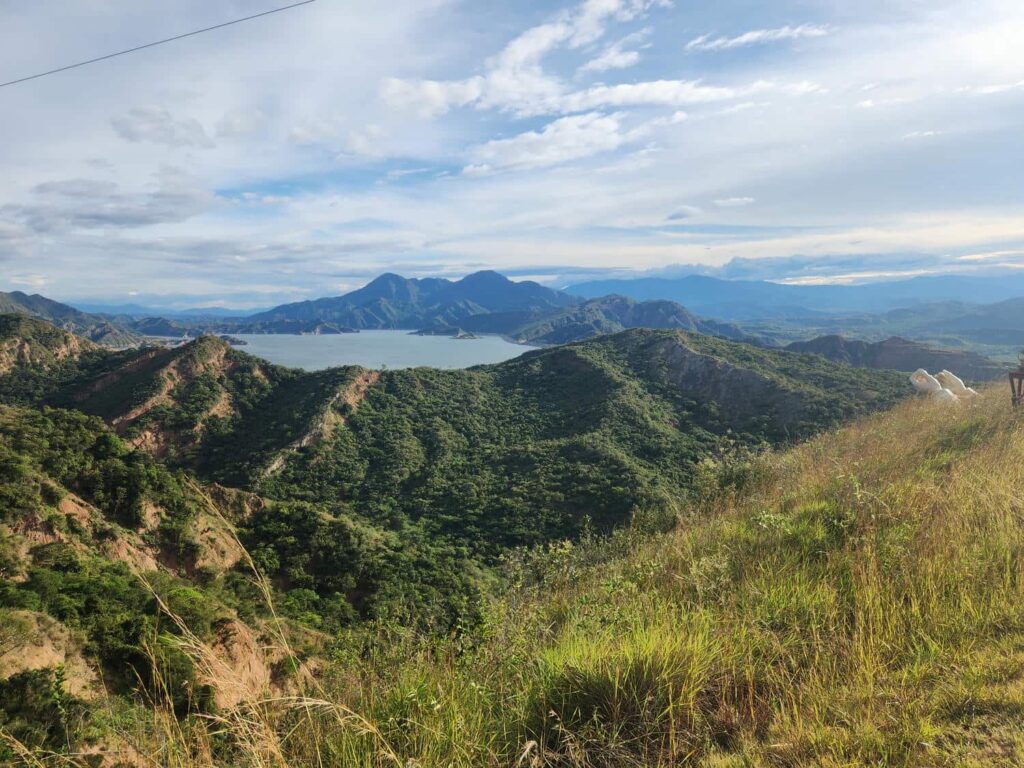
Driving down the highway, we were very careful about keeping Tevin at the back of our 3-vehicle convoy, so that he would be less interesting to a police officer at a checkpoint. The checkpoints often pull over cars as soon as they have a free office to talk to the driver, and most only have 2 or 3 cars pulled over at a time. Having Tevin behind two very interesting looking vehicles in the Sprinter and our jeep made it much less likely for him to be pulled over and his documents looked at. The drive was uneventful, and we spent the night at a viewpoint overlooking the El Quimbo Reservoir. It was a ridiculous view, one of the best of the trip. We could see the reservoir below us, and endless mountains stretching out in almost all directions. It was hard to spend just one night there on our way to the border with Ecuador- it was a perfect temperature, there was a wonderful breeze, and we were all alone out on the edge of a cliff with a world-class view.
The next morning, we got back on the highway headed south. Our progress was a lot slower, as the highway shrunk down a bit and there was a lot of construction work on some precarious sections of road through the mountains. We did get stopped briefly at a checkpoint, but when I explained to the officer that we three vehicles were all traveling together, and that we had loved exploring Colombia, he shook my hand multiple times and told me how happy he was that we had enjoyed his country. We have had this experience at multiple police and military checkpoints- they have been so friendly, and will often ask us how we have enjoyed their country. They are obviously proud of Colombia, and glad that tourists are beginning to explore it again.
The area got a lot rainier and wetter, and we saw lots of evidence of landslides and mudslides. I had some pretty nasty stomach pains while we were stopped for construction, some of the worse pain and cramping I’ve ever felt. I could feel my stomach turning in knots! When we finally got to our campsite for the night, a small restaurant and hostel, I finally made it to a toilet and had nearly 20 seconds of nothing but flatulence. I’d never had anything like that in my life, but it sure solved my problem! We were just south of the town of Mocoa, which seemed to offer lots of tourist activities such as hiking, rafting, and waterfall viewing. The little restaurant we were at was awesome- it had a huge covered area that the 5 of us could relax under while the rain poured outside. We got some slightly overpriced pizzas at the restaurant for dinner, and headed to bed. The next morning, we would drive one of the most notorious roads in South America- the Trampolin de la Muerte- the Trampoline of Death.
The road is notorious for its rain, landslides, water crossings, shelf roads, tight switchbacks, and truck traffic. We’ve been on many roads similar to the Trampoline, but none actually had traffic on them! This was the main crossing of the Andes in southern Colombia. We aired down the tires and set off into the rain- all of our weather apps showed a 100% chance of rain all day, not a great sign for a road known for landslides! We were immediately tossed into steep grades and a wet, rocky road, but thankfully very little traffic. We followed a few small sedans up a hill where the road went across a small river, probably around 18 inches deep. One sedan went through the flatter but deeper section of water and made it through, but the second tried going across further upstream, where it was much more rocky, and got stuck. We drove across and then hopped out to help. A few other people joined in and we were able to push the little car through. I was shocked that it hadn’t gone in deep enough to suck some water in- it had just lost traction against the rocks in the water.

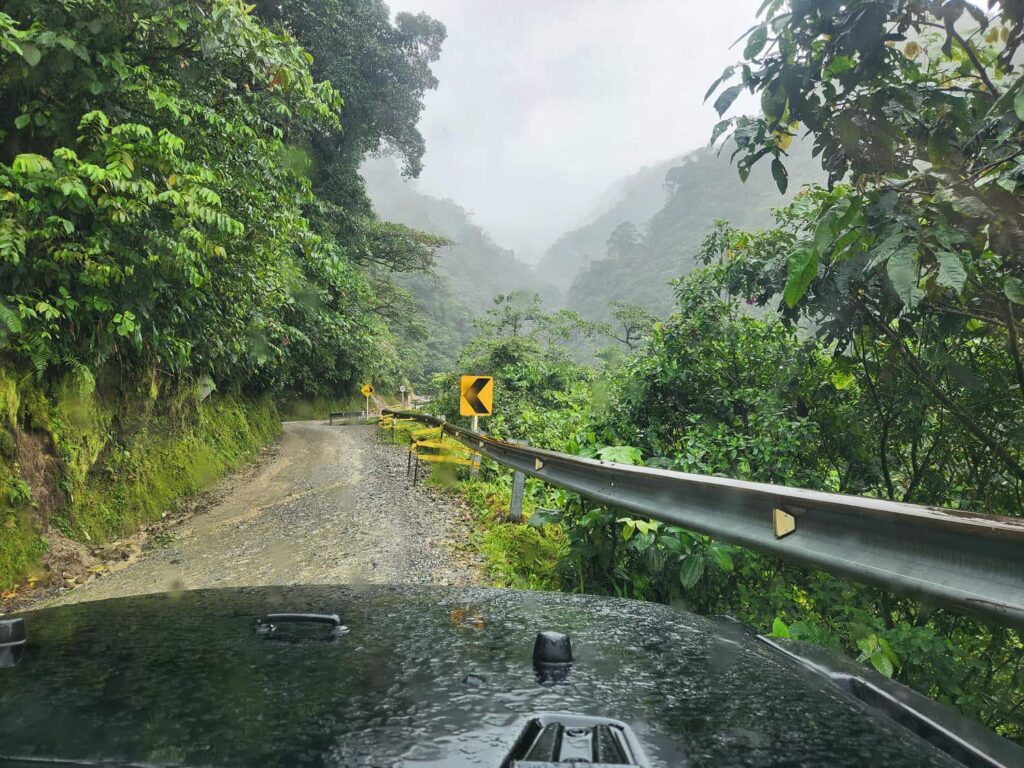
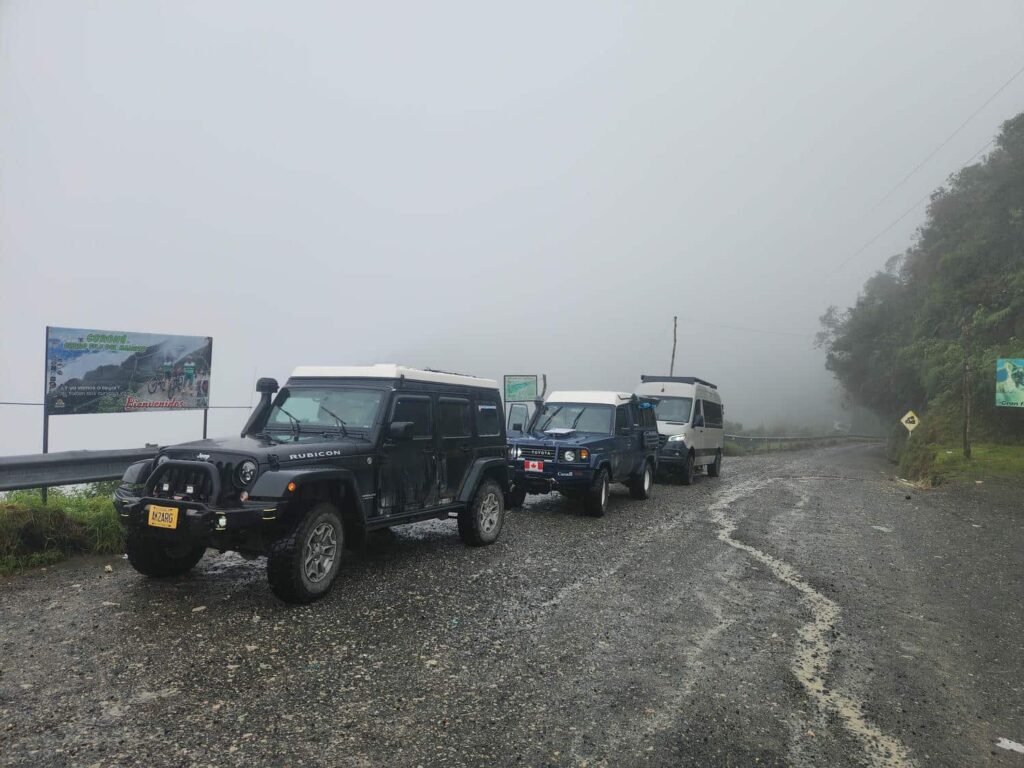
The sprinter and landcruiser made it across no problem, and we continued up. After another half hour or so of switchbacks and pouring rain, we came to a tight corner where we were stopped by a frantic woman in a safety vest. She explained to us that a bus had just gone off the edge and that we would have to wait, and to please not drive up the road and block it. We were all pretty shocked- she as certainly acting as if a busload of people had just died, but after we had parked and walked up the road to see if we could help, the bus was already back on the road. It had only dropped a single tire off the gravel shoulder, and some road maintenance equipment had pulled it through. No one had gotten hurt at all! The woman had seemed so frantic over such a little thing. We were glad that someone else had pulled it out and we didn’t have to try.
We continued on through the dense fog and rain. The road is supposed to be quite scenic, but we couldn’t see more than 50 feet or so for most of the drive! The fog did lift enough to let us see a few waterfalls on the other side of the valleys we passed through, but not nearly enough. It took us over 4 hours to make it over the Trampoline, but we made it without any problems. Tevin had been quite worried about it, as it does have a bit of a fearsome reputation, but we’ve driven so many roads like it over the last few months that it really didn’t seem bad or abnormally dangerous at all. There weren’t a whole lot of trucks coming through, and I’m sure that helped us. The Trampoline officially ends at the little town of San Francisco, but we still had a long ways to go until we were back on a main road. We drove up and down through little mountain towns, with stunning views the whole way. Finally we reached the main highway at the major city of Pasto, and headed south. The road was stunning- it was all high elevation, 4-lane divided highway, and we flew through the gorgeous scenery. We dropped down into a massive canyon, before climbing up the other side. After a few hours at what felt like a breakneck pace (I’m sure it wasn’t any faster than about 50mph, but anything more than 40mph feels ridiculously fast now) we arrived at Ipiales, the Colombian border town with Ecuador. We parked at an event center owned by a Colombian overlander, Ana. She had done parts of the Pan-Am a few years ago, and now offered part of her family’s property as a campground, which is perfectly situated within less than a mile of the border. It had been a very long day, and after another fantastic group dinner, we settled in for the night.


We had a slow morning after several long days. We hadn’t spent more than a single night anywhere since Bogota almost a week ago, and had driven most of each day since then. However, we had some errands to run. Dan and Patricia needed to visit a veterinarian for their dog, Brody. Colombia requires that a vet sees any pets that cross the border within a few days of crossing, so the five of us plus Brody all piled into the sprinter van to drive around Ipiales. Patricia and Brody walked to the vet while the rest of us stayed in the van to talk. Tevin had a package to pick up in Ipiales, so he texted the receiver to see what part of town we needed to head to next. The receiver turned out to be Ana, at the campground! We all laughed and laughed at the coincidence. After Brody had his paperwork done, we set out to a restaurant that Ana had recommended. It was a very, very local place on the outskirts of town. The food was decent enough, but absolutely flavorless. The food has steadily gotten less and less flavorful the further south we go, and we all miss Mexico dearly, which has had by far the best food of anywhere. After lunch, we drove to the big tourist attraction in Ipiales: the Santuario de Nuestra Señora del Rosario de Las Lajas, or the “Sanctuary of Our Lady of the Rosary of Las Lajas”.


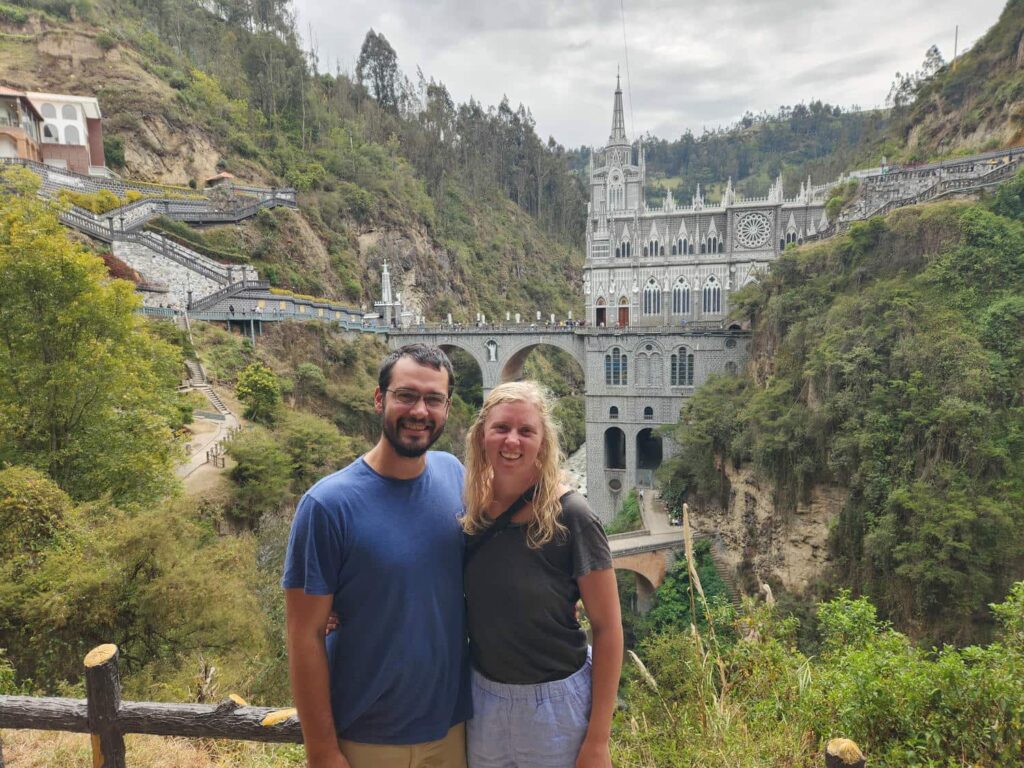
The Santuario is a massive church built in the bottom of a deep canyon. It really defies description- the church itself bridges the canyon, with the floor of the church being high above the river below. We parked at the edge of the canyon, and we were shocked to see Gerry and Danya (we’d met them in Jardin) parked there. They were also getting set to head down to the church, so we made introductions between them and Dan, Patricia, and Tevin, and made the mile or two hike down into the canyon. We spent a few hours walking around the church, and following all the little trails around the whole place. The trails went out to a waterfall, through some restaurants, and even down to the river itself. The church dominated the view from everywhere- it was as if it had parachuted out of the sky and become wedged in the canyon. When we were finished sightseeing, instead of walking the mile or two we’d walked down from the parking lot, we took the teleferico, or cable car, back up to the top. How many churches can be accessed by cable car? It was such a cool experience to see the church in person, and especially while a mass was being said- I’ve seen so many pictures of the church, seeing it in person was totally surreal.
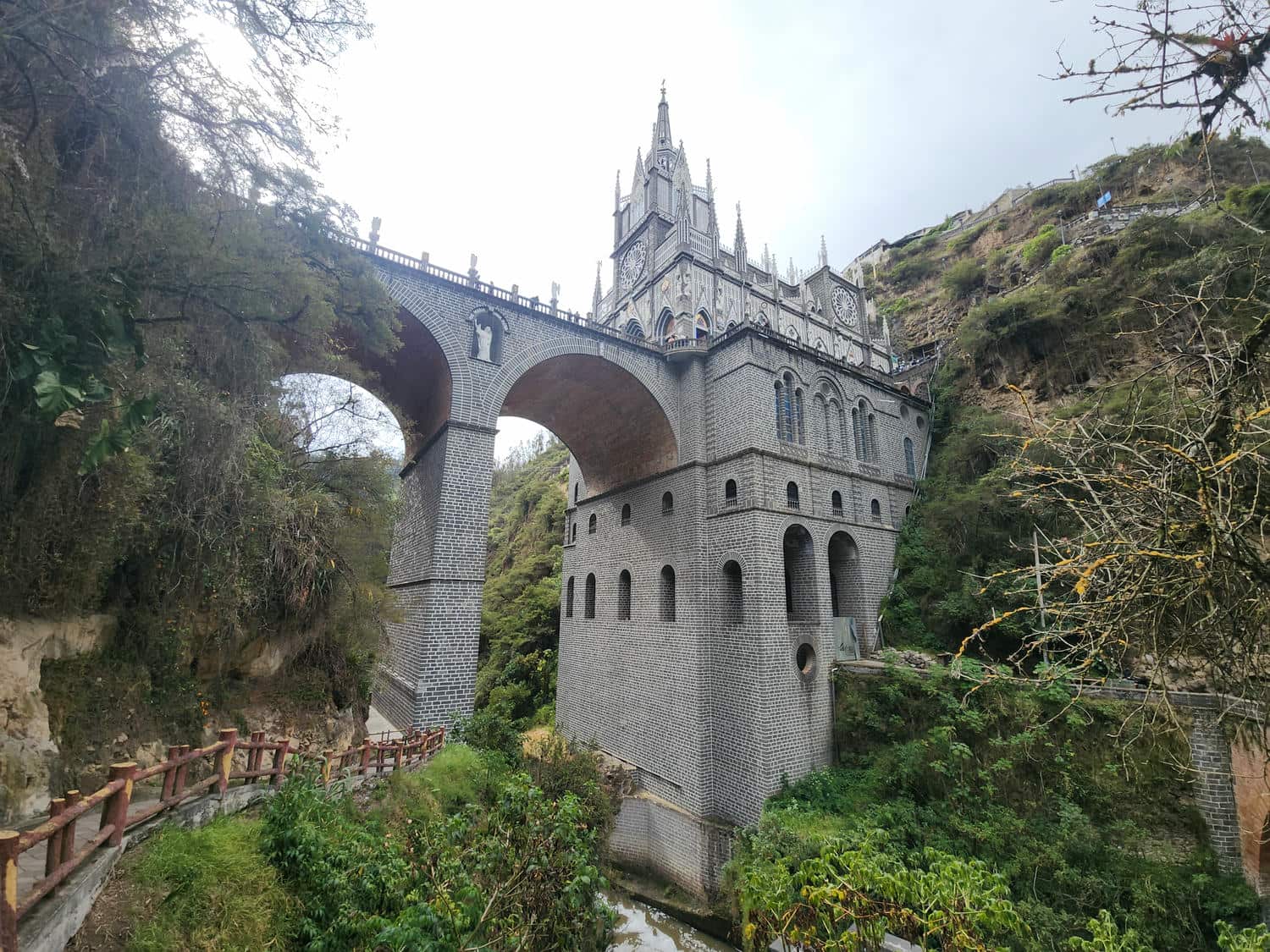

Gerry and Danya were staying the night at the parking lot, so we headed back to Ana’s place and got the vehicles all cleaned up for the border crossing the next day. Tevin had been having some issues with his landcruiser- his exhaust had a lot of black and white smoke, and his driver side door wasn’t opening from the outside. He and I worked on it for most of the afternoon and evening, but were unable to completely solve either problem. For supposedly being so reliable, his 70 series landcruiser has given him quite a few problems! I also spent some time with Ana’s giant rottweiler dogs- parents and three puppies. They were caged up the whole time we were there, but the male and puppies were very friendly and came up to the fence frequently to play. I wish we could fit a dog in the jeep, but after seeing all the trouble that Brody has caused Dan and Patricia, and all the trouble that Bri and Tevin’s cat Bali has caused them, I would never travel like this with a pet.


The next morning, we got up and were headed out of the campground by around 8am. We pulled onto the main highway right outside the campground, and were immediately stopped by a police checkpoint, just a few hundred yards from the border! These guys weren’t as friendly as the stop the other day, but Patricia explained that we were all together, and he let us continue without bothering to check our paperwork. Tevin was sure happy that he didn’t get “found out” within sight of the border!
We’d spent nearly three months in Colombia, only having intended to spend around two. It was an incredible country, with all sorts to offer- beaches, mountains, big cities, deserts, jungles, and our beloved cloud forest. We didn’t have a single moment in Colombia where we felt unsafe, despite traveling to areas that were supposed to be a bit dangerous. The people of Colombia also were so proud of their country, and so happy that we were exploring it. I’m sure Delaney and I will be back someday!
Below the normal route maps, I’ve added a map that shows our route through all of Colombia over the past 3 months. Even though it felt like we saw so much of the country, there is so much that we left unexplored!